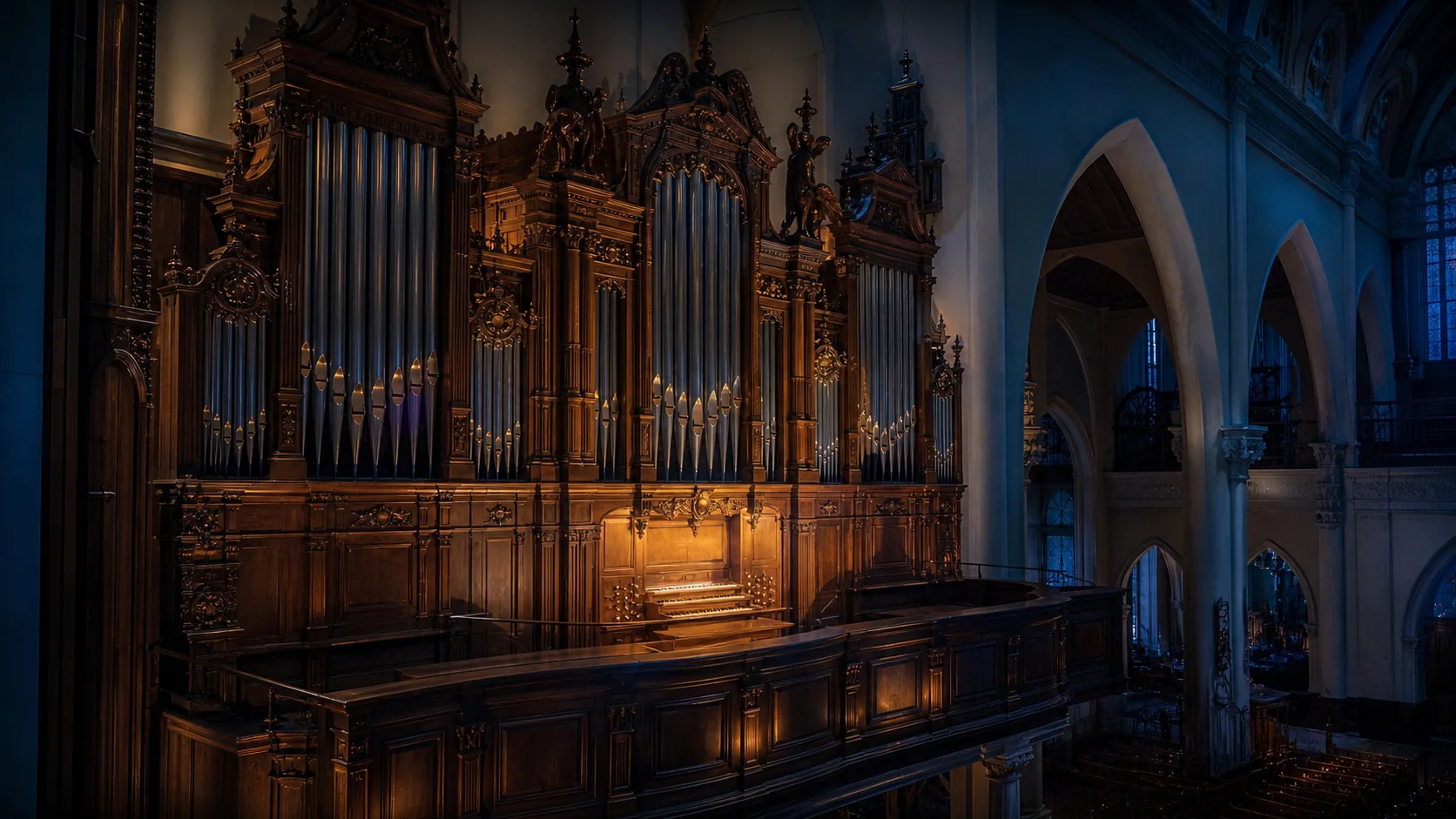
Martin Ott Opus 101 at Zion Lutheran Church
Martin Ott Opus 101 was commissioned in 2001 for Zion Lutheran Church in Harvester, Missouri. The stop specification gives 28 stops, 30 ranks, four extensions, electric slider chests, selected electro-pneumatic actions, and a media interface.
Architecture and placement: Zion's oak case and MIDI console
Zion Lutheran Church in Harvester, Missouri gave Opus 101 its architectural setting. According to the architectural record for Zion Lutheran Church, a church organ shares the interior with singers and worshippers, so case position and sight lines belong to the musical history whenever the commission description names them. No measured acoustic data accompanies the commission history.
The architectural record from Zion Lutheran Church shows that the interior is best read through concrete clues: case position, nearby architecture and the player's relation to other musicians. Opus 101 should not be assigned a reverberation profile from appearance alone. The surviving account does not include it.
28 stops and 30 ranks: the scale of Opus 101
The catalogue figures for Opus 101 read 28 stops and 30 ranks. For Opus 101, one total counts the player's controls, the other the rows of pipes available behind them. The published numbers for Zion Lutheran Church support a narrower conclusion: an organ of this scale can distribute several choruses and solo colors, although that possibility must not be mistaken for a verified stop-by-stop plan. The Opus 101 outline adds that the overview does not state the number of keyboards. The outline notes 4 extensions; extension work allows pipework to be reused at another pitch or under another stop control. A stop-by-stop account of Opus 101 must wait for the complete disposition.
Opus 101 has 2 more ranks than stops. The published numbers for Zion Lutheran Church support a narrower conclusion: a mixture could explain part of the gap, although the abbreviated record does not place it. The entry separately lists 4 extensions. For Opus 101, the arithmetic offers a check against the missing stoplist.
How the notes travel: Zion's oak case and MIDI console
Electrical commands carried the player's key actions to the chests in Opus 101, with sliders retaining their role in stop selection. This identifies the layout without establishing how the mechanism behaves today.
For Opus 101, action type and tonal design should be read on separate lines. According to the action account for Zion Lutheran Church, one concerns control; the other concerns what the pipes were made to say.
Inside the physical design: Zion's oak case and MIDI console
Opus 101's console was detached and movable. Granadilla covered the natural keys, while Ivora was used for the sharps. Cherry wood finished the playing console interior. The organ occupied an oak case made to match the church woodwork, with raised panels of quarter-sawn oak. The playing console equipment included a sforzando control, MIDI input and output, and a transposer. The materials and placement named here make the organ project recognizable in project images, although they do not provide a pipe-by-pipe inventory or a complete set of workshop drawings for Opus 101.
The design evidence from Zion Lutheran Church has one clear limit: a well-framed installation image may verify timber, placement and facade pattern. Windchests, trackers and enclosed divisions of Opus 101 remain only partly visible in that image.
The human side of the commission: Zion's oak case and MIDI console
These are the construction and control details supplied by the captured company entry. It does not document subsequent alterations or condition. The musical history at Zion Lutheran Church begins where the record names a player, a recital or a reason for the organ project. At Zion Lutheran Church, regular service use and later concerts need their own documentation. For Opus 101, a dedication program has not yet been found for this project.
The project entry is quiet about performances. A church, school or owner's archive may hold the first dependable musical date for Opus 101.
Evidence, images and unanswered questions for Opus 101
The former builder's Opus 101 entry, captured on February 6, 2020, links two project images and supplies the commission details used here. Neither image carries a named photographer in the extracted text.
Without captions, the views document the project broadly but cannot answer questions about later alterations, ownership or present condition. A dated institutional photograph and a full stoplist would extend the record.