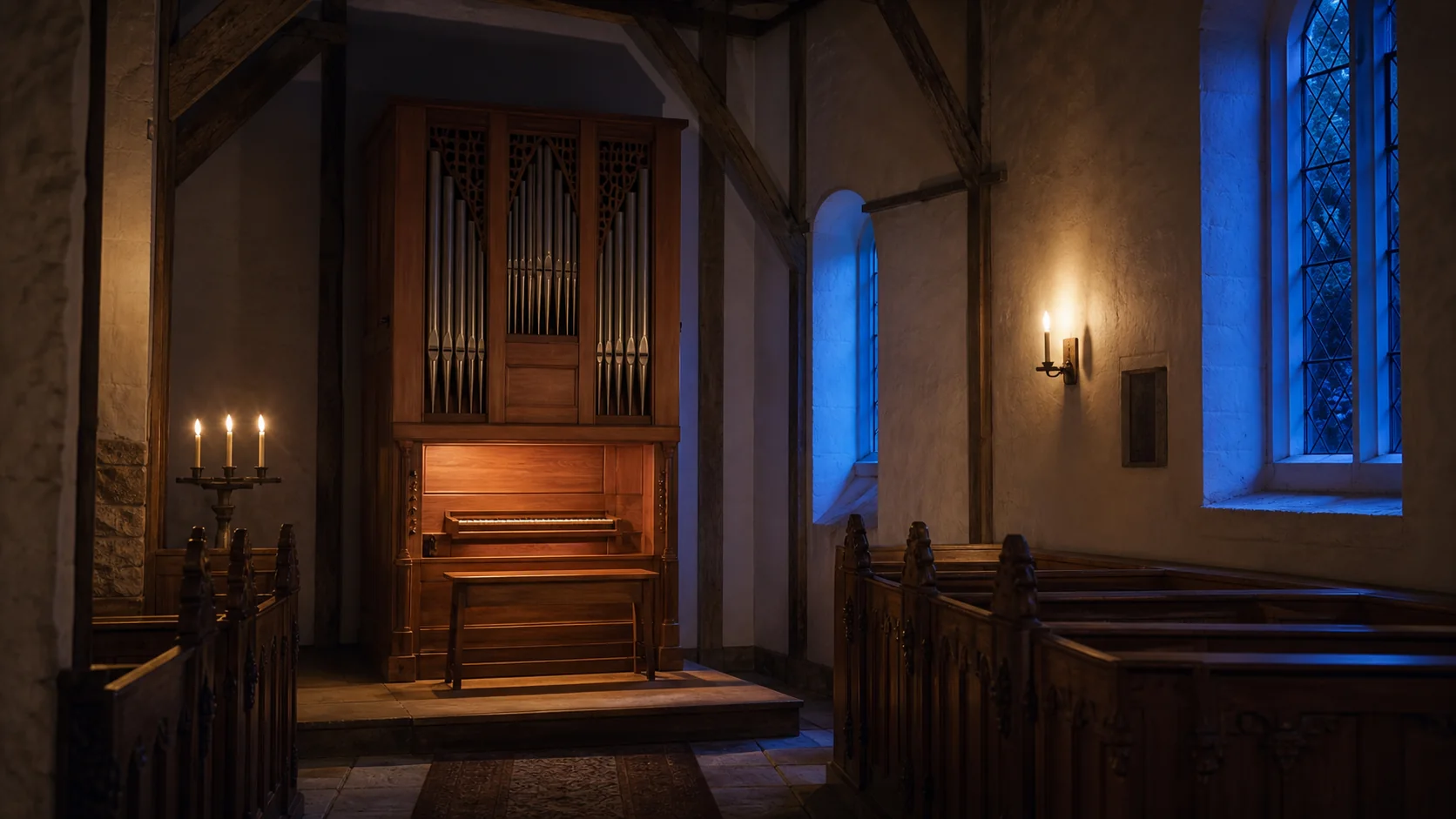
Martin Ott Opus 100 at Smith Chapel at Penn State Erie, the Behrend College
Martin Ott Opus 100 was commissioned in 2001 for the multi-faith Smith Chapel at Penn State Erie, the Behrend College. The stop specification gives 21 stops and 23 ranks, with suspended mechanical key action and electric stop action.
Inside the room: the Smith family's chapel gift
Larry and Kathryn Smith gave the chapel to the college and also presented the custom tracker organ in honor of their children, Colleen and Kevin. The organ project went to Smith Chapel at Penn State Erie, the Behrend College, Erie, Pennsylvania, where the instrument entered an educational rather than purely liturgical setting. Classroom use, individual practice and public performance ask different things of an organ, so none is assumed unless the entry names it.
Practice, rehearsal and recital place different demands on an organ room. The company account supplies selected facts about Opus 100, not a full calendar or acoustic survey.
21 stops and 23 ranks: the scale of Opus 100
Opus 100 is summarized as an organ of 21 stops and 23 ranks. The Opus 100 outline adds that a stop need not correspond to a single independent rank, which is why the two totals deserve separate reading. At Smith Chapel at Penn State Erie, the Behrend College, this count suggests room for contrasting families without describing their balance. For Opus 100, a stoplist is needed before calling the design bright, dark, orchestral or classically ordered. One numerical limit remains in Opus 100: the manual count is not stated in the brief outline. The figures for Opus 100 also show that the totals establish scale but cannot replace the actual specification.
In Opus 100, the rank count exceeds the stop count by 2. At Smith Chapel at Penn State Erie, the Behrend College, compound stops such as mixtures can place several ranks under one control, but their allocation is not given. For Opus 100, that distinction prevents a numerical outline from becoming an invented tonal scheme.
Console and transmission: the Smith family's chapel gift
Opus 100 is described as having suspended mechanical key action. The keys pull through a physical linkage to the pallets, without an electrical key command. Suspended names the geometry, not the weight of touch; leverage and regulation would determine that. Electrical stop control worked alongside mechanical keys. Under the action description for Smith Chapel at Penn State Erie, the Behrend College, one selected ranks; the other carried the player's notes to the chests.
The electrical system describes transmission, not musical character. Voicing and pipework remain separate parts of the story of Opus 100.
Wood, metal and placement: the Smith family's chapel gift
The organ stood at the front of the chapel with its keydesk attached to the organ case. Taken together, these construction details give Opus 100 a physical identity beyond its stop count. According to the design record for Smith Chapel at Penn State Erie, the Behrend College, a complete case drawing and internal chest plan have not yet surfaced.
In the design record for Smith Chapel at Penn State Erie, the Behrend College, console placement can show how player, choir and room were meant to relate. It cannot alone explain the plan of the internal divisions of Opus 100.
From dedication to daily use: the Smith family's chapel gift
The source names Karen Keene as organ consultant and curator of the Smith Memorial Chapel organ. Larry Smith, professor emeritus at the Jacobs School of Music at Indiana University, played the dedicatory recital. The company entry does not document subsequent alterations, ownership, or condition. Teaching instruments are often heard in more than one context. Here the known faculty links and dated events carry more weight than a general assumption about how the organ served Smith Chapel at Penn State Erie, the Behrend College. Later programs could extend that chronology.
One program can reveal repertory and occasion without describing routine use. More bulletins or recordings would show how Opus 100 settled into the institution.
Evidence, images and unanswered questions for Opus 100
The starting point is Martin Ott's own Opus 100 page, preserved in the form captured on February 6, 2020. Readers can compare the record with 5 images linked on that page. Among the surviving sources for Smith Chapel at Penn State Erie, the Behrend College, every file came directly from the same project entry. None carries an individual named photographic credit in the extracted text. For Opus 100, that dated account is useful for the organ project history, not as proof of the organ's state today. The Opus 100 evidence also shows that a present-day condition report could extend the story without rewriting its older evidence.