Martin Ott Opus 107 at Lord of Life Lutheran Church
Martin Ott Opus 107 was commissioned in 2005 for Lord of Life Lutheran Church in Chesterfield, Missouri. The stop specification gives 19 stops and 24 ranks, with mechanical key action and electric stop action.
How the room shaped the commission: the Chesterfield grillwork and side towers
The organ stood in the center of the sanctuary balcony. The church combined angular modernist forms with a large round stained-glass window above the rear balcony. The organ design served as a visual counterpoint between those straight lines and the circular window. The red brick wall behind the instrument acted as an acoustic reflector and was considered during voicing. Lord of Life Lutheran Church in Chesterfield, Missouri gave Opus 107 its architectural setting. The architectural record from Lord of Life Lutheran Church shows that a church organ shares the interior with singers and worshippers, so case position and sight lines belong to the musical history whenever the commission description names them.
In the room documented at Lord of Life Lutheran Church, the interior is best read through concrete clues: case position, nearby architecture and the player's relation to other musicians. Opus 107 should not be assigned a reverberation profile from appearance alone.
19 stops and 24 ranks: the scale of Opus 107
The catalogue figures for Opus 107 read 19 stops and 24 ranks. At Lord of Life Lutheran Church, one total counts the player's controls, the other the rows of pipes available behind them. The published numbers describe moderate breadth, not volume. Voicing, wind and the interior would decide how large the organ seemed to a listener. For Opus 107, the overview does not state the number of keyboards. A stop-by-stop account of Opus 107 must wait for the complete disposition.
Opus 107 has 5 more ranks than stops. At Lord of Life Lutheran Church, a mixture could explain part of the gap, although the abbreviated record does not place it. For Opus 107, the arithmetic offers a check against the missing stoplist.
The route from key to pipe: the Chesterfield grillwork and side towers
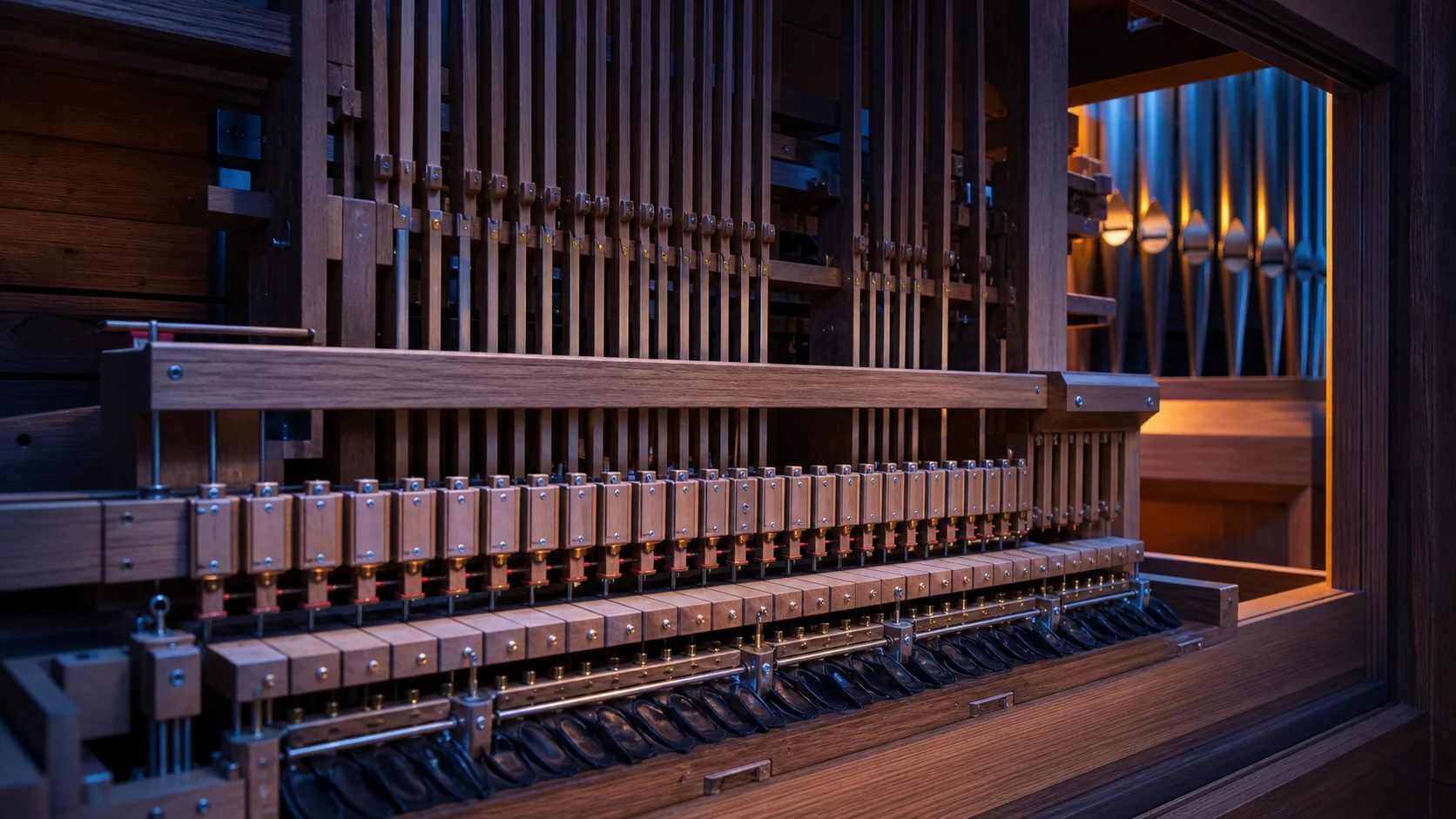
In Opus 107, the player reached the windchest through a direct tracker linkage instead of an electrical key command. This is the basic meaning of tracker action. The action record from Lord of Life Lutheran Church is precise on this point: it cannot tell us how the keyboard felt when completed or how the action has worn since installation. The combination joined tracker keys with electrically operated stops. It should not be shortened to a single action description.
In Opus 107, the space between console and case was crossed by direct tracker linkage. The entry records that arrangement but gives no measurements for key resistance or lost motion.
Materials and workmanship: the Chesterfield grillwork and side towers
Opus 107's case was built from red oak, with quarter-sawn oak panels, and its detached console stood about ten feet away to leave room for three choir risers. The materials and placement named here make the organ project recognizable in project images, although they do not provide a pipe-by-pipe inventory or a complete set of workshop drawings for Opus 107.
In the design record for Lord of Life Lutheran Church, a well-framed installation image may verify timber, placement and facade pattern. Windchests, trackers and enclosed divisions of Opus 107 remain only partly visible in that image.
Recitals, worship and memory: the Chesterfield grillwork and side towers
Computer-assisted design helped shape the intricate grillwork and two cantilevered side towers. The musical history at Lord of Life Lutheran Church begins where the record names a player, a recital or a reason for the organ project. According to the musical record for Lord of Life Lutheran Church, regular service use and later concerts need their own documentation. For Opus 107, no dedicatory recital is named in the surviving material.
The project entry is quiet about performances. A church, school or owner's archive may hold the first dependable musical date for Opus 107.
Evidence, images and unanswered questions for Opus 107
For Opus 107, the closest source is the former builder's project entry dated February 6, 2020. It links 5 images from the corresponding project directory. Together they form the image record published beside Opus 107. The Opus 107 evidence also shows that the entry does not name a photographer for the listed views. According to the surviving sources for Lord of Life Lutheran Church, without captions, the views remain broad evidence and cannot settle questions about later alterations. For Opus 107, dated images or an institutional inventory could carry the account forward.