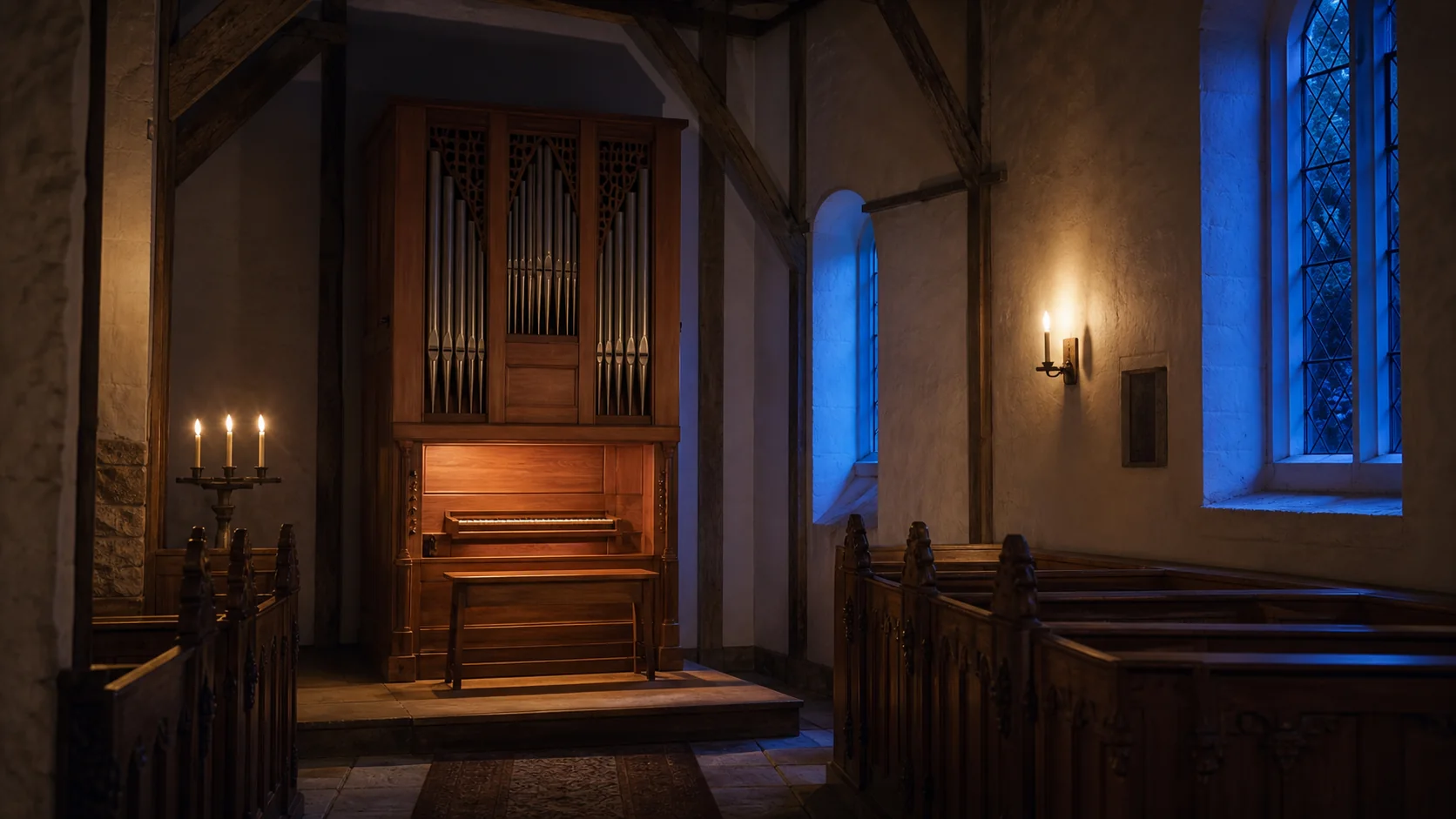
Martin Ott Opus 108 at First Presbyterian Church
Martin Ott Opus 108 was commissioned in 2006 for First Presbyterian Church in Kirkwood, Missouri. The stop specification gives 12 stops and 13 ranks with tracker action and divided sliders.
Organ, choir and congregation: the Tree of Life Chapel
The instrument stood on the balcony of the new chapel. The donors asked that the interior be called the Tree of Life Chapel, and the grillwork above the facade pipes followed a leaf pattern that connected the organ with that architectural theme. At First Presbyterian Church, the organ had to find its place within a working worship space. The architectural record from First Presbyterian Church shows that front, gallery and balcony sites change the organ's relation to choir and altar; this article follows only positions documented by the builder.
What survives about the room at First Presbyterian Church is enough to say this: siting and acoustics need to be read together, though they are not the same evidence. The commission description can locate Opus 108; describing the room's response requires measurements or first-hand technical notes.
12 stops and 13 ranks: the scale of Opus 108
The published count for Opus 108 is 12 stops and 13 ranks. The Opus 108 outline adds that stops name the organist's available controls; ranks count the pipe sets behind those choices. Within the published specification for First Presbyterian Church, its numerical scale is neither miniature nor among the firm's largest. For Opus 108, the musical plan still rests in the missing sequence of names of the stops and pitches. One numerical limit remains in Opus 108: no manual count appears in the condensed technical note. These figures sketch scale without describing tone.
The two totals for Opus 108 are separated by 1 rank. The 12-stop, 13-rank summary for First Presbyterian Church shows that compound stops can create that difference; only the complete disposition can show where the extra ranks lie. For Opus 108, this is why the two numbers belong together in print.
Action and touch: the Tree of Life Chapel
The action record from First Presbyterian Church is precise on this point: a tracker mechanism links the keys, connecting parts and pallets in one physical linkage. The outline assigns that principle to Opus 108. For Opus 108, response and comfort would have depended on the precise layout and subsequent regulation, neither of which is measured on the entry.
At First Presbyterian Church, the action description becomes more meaningful when read beside console placement and division layout. For Opus 108, only the details explicitly recorded above can complete that picture.
Console, divisions and facade: the Tree of Life Chapel
The instrument used a 63-note manual and 30-note pedal compass, with the manual stops divided between f-sharp 31 and g32. Its console was attached to the organ case. Except for the Oktave 4-foot, the manual division was under expression. The quarter-sawn American cherry case matched the chapel woodwork. At First Presbyterian Church, these are helpful points of contact between the written history and the commission images. Internal dimensions and the full division plan of Opus 108 are not supplied.
The physical details of Opus 108 matter because they show how instrument and people occupied the same setting. In the design record for First Presbyterian Church, they are more useful than an interchangeable description that could belong to any nearby organ project.
Who played and why: the Tree of Life Chapel
The performance evidence for First Presbyterian Church sets the limit of the account: in worship, an organ may accompany congregational music or take a solo role. For Opus 108, those roles are kept separate unless the commission narrative or a dated program connects them. For Opus 108, the record identifies no resident organist or later concert.
Later testimony could add the sound and people now absent from the written history of Opus 108. Until then, the technical record carries the story.
Evidence, images and unanswered questions for Opus 108
The former Martin Ott page for Opus 108, dated February 6, 2020, provides the principal evidence for this article. The entry supplies 5 linked images to be read beside the written account. Their presence in the project entry ties them to Opus 108. Among the surviving sources for First Presbyterian Church, individual image credits are absent from the extracted material. For Opus 108, its evidence stops before the present day; present location, access and condition need more recent confirmation. The Opus 108 evidence also shows that the most valuable additions would be a full disposition and a recent survey.