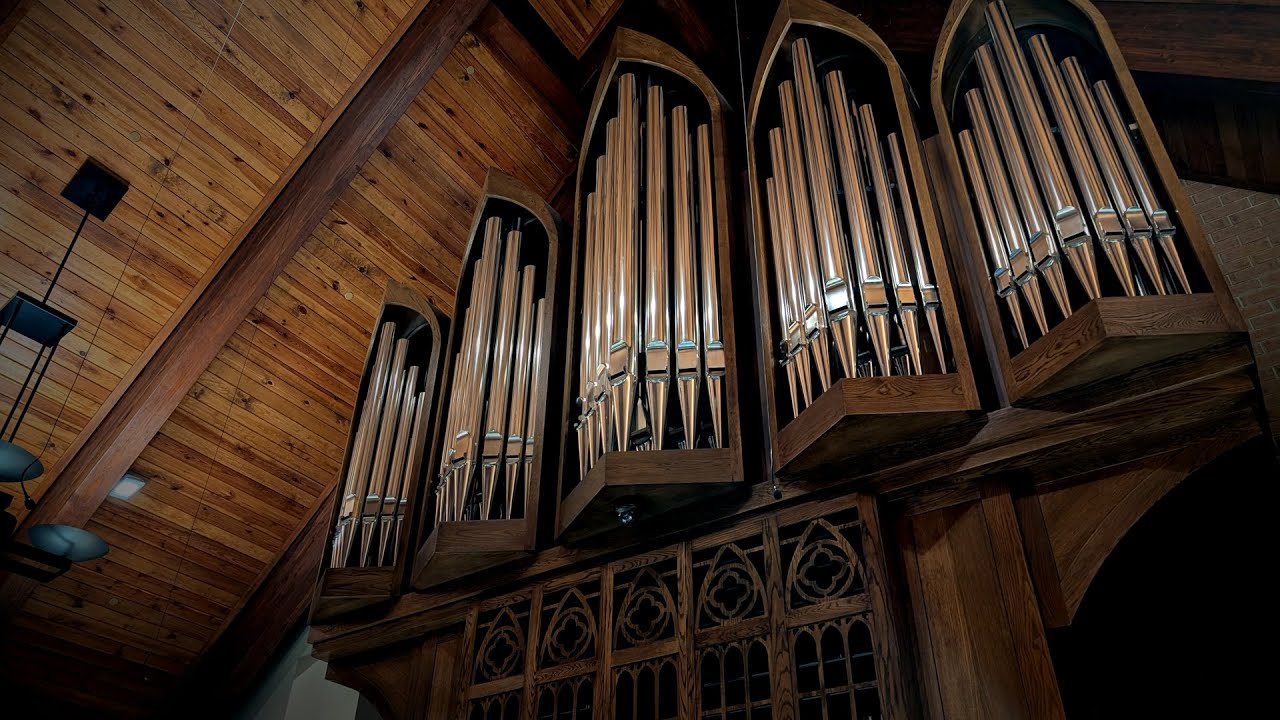
Martin Ott Opus 114 at Peace Lutheran Church
The archived builder page dates the Martin Ott Opus 114 commission to 2012 and gives 30 stops, 31 ranks, three extensions, mechanical key action and electric slider action. That page caught the organ under construction. Peace Lutheran Music Ministry later published its specification and linked to an Organ Media Foundation video showing the completed instrument. The later visual evidence establishes completion without supplying a completion date.
A room shaped for sound: Peace Lutheran's construction-to-completion record
At the time captured by the source, the new sanctuary and organ were projected for completion in summer 2014. At Peace Lutheran Church, the organ had to find its place within a working worship space. What survives about the room at Peace Lutheran Church is enough to say this: front, gallery and balcony sites change the organ's relation to choir and altar; this article follows only positions documented by the builder.
At Peace Lutheran Church, siting and acoustics need to be read together, though they are not the same evidence. The commission description can locate Opus 114; describing the room's response requires measurements or first-hand technical notes.
30 stops and 31 ranks: the scale of Opus 114
The published count for Opus 114 is 30 stops and 31 ranks. For Opus 114, stops name the organist's available controls; ranks count the pipe sets behind those choices. Within the published specification for Peace Lutheran Church, this is a broad specification, but a large count is not a synonym for loudness. The figures for Opus 114 also show that wind pressure, voicing and the interior still govern the result. The Opus 114 outline adds that no manual count appears in the condensed technical note. One numerical limit remains in Opus 114: the entry also counts 3 extensions, showing that one rank supplied more than one pitch or stop function. These figures sketch scale without describing tone.
The two totals for Opus 114 are separated by 1 rank. Within the published specification for Peace Lutheran Church, compound stops can create that difference; only the complete disposition can show where the extra ranks lie. The entry separately lists 3 extensions. For Opus 114, this is why the two numbers belong together in print.
From console to pipe: Peace Lutheran's construction-to-completion record
Under the action description for Peace Lutheran Church, a tracker mechanism links the keys, connecting parts and pallets in one physical linkage. The outline assigns that principle to Opus 114. For Opus 114, response and comfort would have depended on the precise layout and subsequent regulation, neither of which is measured on the entry. The key action and stop control were not the same system: the keys used mechanical linkage, while the sliders were actuated electrically.
Electric control gave the builder more freedom in locating the playing console and divisions of Opus 114. Under the action description for Peace Lutheran Church, the project entry must still be consulted before assigning a detached or movable console.
Music and people: Peace Lutheran's construction-to-completion record
The construction-stage builder page credits a 2014 photograph to Thorsen Ott and describes the instrument before installation was complete. The later Peace Lutheran page and Organ Media Foundation presentation show the finished organ in its sanctuary. These records establish two stages of the project without turning the projected summer 2014 schedule into a claimed completion date.
The later presentation documents the instrument as a musical object, while programs and service records would be needed for a fuller performance history. It does not by itself establish the organ's present technical condition.
Evidence, images and unanswered questions for Opus 114
The former Martin Ott page supplies four construction-stage images, all with usable caption or credit context in the extracted entry. It remains the closest source for the original design and projected schedule.
Peace Lutheran Music Ministry's organ page adds a later specification and links to the Organ Media Foundation video presentation. A frame from that video documents the completed organ, but no reuse licence is stated for the image. Completion is therefore supported, while its exact completion date and present technical condition remain separate questions.