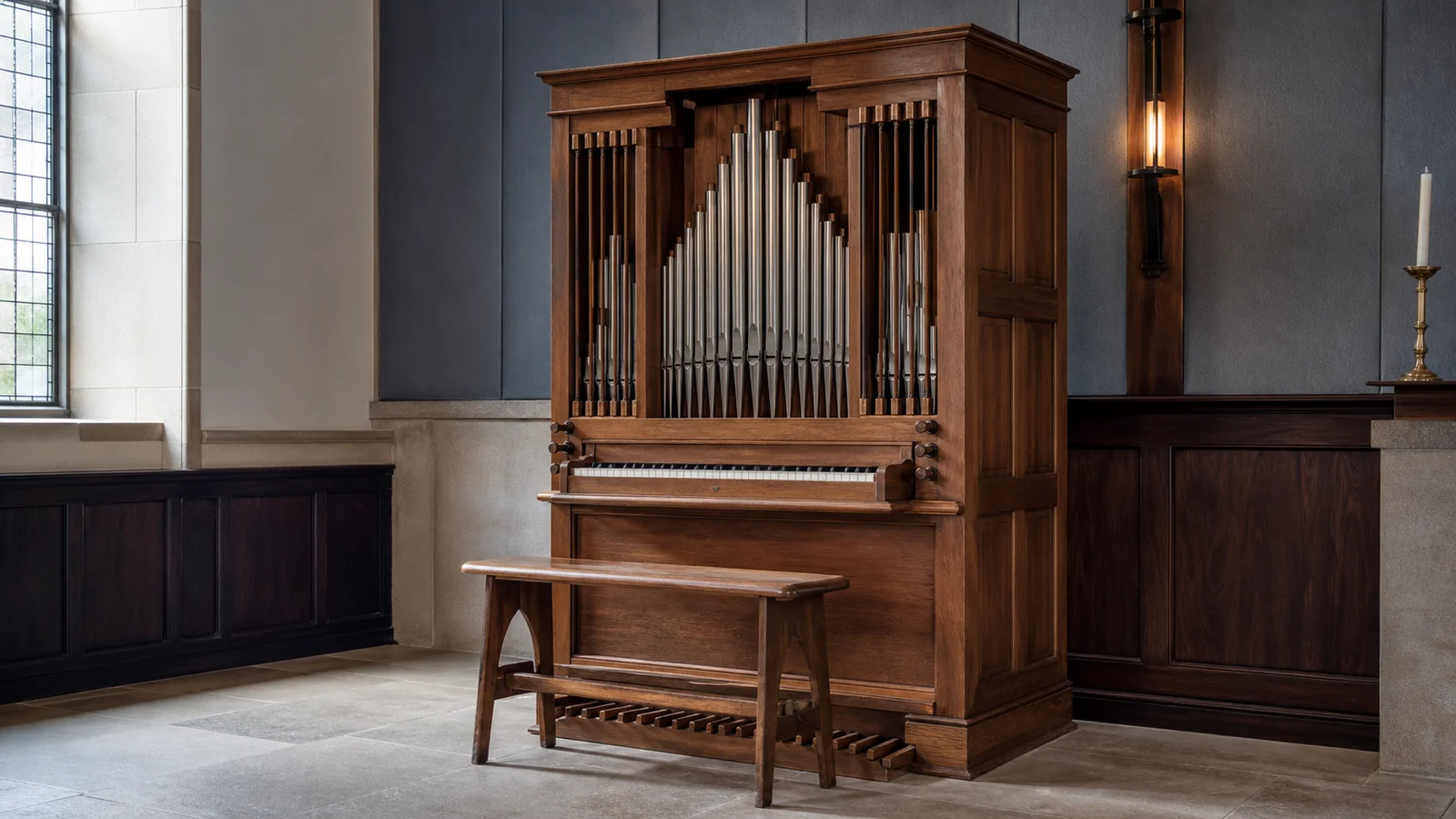
Martin Ott Opus 113 at Concordia Seminary
Martin Ott Opus 113 was built in 2011 as a three-stop, three-rank continuo with tracker action. Concordia Seminary in St. Louis purchased the instrument upon completion, and Robert and Lori Duesenberg gave it in memory of Robert Bergt.
Where the instrument stood: Concordia's touring continuo
At Concordia Seminary, the interior and the curriculum would have met around the organ. The dated description gives enough to discuss the installation, while leaving the timetable of lessons and performances to later institutional records. No measured acoustic data accompanies the commission history.
The next useful institutional evidence would be a architectural plan, a recital program or a faculty inventory. Each would answer a different question about Opus 113. The surviving account does not include it.
3 stops and 3 ranks: the scale of Opus 113
The catalogue figures for Opus 113 read 3 stops and 3 ranks. The 3-stop, 3-rank summary for Concordia Seminary shows that one total counts the player's controls, the other the rows of pipes available behind them. Few ranks do not mean one color. Flutes, principals or reeds could change the picture, but only a stoplist can confirm which families were present. For Opus 113, the overview does not state the number of keyboards. A stop-by-stop account of Opus 113 must wait for the complete disposition.
Stops and ranks have matching totals in Opus 113. That does not prove a simple one-to-one plan, since compound or borrowed resources may balance elsewhere. For Opus 113, the arithmetic offers a check against the missing stoplist.
The playing action: Concordia's touring continuo
In Opus 113, the player reached the windchest through a direct tracker linkage instead of an electrical key command. This is the basic meaning of tracker action. Under the action description for Concordia Seminary, it cannot tell us how the keyboard felt when completed or how the action has worn since installation.
At Concordia Seminary, touch is a physical result, not a synonym for tracker action. A player or technician would need to examine Opus 113 before describing its present feel.
How the instrument was arranged: Concordia's touring continuo
The American walnut case was designed for ensemble and touring use, with locked pipes, carrying handles, casters, and a detachable blower section. The materials and placement named here make the organ project recognizable in project images, although they do not provide a pipe-by-pipe inventory or a complete set of workshop drawings for Opus 113.
According to the design record for Concordia Seminary, a well-framed installation image may verify timber, placement and facade pattern. Windchests, trackers and enclosed divisions of Opus 113 remain only partly visible in that image.
Listening history: Concordia's touring continuo
Bergt had founded the American Kantorei in 1968 and conducted the Bach at the Sem concert series until his death on July 26, 2011. The Robert Bergt Memorial Continuo Organ was dedicated on December 5, 2012, during a Bach at the Sem performance of movements from the Mass in B Minor. Joan Bergt played the continuo part. Its partially open upper cabinet preserved a sight line from the player to the conductor. At Concordia Seminary, named teachers, students or recitalists are better guides to use than the institution's name alone. The stop specification suggests possibilities for study, but programs are needed to show what was actually played. Its subsequent concert life is not described.
The musical event named on the entry supplies a date that can be checked against local records. It leaves room for a longer chronology of Opus 113.
Evidence, images and unanswered questions for Opus 113
For Opus 113, the closest source is the former builder's project entry dated February 6, 2020. It links 6 images from the corresponding project directory. Together they form the image record published beside Opus 113. Of those files, 6 carry caption or credit context. The project sources for Concordia Seminary leave one question open: without captions, the views remain broad evidence and cannot settle questions about later alterations. For Opus 113, dated images or an institutional inventory could carry the account forward.