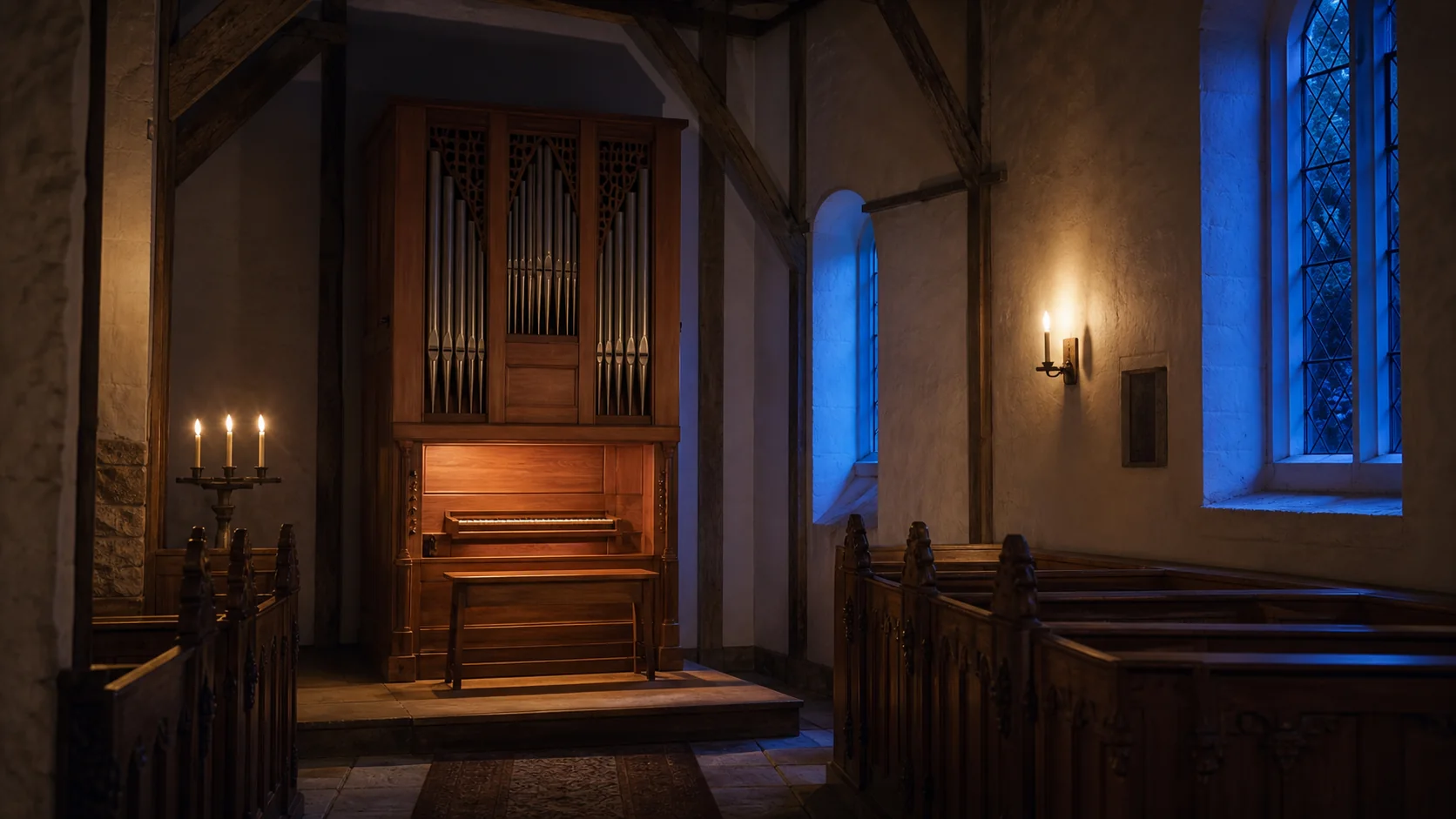
The 1979 project at Northwestern University: Opus 12
Martin Ott Opus 12 was a five-stop, five-rank mechanical practice organ built in 1979 for Northwestern University in Evanston. The archived page identifies it as the firm's first two-manual practice instrument and says that several related practice organs followed.
The surviving chronology begins with 1979 beside Opus 12. No day, month, or event label accompanies that year. Northwestern University in Evanston, Illinois fixes the historical setting, but a contract or dedication programme would be needed for a tighter sequence. The entry does not answer present access or condition.
Reading the setting in Evanston, Illinois: Opus 12
Northwestern University in Evanston, Illinois places the organ within an academic setting. A university or school instrument can support practice, teaching, ensemble work, or public performance, but the institution's name alone does not prove which duties applied here. The project account must carry that distinction. It also gives no room measurements or current programme information.
Scale in figures: the stops and ranks of Opus 12
A total of 5 stops and 5 ranks is attached to Opus 12. The first figure belongs to the console controls and the second to sets of pipes, so the numbers should not be treated as synonyms. Opus 12 has equal listed counts for stops and ranks. The equality alone cannot identify borrowed pipes or a stop made from several rows. They provide a useful scale marker while leaving voicing, wind pressure, pipe count, and division layout unresolved.
The figures for Opus 12 give one fixed point in the history of Northwestern University. They allow the project to be compared with a future dated disposition, although they do not reveal the names or pitches of individual voices. If the two records differ, that change would need its own explanation and date. The present account keeps the builder's numerical outline intact rather than smoothing over an unknown later history.
From the keyboard into the organ: Opus 12
For Opus 12 at Northwestern University, the action is recorded as mechanical. That tells us how the key command began its journey to a pipe valve; it does not tell us how the stops operated, how the console sat in the room, or how the mechanism has aged. Historic action type and current playing condition are not the same claim.
The detail that gives Opus 12 its character
For Northwestern University, the strongest surviving clues are concrete: it was the builder's first two-manual practice instrument. At Northwestern University, specification and access can serve very different kinds of work, from individual practice to recital. A named function can be reported when the Evanston project history supplies it; the institution label alone is not enough. The evidence from Northwestern University does not reconstruct curriculum, repertoire, teaching practice, or current availability. The listed 5-stop, 5-rank scale remains the numerical boundary for this reading.
Where the chronology for Opus 12 falls quiet
No case material, room within the university, recital, consultant, relocation, or later alteration appears in the extract. Its historical distinction is therefore precise but limited: Opus 12 marks the builder's first two-manual practice design, made for university teaching rather than a public worship or concert installation. The page does not identify which later practice instruments followed its pattern at Northwestern thereafter.
Images, sources, and the open questions for Opus 12
For Opus 12, the source links 3 numbered image files; images/012/012_m.jpg is the first candidate. They may show the instrument associated with Northwestern University, yet the links alone cannot confirm every subject or permit reuse. No photographer, date, or licence is attached in the extracted material.
The Opus 12 trail stops before a later condition report. A dated stop list or programme from Northwestern University would add substance without guessing, while a recent institutional statement could establish whether the organ remains in Evanston, Illinois. Until then, present access and playing condition are unknown.