Two dates at the beginning of Opus 11
The archived builder account begins at Our Lady of Providence in St. Louis, where Monsignor Nicholas Schneider and organist Marie Kremer commissioned Opus 11 in 1978. A partial company opus list published by the National Association of Pastoral Musicians also gives 1978 as the year of order, with 11 stops, 16 ranks, and an original price of $47,750. The June 1989 issue of The American Organist, reporting on the later Wisconsin installation, calls the instrument a 1980 build. The difference may separate the order from completion, but none of the three sources says so directly.
The St. Louis account describes a small mechanical-action organ working in an acoustically difficult sanctuary. It singles out an 8-foot Trompete mounted horizontally so the organ could lead congregational singing with more presence. That is a builder's explanation of one tonal choice, not a measured acoustic report for the room.
Marie Kremer and the first St. Louis chapter
Marie Kremer played the dedicatory recital at Our Lady of Providence. The builder account does not date that recital or reproduce the programme, so the surviving evidence cannot say what she played. Monsignor Schneider later moved to St. Monica Catholic Church in Creve Coeur, Missouri, where another Ott commission became Opus 61. That later appointment belongs to Schneider's biography, while Opus 11 remained tied to the changing needs of the Providence parish.
Why a new sanctuary led to Opus 51
Monsignor Forst succeeded Schneider and oversaw a new sanctuary for Our Lady of Providence. The parish ordered the larger Opus 51, and the archived builder account says the sale of Opus 11 helped finance that project alongside a parish gift. The change is described as a response to a different building, not as a judgment that the smaller organ had failed.
The National Association of Pastoral Musicians list records a 1988 sale price of $67,400, including installation and one added stop. The builder history supplies a purchase date of October 28, 1988, and identifies the addition as an 8-foot Prinzipal. Those two records give the move an unusually clear financial and tonal outline, though neither explains transport, case alterations, or workshop hours.
A freestanding organ in New Berlin
Martin W. Banget, pastor of Peace Lutheran Church in New Berlin, Wisconsin, bought the organ for the congregation. The American Organist placed the reinstalled instrument near the rear wall of a new 450-seat building and called it the first Ott installation in a Wisconsin church. It was freestanding rather than fitted into an older organ chamber, a practical detail that helps explain how listeners and worshippers would have encountered the case.
The 1989 report says the facade contained a 4-foot Prinzipal and the horizontal 8-foot Trompete. Its printed stop list calls the main 4-foot chorus voice Octave rather than Prinzipal, so the wording should remain attributed instead of silently harmonized. The same notice credits Gary Foxe with a newly added Zimbelstern.
The 1989 stop list, division by division
The American Organist printed a two-manual specification with 56 notes on both Hauptwerk and enclosed Brustwerk, plus a 32-note Pedal. The Hauptwerk listed Prinzipal 8, Rohrflote 8, Octave 4, Gemshorn 2, Mixtur III-IV, and the horizontal Trompete 8. The Brustwerk carried Eichengedackt 8, Blockflote 4, Prinzipal 2, Terz 1 3/5 from tenor C, Quinte 1 1/3, and Tremulant.
The Pedal list named Subbass 16, Choralbass 4, and a prepared Fagott 16, with couplers from both manuals. A stop is the organist's control, while a rank is a row of pipes. This is why the company's total of 11 stops and 16 ranks need not match the count of every coupler, tremulant, prepared voice, or Zimbelstern printed beside the tonal stops.
Dedication dates and the 1989 recital series
The American Organist says the dedication took place on December 18, 1988. The archived builder page separately dates Scott Riedel's dedicatory recital to January 8, 1989. The two statements may refer to a church dedication followed by a recital, but the sources do not spell out that distinction. John A. Behnke played on February 26, and Paul Manz led a hymn festival on June 1. The contemporary magazine calls Manz's appearance the last dedication recital.
Together, those notices place Opus 11 in both recital and congregational use soon after the move. No programme, recording, review, or attendance figure accompanies the dates. The events establish who appeared and when, but they cannot support a modern judgment about the organ's sound or condition.
The photograph trail and what remains unknown
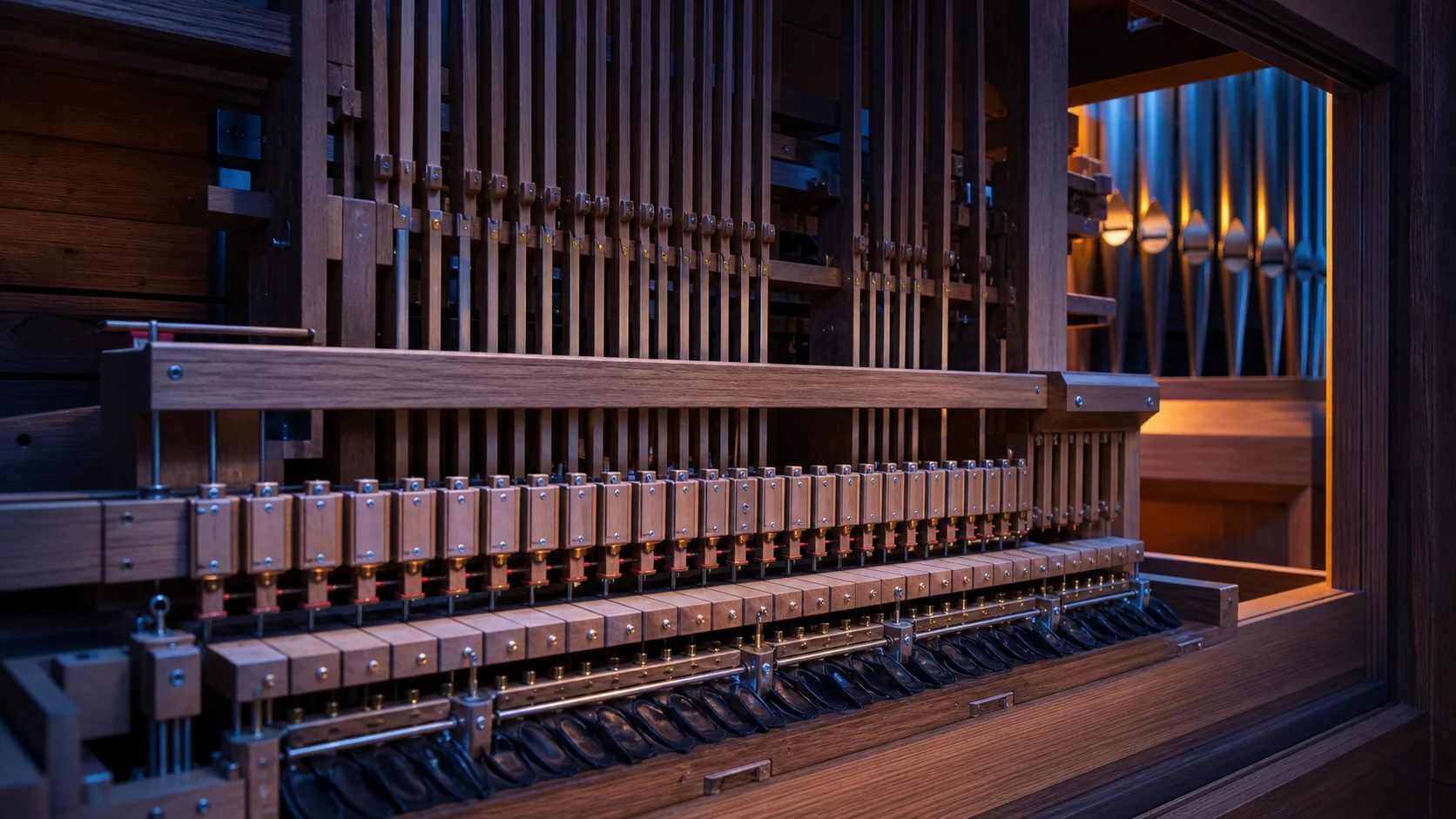
The archived Opus 11 page links images/011/011_m.jpg, a file path that matches the project number. The extracted page gives no caption, photographer, date, licence, or reuse permission. The two published PDFs also contain historical page images, but publication in a magazine or association document does not create permission to copy them into a new article.
None of these sources is a current condition report. They do not confirm present ownership, access, maintenance history, or playing condition. A statement from Peace Lutheran, a recent stop list, and credited photographs of the case and console would answer those questions. Until those are obtained, the reliable story ends with the documented move and the 1988-89 public events.