How Opus 19 entered the history of Immanuel Lutheran Church
Martin Ott Opus 19 was originally built in 1981 for Redeemer Lutheran Church in Highland Park. After Redeemer merged with Faith Lutheran, Immanuel Lutheran Church in Washington, Missouri, bought the organ in 2009 and moved it to the balcony of a new sanctuary in 2011.
Opus 19 appears in the catalogue under 1995. In the Immanuel Lutheran Church account from Washington, Missouri, catalogue dates can mark different stages of an organ project, and this entry does not choose among them. For Immanuel Lutheran Church in Washington, Missouri, the exact stage remains open unless a narrative or dated document names it. At Immanuel Lutheran Church in Washington, Missouri, current status requires newer evidence than the catalogue year.
What the Washington location tells us, and what it does not: Opus 19
Immanuel Lutheran Church in Washington, Missouri is the named institutional setting. A church instrument may meet congregational, choral, and solo demands, but those uses cannot all be assigned to this organ unless the project account says so. No floor plan or measured acoustic data accompanies the entry, so the building's present response and the organ's balance within it remain open questions.
What the numerical overview actually establishes for Opus 19
Opus 19 is listed with 22 stops and 25 ranks. For the Immanuel Lutheran Church project in Washington, Missouri, those numbers answer different questions: stops describe controls, while ranks count sets of pipes. The rank count on Opus 19 exceeds the stop count by 3. Multi-rank chorus stops may contribute to that gap; only the full disposition can show how. The figures recorded for the Washington project establish the documented scale, not the exact number of pipes, the balance between divisions, or the sound of a particular chorus.
At Immanuel Lutheran Church, the recorded overview for Opus 19 is useful because it fixes the scale associated with the historical project. That Opus 19 line cannot explain voicing or the balance between divisions. A later specification from Washington, Missouri could show whether the count remained stable and whether any stop changed name, pitch, or function. For Opus 19, the older total is reported without assuming continuity.
The action named for Opus 19
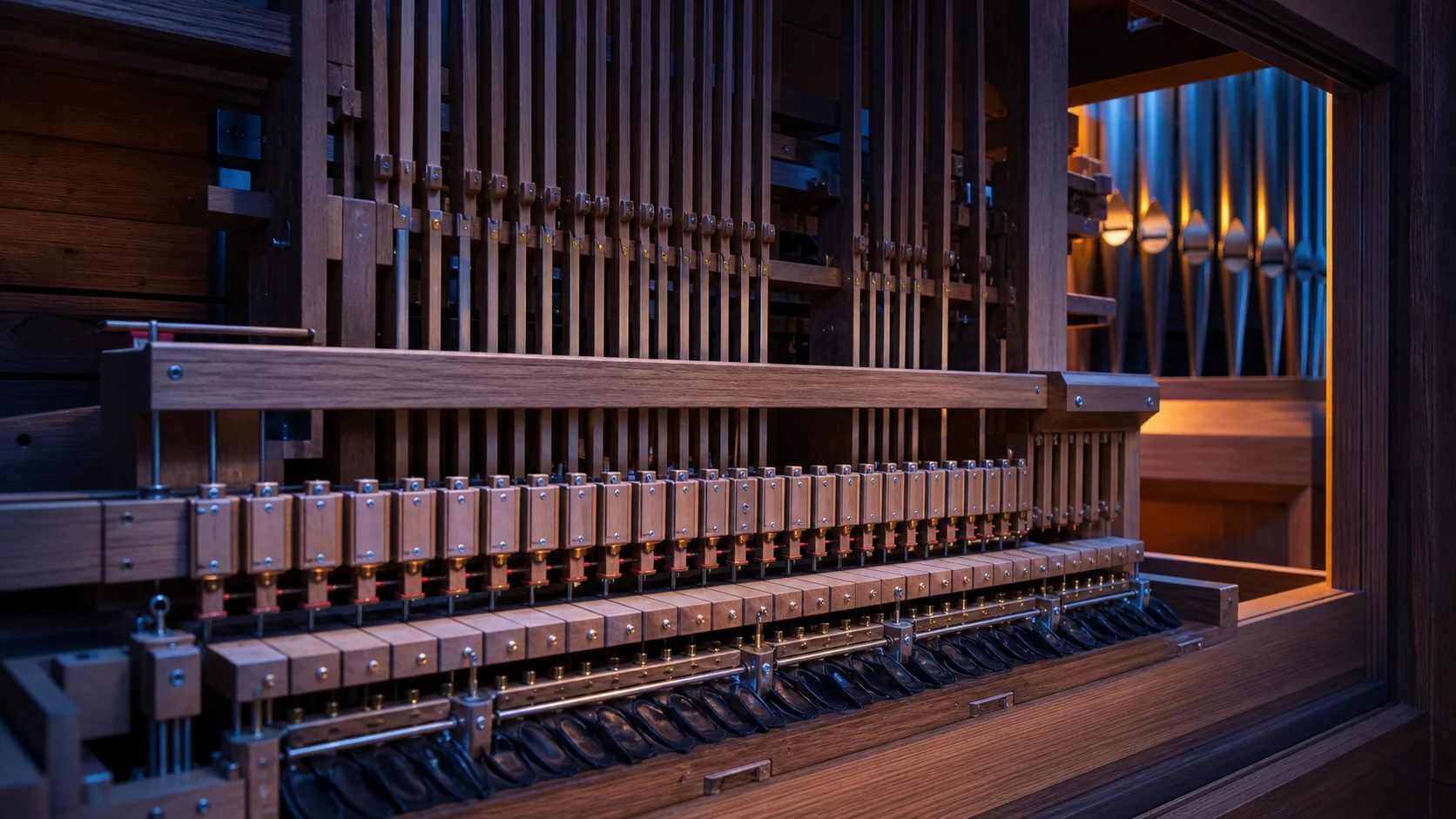
For Opus 19 at Immanuel Lutheran Church, the action line combines direct mechanical control of the keys with electric control of the stops. This can give a player physical key linkage while allowing electrically managed registration. It is not evidence for a particular console layout, touch, or current system condition.
A cautious musical reading for Immanuel Lutheran Church: Opus 19
Beyond the totals, Opus 19 is defined by the source's own sequence: it was originally built for Redeemer Lutheran Church and it was purchased by Immanuel Lutheran in 2009. A church commission raises practical questions about leading song, accompanying a choir, and fitting the instrument into the room. The project details above do not answer questions about registration or repertoire. Those need a specification and evidence of actual services or recitals. The listed 22-stop, 25-rank scale remains the numerical boundary for this reading.
The chronology after the first commission: Opus 19
The relocated instrument gained a Blockflöte and Celeste, electric stop action in place of the former mechanical system, new case finish, and additional moldings. Captions date a photograph to October 2012, and a John Behnke hymn festival was scheduled for November 27. The source presents the Washington installation as an enlargement and refurbishment, not merely a change of address.
The photograph trail and the limits of the evidence: Opus 19
Image evidence for Opus 19 begins with images/019/019_d3.jpg; 3 linked files carry the same project number. For the Immanuel Lutheran Church project in Washington, Missouri, that is enough to investigate identity, not enough to treat the files as freely reusable photography. The old caption includes a credit, although no clear reuse licence accompanies it.
What remains unknown about Opus 19 is concrete: its present location, condition, and complete current specification. The Immanuel Lutheran Church history could be extended by an identified console or case photograph and a dated institutional account. For the Immanuel Lutheran Church project in Washington, Missouri, until then, the old chronology is not evidence of current access.