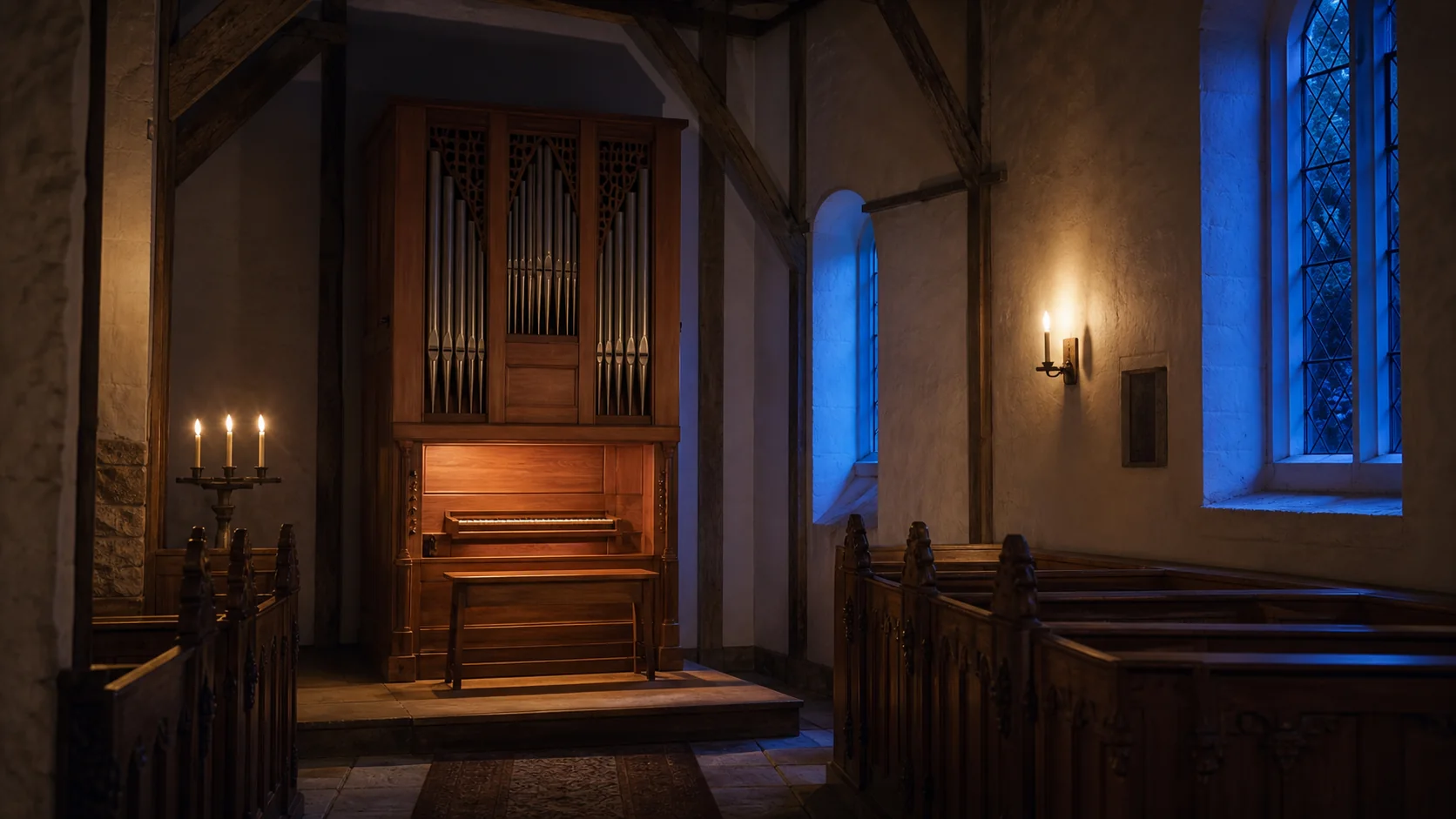
Opus 20 in Bethany: the documented commission
Martin Ott Opus 20 was built in 1982 for Our Savior Lutheran Church in Bethany, Oklahoma. Its detached console is reversed so the music director can face and lead the choir while playing. The page says this arrangement retained the responsive touch of the mechanical key action.
The date line for Opus 20 reads 1982. It is useful evidence, but it should not stand for every missing milestone in the build. The date belongs to the named project at Our Savior Lutheran Church in Bethany, Oklahoma, while later events keep their own dates. Ownership and playing condition today are not implied.
Our Savior Lutheran Church as the documented place: Opus 20
The documented place is Our Savior Lutheran Church, Bethany, Oklahoma. The name tells us that the commission belonged to a worship community, not how the sanctuary was built or how long a chord remained in the room. The surviving account does not identify ceiling height, reflective surfaces, chamber depth, or later alterations. Those omissions prevent a confident description of the venue's acoustics.
Stops, ranks, and the limits of the specification: Opus 20
For Opus 20, the numerical outline is 18 stops against 21 ranks. Stops are the organist's tonal selections; ranks are pipe rows. For Opus 20, ranks outnumber stops by 3. The difference hints at compound resources without naming them, so no specific mixture or mutation should be inferred. Because the surviving evidence here does not include a complete stop list, no reed, flute, string, mixture, manual, or pedal resource is added by assumption.
This brief numerical profile belongs to the Bethany, Oklahoma chapter of Opus 20. It should not be blended with an undated stop list or with the specification of another instrument by the same builder. A later source could reveal additions, removals, or shared resources, but only if it names the organ and date clearly. The historical count therefore remains a reference point, not a current inventory.
How the documented command system works: Opus 20
For Opus 20 at Our Savior Lutheran Church, the overview separates two jobs. Mechanical key action carries the player's key motion through a physical linkage, while electric stop action handles the selection of tonal resources. That combination says nothing by itself about combination pistons, console electronics, later upgrades, or present reliability; those require a dated specification or survey.
Design evidence beyond the recorded totals: Opus 20
The design becomes clearer through the details on the page: it has a detached, reversed console and it was designed for directing the choir from the keyboard. In a sanctuary, tonal resources can serve worship as well as occasional performance. The available facts establish the named design features, not the registrations chosen by players or the musical habits of the parish. A dated programme and full disposition would make that history more precise. The listed 18-stop, 21-rank scale remains the numerical boundary for this reading.
Moves, music, and later work in the source: Opus 20
Nancy Maschino is named as director of music and Jerry Frank as consultant. The organ has 18 stops and 21 ranks, with mechanical key action and electric stop action. The reversed console answers a specific ensemble need: it preserves direct key control while giving the player a clear, practical view of the choir.
What a future source could clarify about Our Savior Lutheran Church: Opus 20
The archived Our Savior Lutheran Church account points to 1 file matching Opus 20. The first path is images/020/020_m.jpg. A matching number is useful provenance, but subject, photographer, date, and rights must still be checked against the image itself. The extracted captions do not settle either authorship or permission.
The source follows Opus 20 through the events described above and no further. A recent condition statement from Our Savior Lutheran Church would answer more than a page of general organ history. So would a complete stop list tied to a date and a clearly credited photograph.