Opus 2 in St. Louis: the documented commission
Martin Ott Opus 2 was a three-stop, three-rank practice organ purchased in 1974 for Washington University's Department of Music in St. Louis. Professor Emeritus Howard B. Kelsey arranged the purchase. Mechanical action and the departmental setting are the only technical and institutional details in the surviving narrative.
The date line for Opus 2 reads 1974. It is useful evidence, but it should not stand for every missing milestone in the build. The date belongs to the named project at Washington University in St. Louis, Missouri, while later events keep their own dates. Ownership and playing condition today are not implied.
Washington University as the documented place: Opus 2
Opus 2 is tied to Washington University, St. Louis, Missouri. The institutional title is useful because it separates an academic project from a parish or residence instrument. It does not reveal whether the organ stood in a studio, chapel, classroom, or hall unless the narrative says so. No current condition or access claim follows from the historic association.
Stops, ranks, and the limits of the specification: Opus 2
For Opus 2, the numerical outline is 3 stops against 3 ranks. Stops are the organist's tonal selections; ranks are pipe rows. Both numerical totals are 3 for Opus 2. That neat correspondence describes the summary, not necessarily the internal layout of the organ. Because the surviving evidence here does not include a complete stop list, no reed, flute, string, mixture, manual, or pedal resource is added by assumption.
This brief numerical profile belongs to the St. Louis, Missouri chapter of Opus 2. It should not be blended with an undated stop list or with the specification of another instrument by the same builder. A later source could reveal additions, removals, or shared resources, but only if it names the organ and date clearly. The historical count therefore remains a reference point, not a current inventory.
How the documented command system works: Opus 2
For Opus 2 at Washington University, the phrase mechanical action is one of the few firm technical labels in the overview. It connects the keyboard physically with the wind valves, but it does not specify whether the keydesk is attached, detached, suspended, or arranged through a particular set of linkages. Those details remain project questions unless the narrative names them.
Design evidence beyond the recorded totals: Opus 2
The design becomes clearer through the details on the page: it was purchased by Howard B. Kelsey and it was intended for the Department of Music. Within an academic setting, specification and access can serve very different kinds of work, from individual practice to recital. A named function can be reported when the project history supplies it; the institution label alone is not enough. The evidence does not reconstruct curriculum, repertoire, teaching practice, or current availability. The listed 3-stop, 3-rank scale remains the numerical boundary for this reading.
Where the chronology for Opus 2 falls quiet
The page presents the instrument as a teaching tool rather than a public recital project. It provides no case description, dedication, relocation, or later alteration, and it names no performer or consultant beyond Kelsey. The record therefore supports a narrow history: a small mechanical organ acquired for student practice at the university, where the department was its stated home.
What a future source could clarify about Washington University: Opus 2
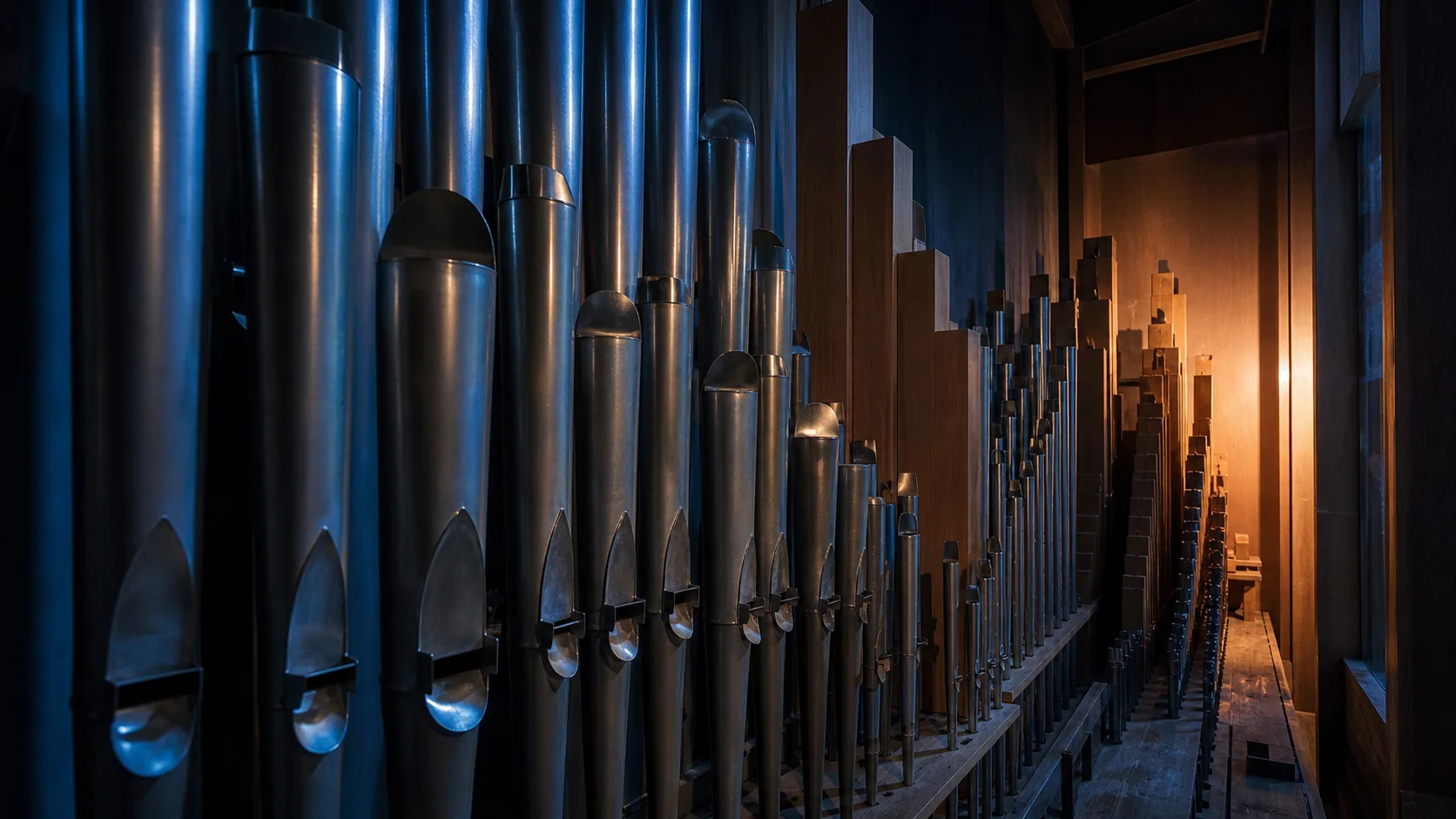
The archived Washington University account points to 1 file matching Opus 2. The first path is images/002/002_m.jpg. A matching number is useful provenance, but subject, photographer, date, and rights must still be checked against the image itself. The extracted captions do not settle either authorship or permission.
The evidence leaves Opus 2 after its documented setting at Washington University. A builder contract could settle the original brief; a current note from the institution could settle location and condition. Without either, the historical description ends where the source ends.