Robert Bergt Residence in the Opus 3 catalogue
The historical opus catalogue identifies Martin Ott Opus 3 with the Robert Bergt Residence in St. Louis, Missouri, and dates the project to 1975. It lists five stops, seven ranks, mechanical action, and a continuo design. That catalogue identity is the clearest starting point for the instrument's first documented home, even though the surviving detail page later shifts its attention to the workshop and a Kansas City owner.
The detail narrative introduces Robert Bergt as an artist-in-residence and Bach scholar at Concordia Seminary in St. Louis. Its sentence says that Opus 4 was commissioned by Bergt, which conflicts with the catalogue's assignment of the Bergt residence to Opus 3. The discrepancy is reported rather than silently corrected: the catalogue supplies the Opus 3 identity, while the detail page preserves a line that may refer to the paired instrument.
The Centennial Room workshop and the paired Opus 4
The builder account places the firm's first organ shop in the Centennial Room at Second Presbyterian Church in St. Louis. Opus 3 and Opus 4 were built there as two matching continuo organs. This workshop chapter connects the projects physically and helps explain why their later histories can be difficult to separate when one sentence on the Opus 3 page names Opus 4.
Both instruments had low cases made from solid white oak. The case height allowed the player to look over the organ toward a conductor, and the page says an organist could also conduct while standing at the keyboard. These are specific design claims from the builder narrative, not assumptions about every continuo organ produced by the company.
Five stops, seven ranks, and a continuo brief
The numerical overview gives Opus 3 five stops and seven ranks. Stops are the controls available to the player, while ranks are organized rows of pipes; the two extra ranks may indicate a compound resource, but the short overview does not identify one. No complete disposition survives in the material reviewed here, so individual flutes, principals, mutations, or couplers should not be supplied from a different Ott instrument.
The word continuo describes the intended musical role more clearly than the totals alone. A compact continuo organ can support singers and instrumentalists without blocking sightlines, which accords with the documented low case. The source does not provide programmes, ensemble names, wind pressure, temperament, or pipe count, so those parts of the tonal portrait remain open.
Mechanical action inside a low white-oak case
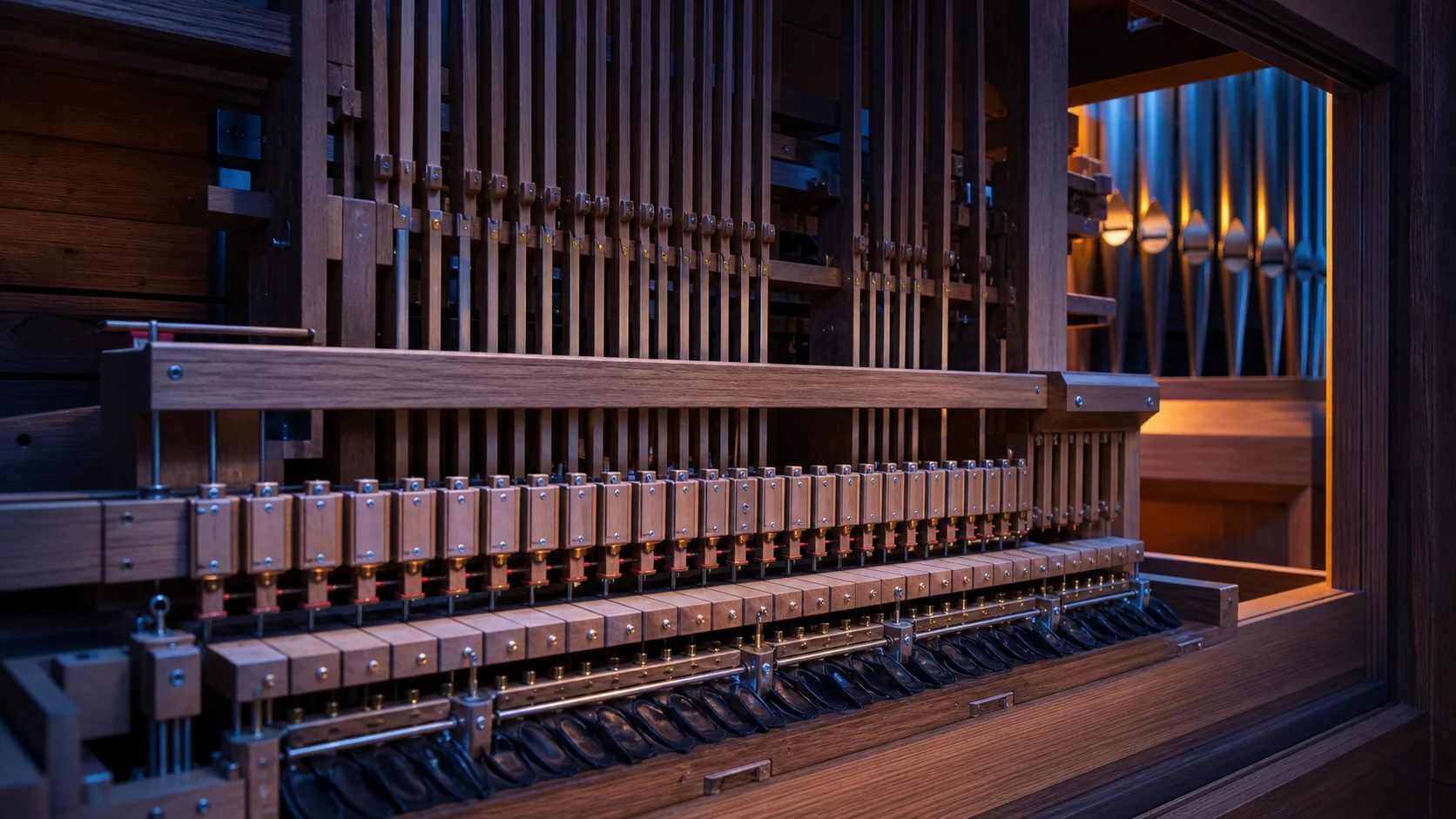
Opus 3 is listed with mechanical action, meaning the keys operate the wind valves through a physical linkage. That principle suits a small freestanding instrument, but the source gives no tracker layout, key dimensions, wind system, or present assessment of touch. The solid white-oak case and the player's view over it are documented; later adjustment and current mechanical condition are not.
Jeffrey Hon and the 2008 move into Kansas City
The detail page opens a second, clearly dated chapter when it states that Jeffrey Hon of Kansas City purchased the instrument in 2008. Read alongside the catalogue, that creates a movement from the Robert Bergt Residence in St. Louis to a later association with the Jeff Hon residence and the greater Kansas City area. The source does not name the seller, transport firm, purchase price, or an intermediate location.
Because the preceding sentence on the archived page mentions Opus 4, the pronoun 'this instrument' is not perfectly tidy. The page itself is headed Opus 3 and its image paths carry the 003 number, while the catalogue assigns Opus 3 to Bergt. Those clues support the Opus 3 reading, but the underlying wording should remain visible to future researchers.
A440, A415, and a rental continuo chapter
At the time of the 2008 purchase, the keyboard was altered so the organ could transpose between A440 and A415. Those pitch standards let one portable continuo serve modern-pitch ensembles and groups working at a lower historical pitch. The builder page then describes the instrument as a rental organ in the greater Kansas City area, giving the compact case a documented working life beyond a private residence.
The source does not explain the transposition mechanism or identify particular rentals, performers, recordings, or venues. It also does not confirm that the rental arrangement continues today. A dated inventory from the owner or a programme naming the organ would be needed before adding a later performance history.
Photographs, source ambiguity, and the unanswered present
The archived Opus 3 page links three files whose paths begin with images/003, including images/003/003_m1.jpg. Their numbering makes them strong identity candidates, but the extracted page provides no photographer credit, caption date, or reuse licence. Each file still needs visual comparison with the low white-oak case before publication.
A current account would need confirmation of ownership, location, playing condition, and the five-stop disposition. The responsible historical line is narrower: a 1975 catalogue identity at the Robert Bergt Residence, construction beside Opus 4 in the St. Louis workshop, and a later Jeffrey Hon and Kansas City chapter beginning in 2008. The conflicting Opus 4 sentence remains a source problem, not a reason to erase either stage.