How Opus 25 entered the history of Ravinia Park Festival
Martin Ott Opus 25 was a portable continuo built in 1983 for Ann Gerdom's residence. Ravinia Park Festival purchased it in 1993. The cherry case has a 50-note compass, solid raised panels, mechanical sticker action, and two sections that can be separated for transport.
The surviving account pairs Opus 25 with 1983. For the Ravinia Park Festival project in Highland Park, Illinois, without an event label, that pair is best read as catalogue chronology. The named place, Ravinia Park Festival in Highland Park, Illinois, gives the date its context; a programme or invoice could distinguish order from completion. No present-state conclusion follows.
What the Highland Park location tells us, and what it does not: Opus 25
The project is associated with Ravinia Park Festival, Highland Park, Illinois. A performance organisation is not automatically a single acoustic room, and a concert hall's name does not tell us its measured response. Event use, placement, and listening conditions are included only when the source provides dates or physical details.
What the numerical overview actually establishes for Opus 25
The Opus 25 overview lists 4 stop controls alongside 4 ranks. At Ravinia Park Festival in Highland Park, Illinois, a rank follows the keyboard compass at a given pitch and tone, whereas a stop may engage one rank or several. For Opus 25, the listed stop total equals the listed rank total. That does not by itself prove that the pipework follows a simple one-control, one-row scheme. Within the documented Highland Park chapter, names and pitches remain missing, so the musical reading stays deliberately limited.
The action named for Opus 25
For Opus 25 at Ravinia Park Festival, the project summary uses the term mechanical action. For the Ravinia Park Festival project in Highland Park, Illinois, in practice, that means the key movement reaches a wind valve through physical linkage rather than an electric-only command. The page for Ravinia Park Festival does not diagram that linkage or report its later maintenance.
Continuo is the second technical clue for Opus 25. The word usually points to a compact accompanying instrument, yet the Ravinia Park Festival account must still provide evidence for transport, pitch change, or concert use. No wheels, carrying handles, divided sliders, or transposing keyboard are added to this description unless they appear in the source.
A cautious musical reading for Ravinia Park Festival: Opus 25
The source adds a human and physical dimension to Opus 25: it was originally built for Ann Gerdom and it was purchased by Ravinia in 1993. A performance setting makes placement, sightlines, pitch, and ensemble use especially relevant, but relevance is not proof. Named events and physical observations remain separate from broader possibilities. Undocumented performers, programmes, and acoustic results are left out. The listed 4-stop, 4-rank scale remains the numerical boundary for this reading.
The chronology after the first commission: Opus 25
Transport wheels, fixed pipe caps, cone tuning, and screwed-down pipes were intended to protect the instrument in motion. The page records its use by Lyle Lovett and his Large Band during summer 2009. That engagement documents the former residential organ in a later public performance setting and gives the portability features a specific, dated musical context.
The photograph trail and the limits of the evidence: Opus 25
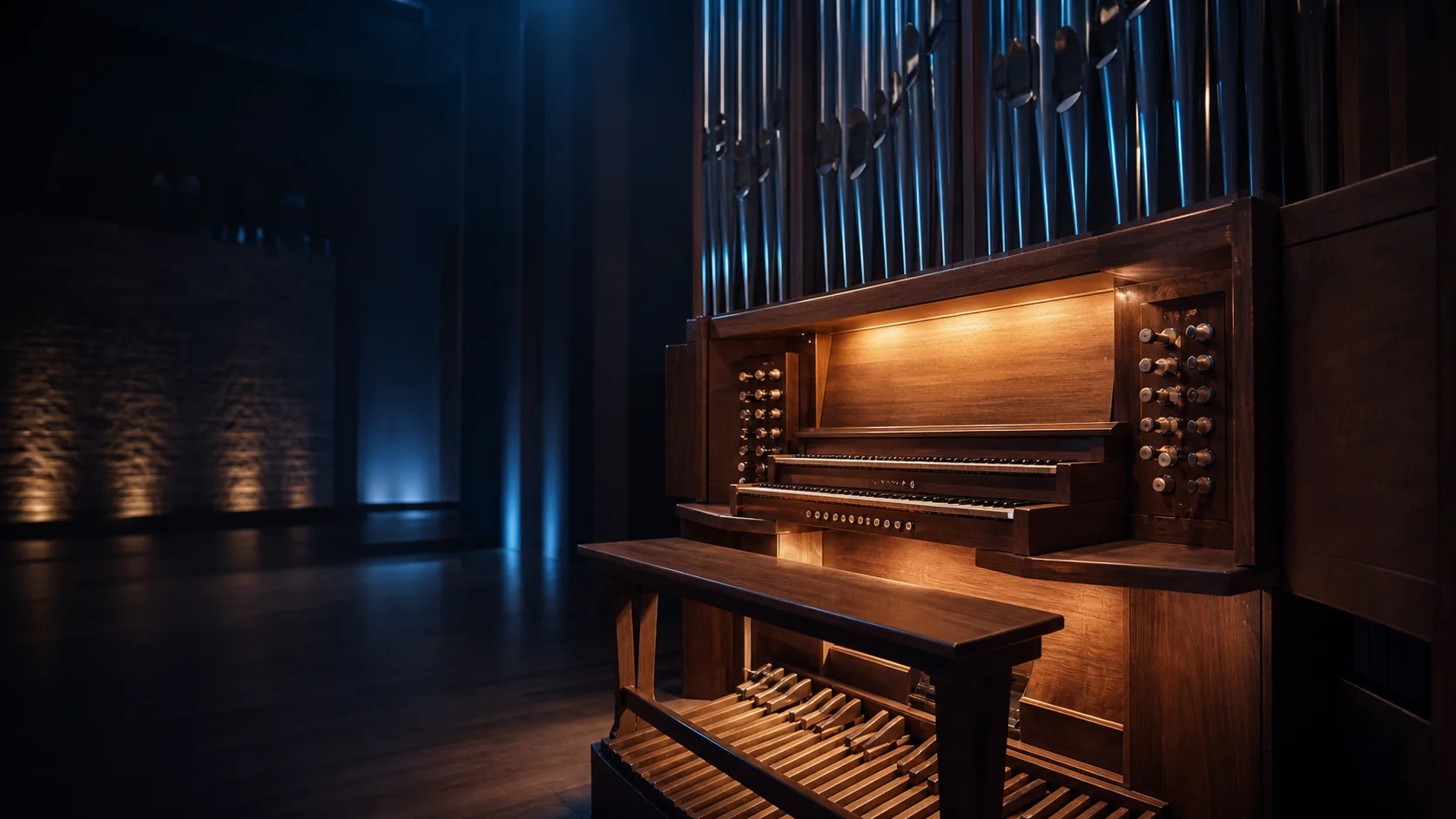
The image trail for Opus 25 breaks before a project-number match. Nothing in the extracted material securely identifies a photograph of the Highland Park, Illinois instrument. A substitute organ image would confuse atmosphere with evidence, so any illustration must say plainly that it is not a documentary view. The page also contains 1 link carrying a different opus number; those files are excluded as documentary images of Opus 25.
The archived narrative gives Opus 25 a history, not a current inspection. A new statement from Ravinia Park Festival could confirm whether the organ remains in Highland Park, Illinois and identify later work. At Ravinia Park Festival in Highland Park, Illinois, a dated stop list would then allow a responsible comparison with the original project.