Opus 26 in Shreveport: the documented commission
Martin Ott Opus 26 was a mechanical continuo built in 1983 for First United Methodist Church in Shreveport. The cherry case follows a baroque raised-panel design and carries a 50-note manual. Granadilla and white beech were used for the keys, with sticker action for both key and stop control.
The historical heading gives 1983 for Opus 26. That date is reported as written, not converted into a dedication or completion year. First United Methodist Church in Shreveport, Louisiana sets the scene, and later events remain separate when the source names them. The heading cannot establish current ownership, access, or condition.
First United Methodist Church as the documented place: Opus 26
The institution and city establish a parish context for Opus 26: First United Methodist Church, Shreveport, Louisiana. Architectural and placement details must come from the project narrative rather than the venue name alone. A contemporary account of use would add more than a generic description of church music.
Stops, ranks, and the limits of the specification: Opus 26
For Opus 26, the surviving numerical profile is 4 stops and 4 ranks. The first total belongs to registration and the second to organized pipe rows. The Opus 26 arithmetic is even: 4 stops and 4 ranks. Details of borrowing, extension, or compound construction must come from the missing specification. No unlisted reed, flute, string, mixture, manual division, or Pedal resource is added to fill the gaps.
How the documented command system works: Opus 26
For Opus 26 at First United Methodist Church, a direct physical key action is the technical fact recorded here. The wording identifies the operating principle without telling us the length of the trackers, the position of the keydesk, or the present quality of the touch. Those details need inspection or a later report.
The label continuo places Opus 26 in a compact accompanying tradition, not automatically on the road. For the instrument connected with First United Methodist Church, mobility and pitch standards remain separate facts. They are reported only where the Shreveport project history identifies casters, handles, two-part construction, or an A440 and A415 arrangement.
Design evidence beyond the recorded totals: Opus 26
Its documented features give Opus 26 an individual profile: it has a cherry raised-panel case and the record highlights a fifty-note manual compass. The commission belongs to a parish context, yet the surviving facts concern the build more than its weekly musical life. Without the disposition, the tonal resources cannot be mapped in detail. Without local programmes or service records, repertoire and patterns of use remain open. For the First United Methodist Church project in Shreveport, Louisiana, the listed 4-stop, 4-rank scale remains the numerical boundary for this reading.
Moves, music, and later work in the source: Opus 26
The instrument separates into upper and lower cases. The lower section contains the blower and five large Holzgedackt pipes; wheels and secured pipework support transport. No performer, owner change, or later alteration appears in the extract. The surviving history is a construction account of how a mechanical organ was divided and made movable.
What a future source could clarify about First United Methodist Church: Opus 26
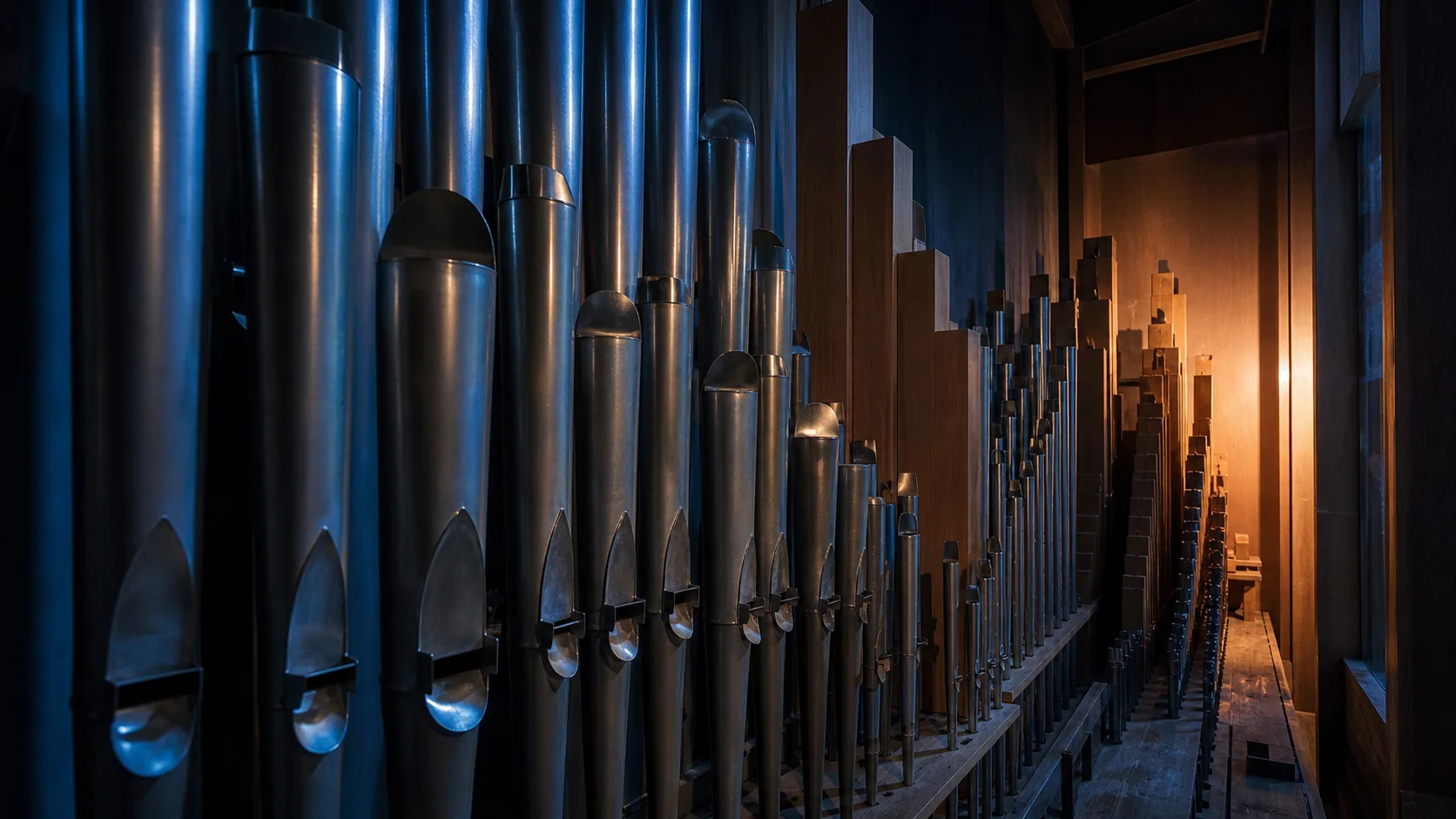
The image list for Opus 26 contains 1 project-number match, led by images/026/026_m.jpg. Numbering makes the files relevant to identification, but it does not provide a licence or guarantee that every view shows the same stage of the instrument. Photographer, date, and publication permission remain unrecorded in the extracted text.
The present chapter of Opus 26 is not covered by the builder account. Location, access, and technical condition would need confirmation from First United Methodist Church or a qualified survey. Until then, the last historical event should remain the end of the public narrative.