The instrument associated with the Walter Pelz residence: Opus 27
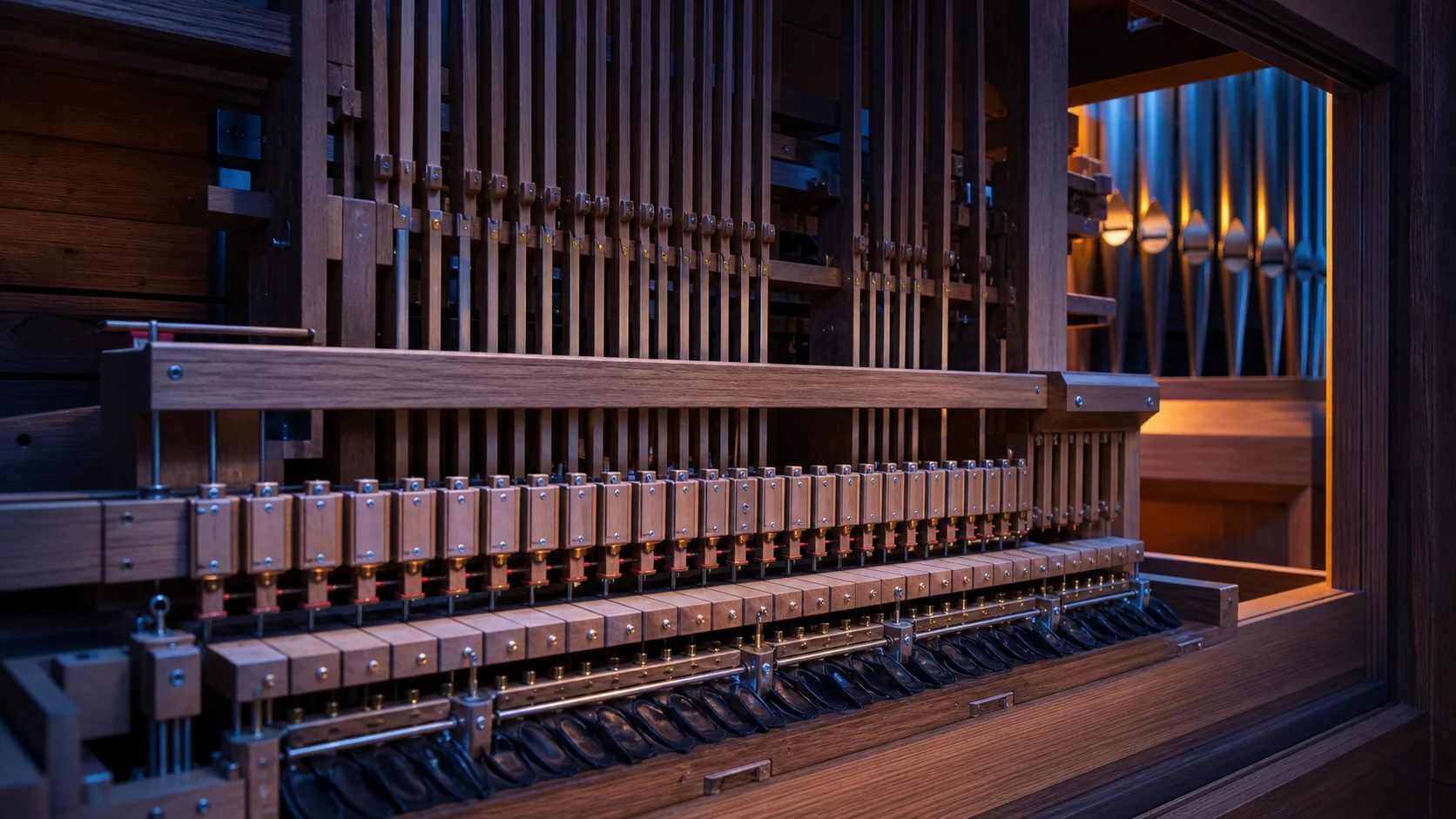
Martin Ott Opus 27 was a three-manual house organ built in 1983 for Walter Pelz and his wife in Lindsborg, Kansas. The lowest keyboard couples the upper two manuals. Its white-oak case is under eight feet tall, and the page says the instrument was intended to support composition.
The project material attaches 1983 to Opus 27. Within the documented Lindsborg chapter, it does not label that figure as the contract, completion, installation, or dedication date. The firm coordinates are the Walter Pelz residence and Lindsborg, Kansas; a dated programme or contract could narrow the sequence. Nothing in the year recorded for the Walter Pelz residence alone establishes the present site or playing condition.
The room question behind Opus 27
Opus 27 is documented in connection with the Walter Pelz residence in Lindsborg, Kansas. The domestic context helps explain why footprint, sightline, or mobility might matter when the source names those features. It does not permit a reconstructed room description, an assumed repertoire, or a present-day access statement.
Reading the numerical outline for the Walter Pelz residence: Opus 27
The surviving overview gives 6 stops and 5 ranks. In the Walter Pelz residence account from Lindsborg, Kansas, a stop is the named control available to the player; a rank is a set of pipes following the compass at one pitch and tone colour. Opus 27 lists 1 more stop than ranks. At the Walter Pelz residence in Lindsborg, Kansas, shared or extended pipework can produce that pattern, but these two numbers do not reveal the borrowing scheme. For the Walter Pelz residence project in Lindsborg, Kansas, manual divisions, pedal resources, pitches, and individual stop names are needed before anyone can describe the tonal design in detail.
The numerical line for Opus 27 offers a practical point of comparison for future research at the Walter Pelz residence. If a later stop list appears, its divisions and pitches can be checked against 6 stops | 5 ranks Mechanical action. At the Walter Pelz residence in Lindsborg, Kansas, any difference might mark an alteration, a relocation, or a correction to the old summary. For the Walter Pelz residence project in Lindsborg, Kansas, until such a document is dated and attributed, the surviving figures remain the safest description of scale.
Touch, control, and the missing technical detail: Opus 27
For Opus 27 at the Walter Pelz residence, the overview identifies mechanical action, meaning that motion at a key is carried through a physical linkage toward the valve admitting wind to the pipework. That wording describes the command path, not the case layout, linkage geometry, or present touch. It also does not prove that the stop controls were mechanical unless the page says so separately.
What the project facts suggest, cautiously: Opus 27
Two documented details frame this project: it has a three-manual arrangement and the lowest keyboard couples the upper manuals. In a residence, dimensions, case materials, transposition, and mobility can shape the practical value of a small organ. Only features named in the project history are attached to this instrument. The private setting does not justify assumptions about repertoire, frequency of use, or where the organ stands today. The listed 6-stop, 5-rank scale remains the numerical boundary for this reading.
What happened after the organ was built: Opus 27
Pelz received several commissions for contemporary organ music from Martin Ott. A caption dates a photograph of him at the console to December 6, 2011. The coupling scheme and compact case gave a domestic instrument three-manual possibilities, while the later photograph connects that design directly with the composer's work at the keyboard.
Where the evidence stops for Opus 27
The historical page for Opus 27 links 3 matching image files, beginning with images/027/027_m.jpg. The filename connects the material with the page for the Walter Pelz residence, but it does not grant publication rights. A caption contains credit wording; the creator, licence, date, and permitted use still need confirmation.
The last named event in the Opus 27 history is still a historical marker, not a report on the instrument today. A current note from the Walter Pelz residence could establish location and condition. A dated stop list would let readers compare the surviving specification with the Lindsborg project as it now stands.