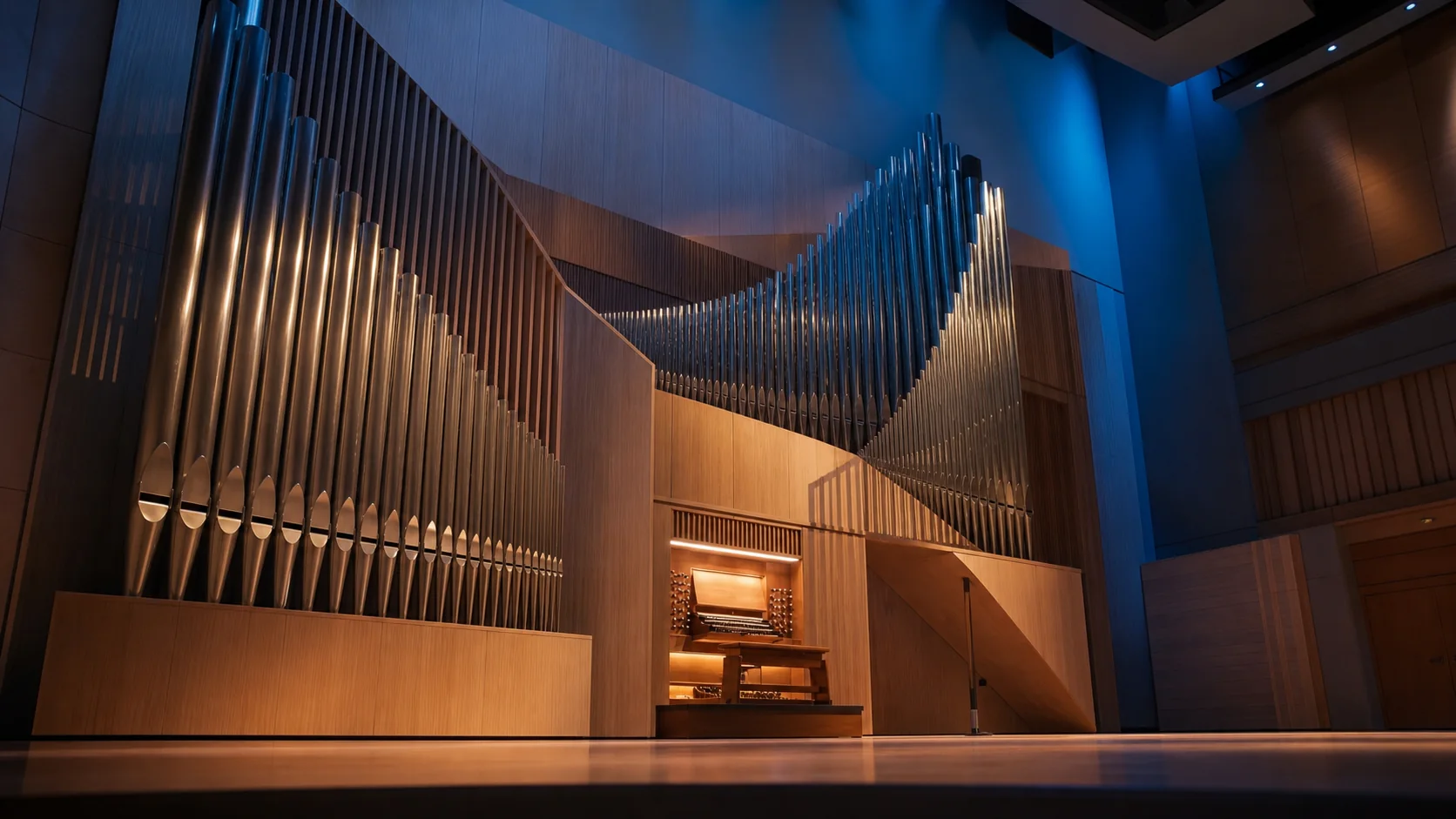
The instrument associated with Lutheran Church of the Redeemer: Opus 39
Martin Ott Opus 39 was a four-stop mechanical continuo built in 1986 for Lutheran Church of the Redeemer in Atlanta. Its cherry raised-panel case has a 50-note manual, granadilla naturals, white-beech sharps, and sticker action for key and stop control.
The surviving chronology begins with 1986 beside Opus 39. In the Lutheran Church of the Redeemer account from Atlanta, Georgia, no day, month, or event label accompanies that year. Lutheran Church of the Redeemer in Atlanta, Georgia fixes the historical setting, but a contract or dedication programme would be needed for a tighter sequence. At Lutheran Church of the Redeemer in Atlanta, Georgia, the entry does not answer present access or condition.
The room question behind Opus 39
For Opus 39, the geographic anchor is Lutheran Church of the Redeemer in Atlanta, Georgia. The church setting gives the Atlanta project a clear institutional frame, yet it cannot stand in for evidence about liturgy, repertoire, access, or sound. Unless a recital, hymn event, placement, or acoustic observation appears in the Atlanta project history, those details should remain unstated.
Reading the numerical outline for Lutheran Church of the Redeemer: Opus 39
A total of 4 stops and 4 ranks is attached to Opus 39. For the Lutheran Church of the Redeemer project in Atlanta, Georgia, the first figure belongs to the console controls and the second to sets of pipes, so the numbers should not be treated as synonyms. Opus 39 has equal listed counts for stops and ranks. The equality alone cannot identify borrowed pipes or a stop made from several rows. At Lutheran Church of the Redeemer in Atlanta, Georgia, they provide a useful scale marker while leaving voicing, wind pressure, pipe count, and division layout unresolved.
Touch, control, and the missing technical detail: Opus 39
For Opus 39 at Lutheran Church of the Redeemer, the action is recorded as mechanical. In the Lutheran Church of the Redeemer account from Atlanta, Georgia, that tells us how the key command began its journey to a pipe valve; it does not tell us how the stops operated, how the console sat in the room, or how the mechanism has aged. Within the documented Atlanta chapter, historic action type and current playing condition are not the same claim.
At Lutheran Church of the Redeemer, Opus 39 is described as a continuo organ. For the Lutheran Church of the Redeemer project in Atlanta, Georgia, that says more about scale and accompanying purpose than about the case hardware. In the Lutheran Church of the Redeemer account from Atlanta, Georgia, a continuo can be movable, but this page does not assume wheels, handles, divided stops, or transposition without a specific sentence in the historical account.
What the project facts suggest, cautiously: Opus 39
For Lutheran Church of the Redeemer, the strongest surviving clues are concrete: it has a cherry raised-panel case and the record highlights a fifty-note compass. At Lutheran Church of the Redeemer in Atlanta, Georgia, the worship setting makes pipe placement and support for singers relevant to the design. For the Lutheran Church of the Redeemer project in Atlanta, Georgia, the archived account does not describe the complete tonal balance or document day-to-day use. Contemporary parish records, a stop list for Lutheran Church of the Redeemer, or a dedication booklet could supply that missing musical context. Within the documented Atlanta chapter, the listed 4-stop, 4-rank scale remains the numerical boundary for this reading.
What happened after the organ was built: Opus 39
The page documents cone tuning, pipe-mouth ears, a removable Regal made from tin-lead alloy, two-piece construction, and transport wheels. The Regal could be exchanged with a Quinte, while pipes were fastened to reduce movement in transit. No recital, named performer, consultant, or later ownership history appears; the source concentrates on an adaptable instrument designed for travel between different performance venues.
Where the evidence stops for Opus 39
None of the surviving image paths carries the Opus 39 number. The visual identity of the instrument at Lutheran Church of the Redeemer is therefore unresolved. Publication should wait for an identified photograph with clear rights, or use a visibly non-documentary illustration. The page also contains 1 link carrying a different opus number; those files are excluded as documentary images of Opus 39.
For Opus 39, the open end of the story lies in Atlanta, Georgia. The historical account does not say whether the instrument at Lutheran Church of the Redeemer remains accessible or unchanged. A dated survey from Lutheran Church of the Redeemer could confirm the present specification and separate surviving fabric from later work.