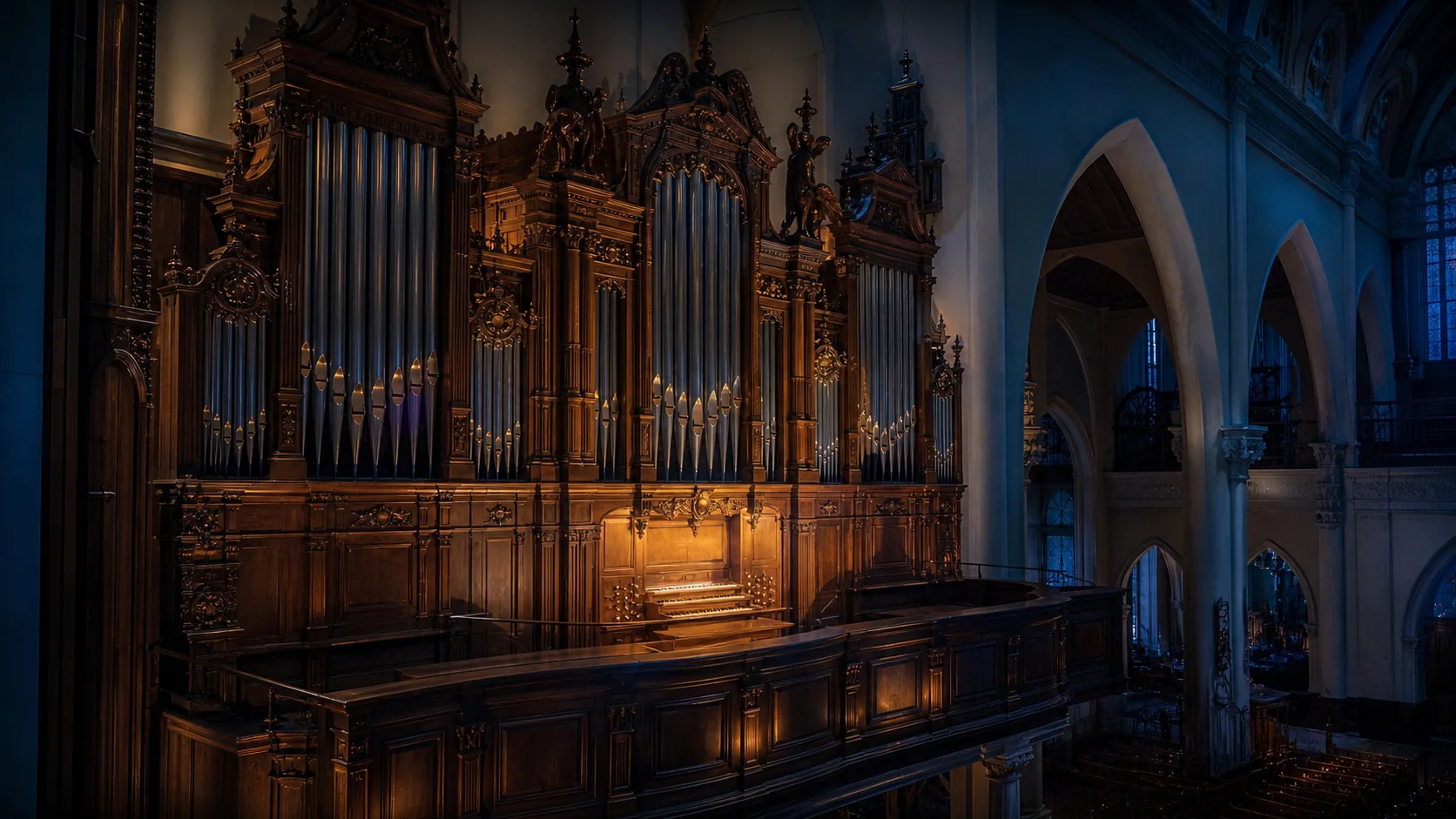
The instrument associated with St. David Episcopal Church: Opus 45
Martin Ott Opus 45 was built in 1987 for St. David's Episcopal Church in Aurora, Illinois. The wooden sanctuary allowed only a small choir beside the balcony organ. Its red-oak case has an attached keydesk, and the manuals share a common windchest. Paul Milliman led the organ committee.
The project material attaches 1987 to Opus 45. In the St. David Episcopal Church account from Aurora, Illinois, it does not label that figure as the contract, completion, installation, or dedication date. The firm coordinates are St. David Episcopal Church and Aurora, Illinois; a dated programme or contract could narrow the sequence. Nothing in the year recorded for St. David Episcopal Church alone establishes the present site or playing condition.
The room question behind Opus 45
The builder page places the project at St. David Episcopal Church in Aurora, Illinois, which identifies a worship setting rather than a recital hall or private house. In the St. David Episcopal Church account from Aurora, Illinois, that distinction matters, but it does not supply an acoustic survey. The builder account for St. David Episcopal Church gives no verified room volume, surface plan, seating figure, or reverberation time. At St. David Episcopal Church in Aurora, Illinois, it is therefore reasonable to discuss the church context while leaving the sound of the room undescribed.
Reading the numerical outline for St. David Episcopal Church: Opus 45
The surviving overview gives 16 stops and 20 ranks. In the St. David Episcopal Church account from Aurora, Illinois, a stop is the named control available to the player; a rank is a set of pipes following the compass at one pitch and tone colour. Opus 45 therefore has 4 more listed ranks than stops. Compound stops are one possible reason, but the totals recorded for St. David Episcopal Church do not identify the affected controls. For the St. David Episcopal Church project in Aurora, Illinois, manual divisions, pedal resources, pitches, and individual stop names are needed before anyone can describe the tonal design in detail.
Touch, control, and the missing technical detail: Opus 45
For Opus 45 at St. David Episcopal Church, the overview identifies mechanical action, meaning that motion at a key is carried through a physical linkage toward the valve admitting wind to the pipework. Within the documented Aurora chapter, that wording describes the command path, not the case layout, linkage geometry, or present touch. It also does not prove that the stop controls were mechanical unless the page for St. David Episcopal Church says so separately.
What the project facts suggest, cautiously: Opus 45
Two documented details frame this project: it was placed on a balcony in a small wooden sanctuary and it has a red-oak case with attached keydesk. The documented facts from St. David Episcopal Church belong to a church commission, where registration and placement may affect how voices are supported. They do not establish the complete tonal plan or show how the congregation used the instrument at St. David Episcopal Church. A stop list for St. David Episcopal Church, programme, or dated building account would allow a closer musical reading. The listed 16-stop, 20-rank scale remains the numerical boundary for this reading.
What happened after the organ was built: Opus 45
Robert Reeves played the dedicatory recital on May 21, 1989, followed by a reception hosted by Rosalie Cassiday. The page also connects Cassiday with the purchases of Opus 30 and Opus 106. That cross-reference places the St. David's project within a wider regional relationship while the balcony description records the immediate space constraint.
Where the evidence stops for Opus 45
The historical page for Opus 45 links 1 matching image file, beginning with images/045/045_m.jpg. The filename connects the material with the page for St. David Episcopal Church, but it does not grant publication rights. Within the documented Aurora chapter, no usable creator and licence statement appears in the extracted caption material.
The last named event in the Opus 45 history is still a historical marker, not a report on the instrument today. A current note from St. David Episcopal Church could establish location and condition. A dated stop list would let readers compare the surviving specification with the Aurora project as it now stands.