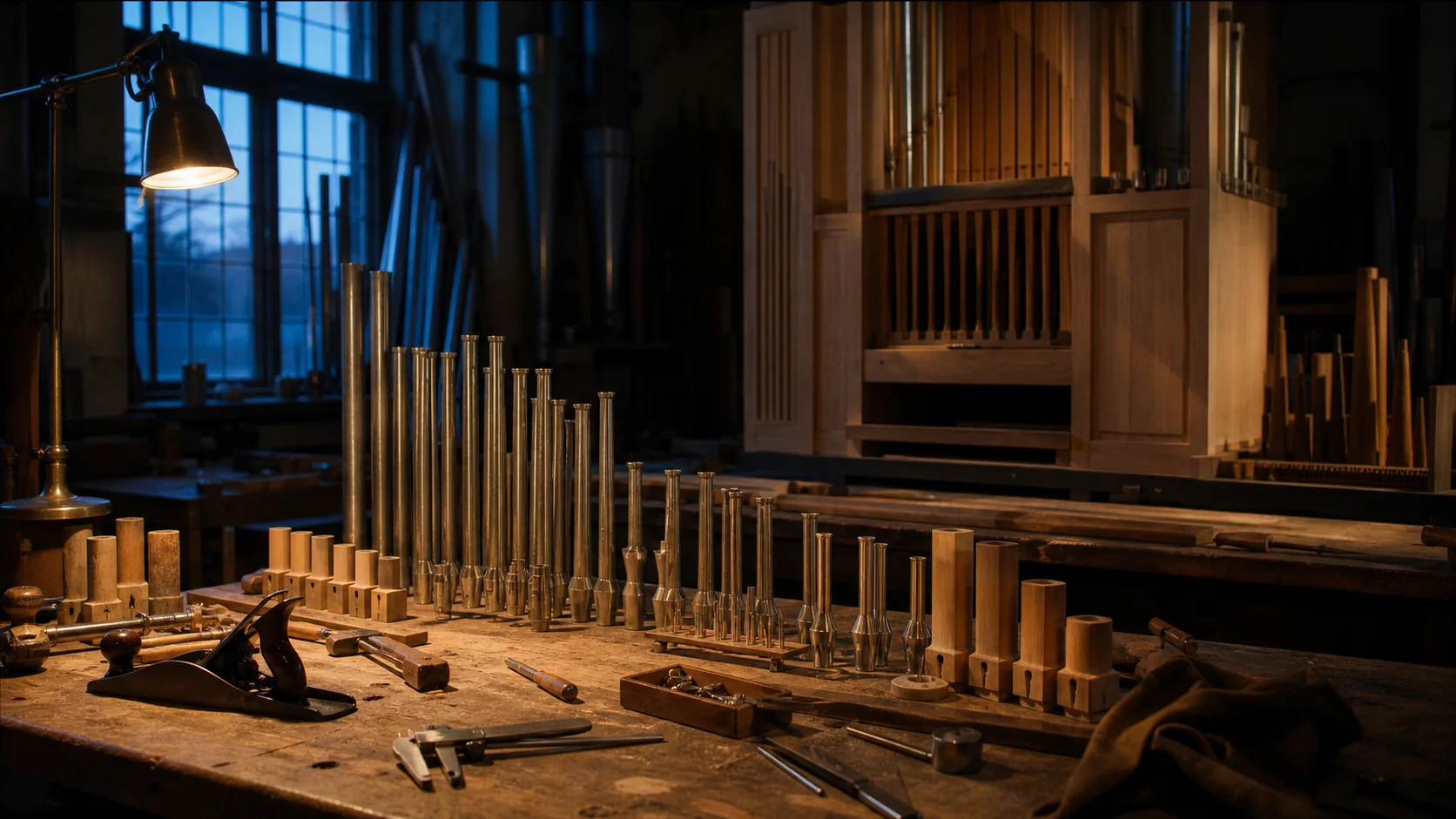
The 1989 project at Wisconsin Lutheran Seminary: Opus 54
Martin Ott Opus 54 was built in 1989 for Wisconsin Lutheran Seminary in Mequon. Its solid red-oak case uses quarter-sawn raised panels and an attached keydesk. The first position blocked three stained-glass windows. During the 2004 to 2005 chapel renovation, the architect moved the organ opposite the glass and restored the windows to view.
The project material attaches 1989 to Opus 54. For the Wisconsin Lutheran Seminary project in Mequon, Wisconsin, it does not label that figure as the contract, completion, installation, or dedication date. The firm coordinates are Wisconsin Lutheran Seminary and Mequon, Wisconsin; a dated programme or contract could narrow the sequence. Nothing in the year recorded for Wisconsin Lutheran Seminary alone establishes the present site or playing condition.
Reading the setting in Mequon, Wisconsin: Opus 54
Opus 54 is tied to Wisconsin Lutheran Seminary, Mequon, Wisconsin. For the Wisconsin Lutheran Seminary project in Mequon, Wisconsin, the institutional title is useful because it separates an academic project from a parish or residence instrument. It does not reveal whether the instrument at Wisconsin Lutheran Seminary stood in a studio, chapel, classroom, or hall unless the narrative says so. No the current condition of the Mequon instrument or access claim follows from the historic association.
Scale in figures: the stops and ranks of Opus 54
The surviving overview gives 20 stops and 25 ranks. For the Wisconsin Lutheran Seminary project in Mequon, Wisconsin, a stop is the named control available to the player; a rank is a set of pipes following the compass at one pitch and tone colour. Opus 54 therefore has 5 more listed ranks than stops. Compound stops are one possible reason, but the totals recorded for Wisconsin Lutheran Seminary do not identify the affected controls. At Wisconsin Lutheran Seminary in Mequon, Wisconsin, manual divisions, pedal resources, pitches, and individual stop names are needed before anyone can describe the tonal design in detail.
The numerical line for Opus 54 offers a practical point of comparison for future research at Wisconsin Lutheran Seminary. If a later stop list appears, its divisions and pitches can be checked against 20 stops | 25 ranks Mechanical action & stop action. Within the documented Mequon chapter, any difference might mark an alteration, a relocation, or a correction to the old summary. At Wisconsin Lutheran Seminary in Mequon, Wisconsin, until such a document is dated and attributed, the surviving figures remain the safest description of scale.
From the keyboard into the organ: Opus 54
For Opus 54 at Wisconsin Lutheran Seminary, the overview identifies mechanical action, meaning that motion at a key is carried through a physical linkage toward the valve admitting wind to the pipework. In the Wisconsin Lutheran Seminary account from Mequon, Wisconsin, that wording describes the command path, not the case layout, linkage geometry, or present touch. It also does not prove that the stop controls were mechanical unless the page for Wisconsin Lutheran Seminary says so separately.
The detail that gives Opus 54 its character
Two documented details frame this project: it has a solid red-oak case and the record highlights quarter-sawn raised panels. At Wisconsin Lutheran Seminary, specification and access can serve very different kinds of work, from individual practice to recital. A named function can be reported when the Mequon project history supplies it; the institution label alone is not enough. The evidence from Wisconsin Lutheran Seminary does not reconstruct curriculum, repertoire, teaching practice, or current availability. The listed 20-stop, 25-rank scale remains the numerical boundary for this reading.
Later events named in the Opus 54 account
James Tiefel represented the seminary and Edward Meyer served as consultant. Captions credit Caleb Bassett and Ian Welch with a 90-minute film about the instrument. The film followed the architectural relocation and provides a separate documentary record of the organ after its case found a new position in the chapel.
Images, sources, and the open questions for Opus 54
The historical page for Opus 54 links 5 matching image files, beginning with images/054/054_m.jpg. The filename connects the material with the page for Wisconsin Lutheran Seminary, but it does not grant publication rights. In the Wisconsin Lutheran Seminary account from Mequon, Wisconsin, a caption contains credit wording; the creator, licence, date, and permitted use still need confirmation.
The last named event in the Opus 54 history is still a historical marker, not a report on the instrument today. A current note from Wisconsin Lutheran Seminary could establish location and condition. A dated stop list would let readers compare the surviving specification with the Mequon project as it now stands.