Hope Presbyterian Church in the Opus 55 catalogue
The historical opus catalogue identifies Martin Ott Opus 55 with Hope Presbyterian Church in Springfield, Illinois. It lists 15 stops, 18 ranks, and mechanical action, but supplies no commission year. That institutional line gives the project a name and city; it does not establish where the organ stands now, whether it remains playable, or whether its specification later changed.
This identity has to be read beside the archived Opus 55 detail page, whose extracted identity field is blank. The two sources are not merged as though both contained the same information. Hope Presbyterian Church and Springfield come from the catalogue, while the physical description below comes from the detail narrative.
Why the Opus 55 detail page remains incomplete
The detailed builder page begins with a technical overview rather than an institution, city, or date. Its short history refers only to 'this small, intimate worship house.' That wording is consistent with a church setting, but it does not independently name Hope Presbyterian Church. The catalogue supplies the identification; the detail page supplies the room-scale description.
No dedication, organist, builder's representative, recital, relocation, or later repair appears in the surviving text. The gap is important because a blank heading can reflect an unfinished page as easily as a missing historical fact. A dated church document would be needed to connect the catalogue identity and detail narrative more securely.
Fifteen stops and eighteen ranks
Both the catalogue and the detail overview give Opus 55 a scale of 15 stops and 18 ranks. Stops are the controls selected at the console, while ranks are rows of pipes. The three-rank difference may reflect one or more compound resources, but the totals do not reveal which controls drew more than one row.
A complete stop list would show the division plan, pitches, couplers, and individual voices. Without it, the article cannot responsibly name a principal chorus, flute family, reed, mixture, manual compass, or Pedal disposition. The two matching totals are useful corroboration, not a substitute for the missing specification.
Mechanical action and main-floor placement
The sources describe mechanical action, in which key movement reaches the wind valves through a physical linkage. The detail page also places the instrument on the main floor rather than a balcony. Together those facts offer a modest technical and spatial outline, but they do not reveal tracker lengths, keydesk arrangement, wind pressure, maintenance history, or present touch.
Main-floor placement can shape how a case meets a congregation and a room, yet the page provides no plan, measurements, seating count, or acoustic data. The phrase 'small, intimate worship house' remains the builder's description. It should not be expanded into an invented sanctuary layout or an unsupported account of how the organ sounds there.
A red-oak case in a small worship house
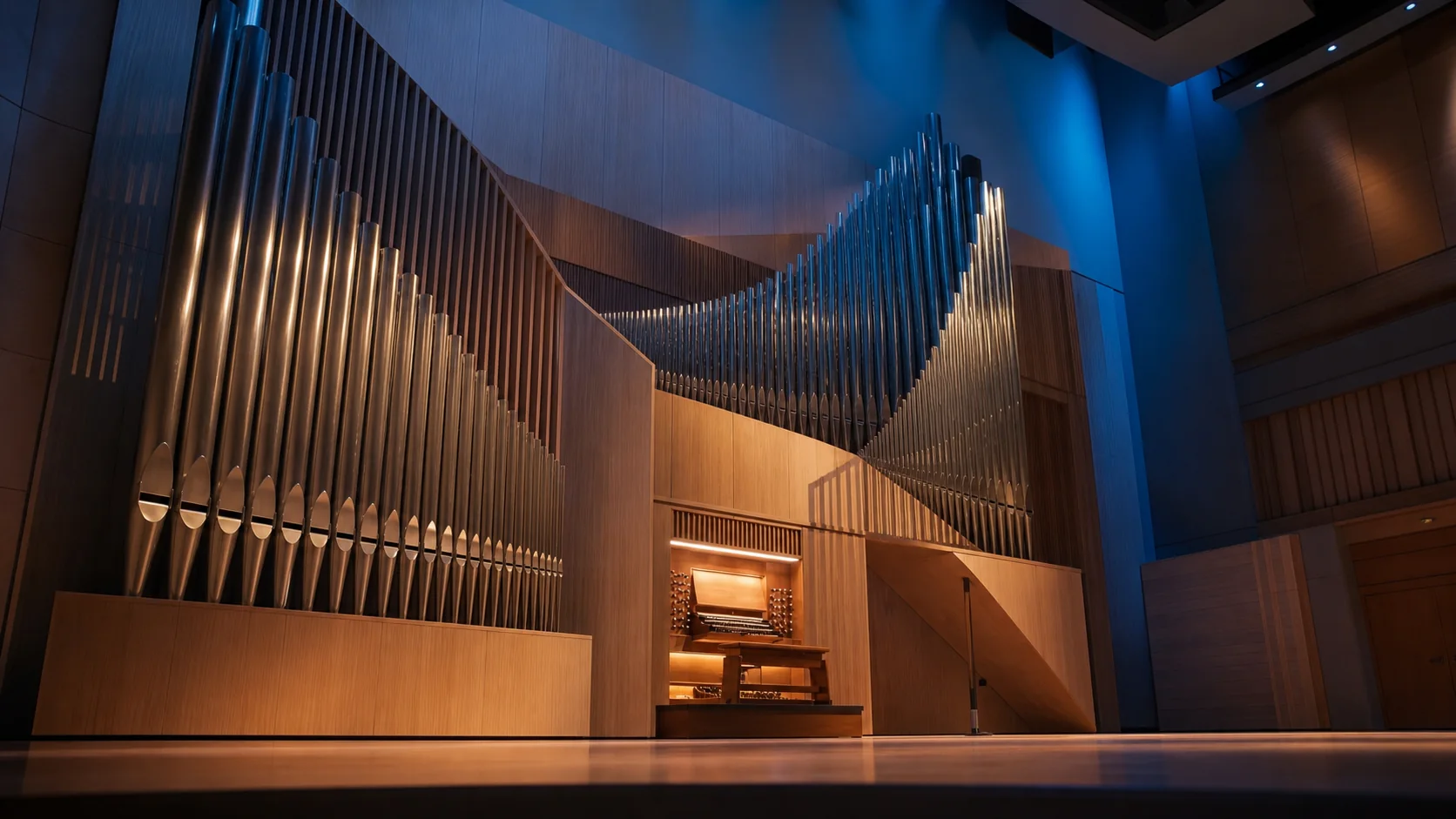
Red oak is the only case material named for Opus 55. The detail page does not describe the facade, pipe arrangement, carving, finish, dimensions, or relationship to the room's architecture. A verified photograph could answer some of those visual questions, but the material alone cannot identify a style or prove that the case remains unchanged.
The small-room description gives the project human scale without supplying a musical programme. Worship accompaniment, choir support, teaching, and recital use are all possible in such a setting, but none is documented here. The article therefore keeps the case and placement facts separate from assumptions about repertoire or frequency of use.
Scott Riedel's documented consultant role
The detail narrative names Scott Riedel as acoustical consultant. That credit is specific and worth retaining, but the page gives no report, design recommendation, measurement, or date for his work. It does not say that he drew the stop list, voiced the pipes, designed the case, or supervised later maintenance.
A consultant's name points toward another possible source trail. Church minutes, correspondence, a dedication booklet, or a project file might explain how placement and room response were considered. Until such material is found, Riedel's role should be stated exactly at the level the builder page supports.
Photographs, rights, and the missing chronology
The archived page links images/055/055_m.jpg and images/055/055_d.jpg. Their 055 paths make them direct Opus 55 candidates, but the extracted text includes no photographer, caption, date, or reuse licence. They should be checked against the red-oak case and cleared for publication before they appear as historical illustrations.
The known account ends without a commission year or later chronology. Hope Presbyterian Church in Springfield, Illinois is the catalogue identity; main-floor placement, red-oak casework, the small worship setting, and Scott Riedel's consultant credit belong to the detail page. A current church statement and dated stop list would be needed to confirm location, access, condition, and any later work.