Martin Ott Opus 59 at Lake Edge Lutheran Church
Martin Ott Opus 59 was commissioned in 1989 for Lake Edge Lutheran Church in Madison, Wisconsin. The specification describes a mechanical-action organ with 19 stops and 23 ranks.
Reading the sanctuary: Lake Edge's fieldstone sanctuary
The setting for Opus 59 was a contemporary sanctuary built with fieldstone walls and large side windows that brought daylight toward the front of the room. The altar stood at the center, with seating arranged on three sides. The organ and choir occupied the front wall behind the altar, making them part of the same visual field as the worship space. Lake Edge Lutheran Church in Madison, Wisconsin gave Opus 59 its architectural setting. A church organ shares the room with singers and worshippers, so case position and sight lines belong to the musical story whenever the project description names them.
The room is best read through concrete clues: case position, nearby architecture and the player's relation to other musicians. Opus 59 should not be assigned a reverberation profile from appearance alone.
19 stops and 23 ranks: the scale of Opus 59
The catalogue figures for Opus 59 read 19 stops and 23 ranks. One total counts the player's controls, the other the pipe sets available behind them. The scale sits between a practice organ and the largest church installations. It leaves open how the builder divided resources among principals, flutes and reeds. The overview leaves the number of keyboards unspecified. A stop-by-stop account of Opus 59 must wait for the complete disposition.
Opus 59 has 4 more ranks than stops. A mixture or another compound resource may account for part of the gap, though the short summary does not locate it. For Opus 59, the arithmetic is a useful check on the missing stoplist.
Keys and windchests: Lake Edge's fieldstone sanctuary
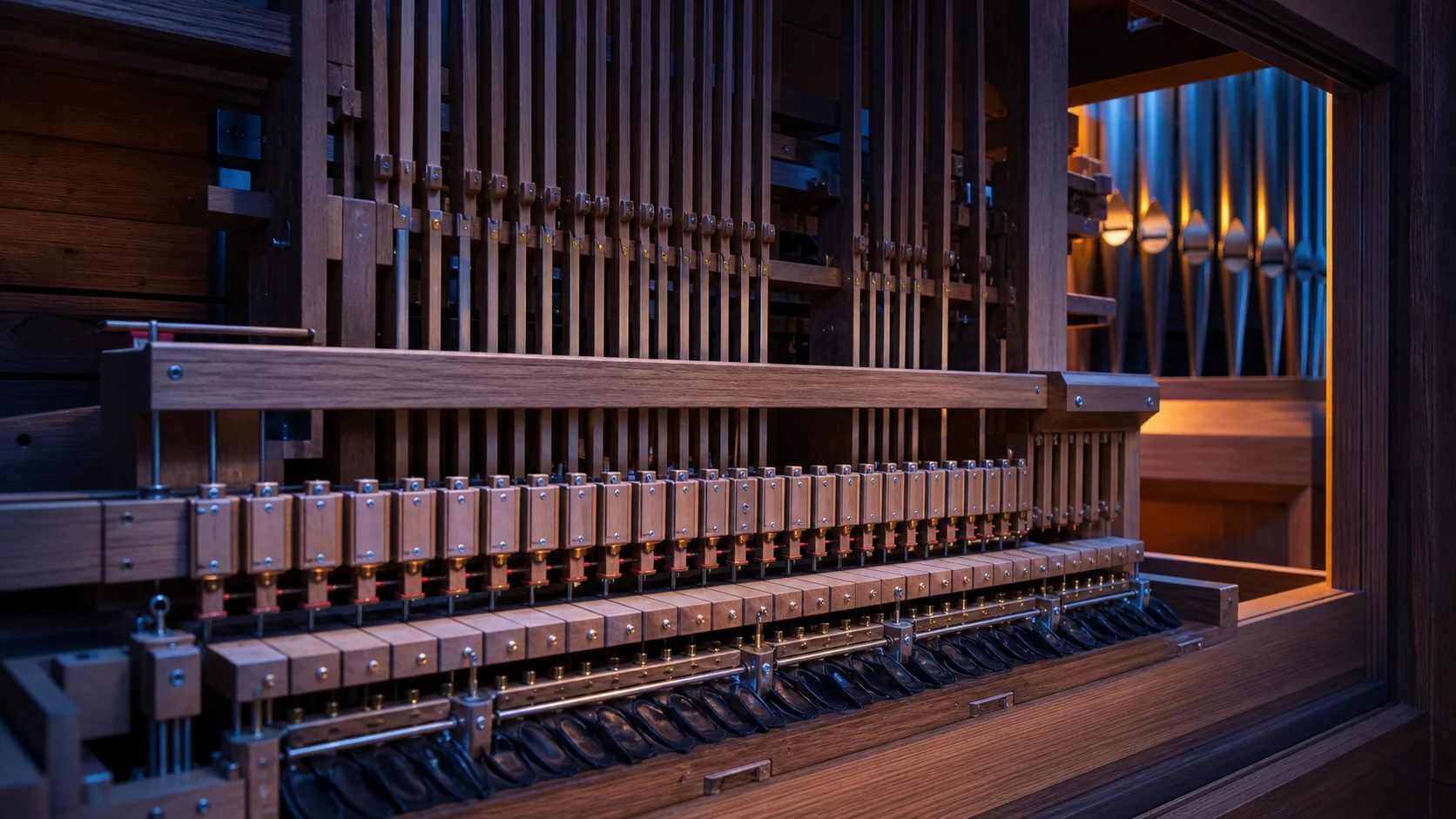
In Opus 59, the player reached the windchest through a physical key linkage rather than an electrical key signal. That is the essential meaning of mechanical action. It cannot tell us how the finished keyboard felt or how the action has worn since installation.
An attached console makes the case itself the player's workstation. For Opus 59, that fact is documented even though key depth and touch weight are not.
The organ as an object: Lake Edge's fieldstone sanctuary
Red oak was used for the case, and the keydesk was attached directly to it. The page therefore connects the organ's architecture, its red oak case, and Manz's recital in one concise commission history. The materials and placement named here make the commission recognizable in photographs. They do not amount to a pipe-by-pipe inventory or a full set of shop drawings for Opus 59.
A clear project photograph may verify timber, placement and facade rhythm. Windchests, trackers and enclosed divisions of Opus 59 remain partly hidden from that view.
Musical life around the instrument: Lake Edge's fieldstone sanctuary
Martin Ott Opus 59 received its dedicatory recital on May 19, 1991, played by Paul Manz. The musical story at Lake Edge Lutheran Church begins where the account names a player, a recital or a reason for the commission. Regular service use and later concerts need their own documentation. Its subsequent concert life is not described.
The musical event named on the page supplies a date that can be checked against local records. It leaves room for a longer chronology of Opus 59.
Evidence, images and unanswered questions for Opus 59
For Opus 59, the closest source is the former builder's project page dated February 6, 2020. It links 1 image from the corresponding project directory. Together they form the visual record published beside Opus 59. The page does not name a photographer for the listed views. Uncaptioned views remain broadly labeled, and the old page cannot answer questions about later alterations. Dated photographs or an institutional inventory could continue the story.