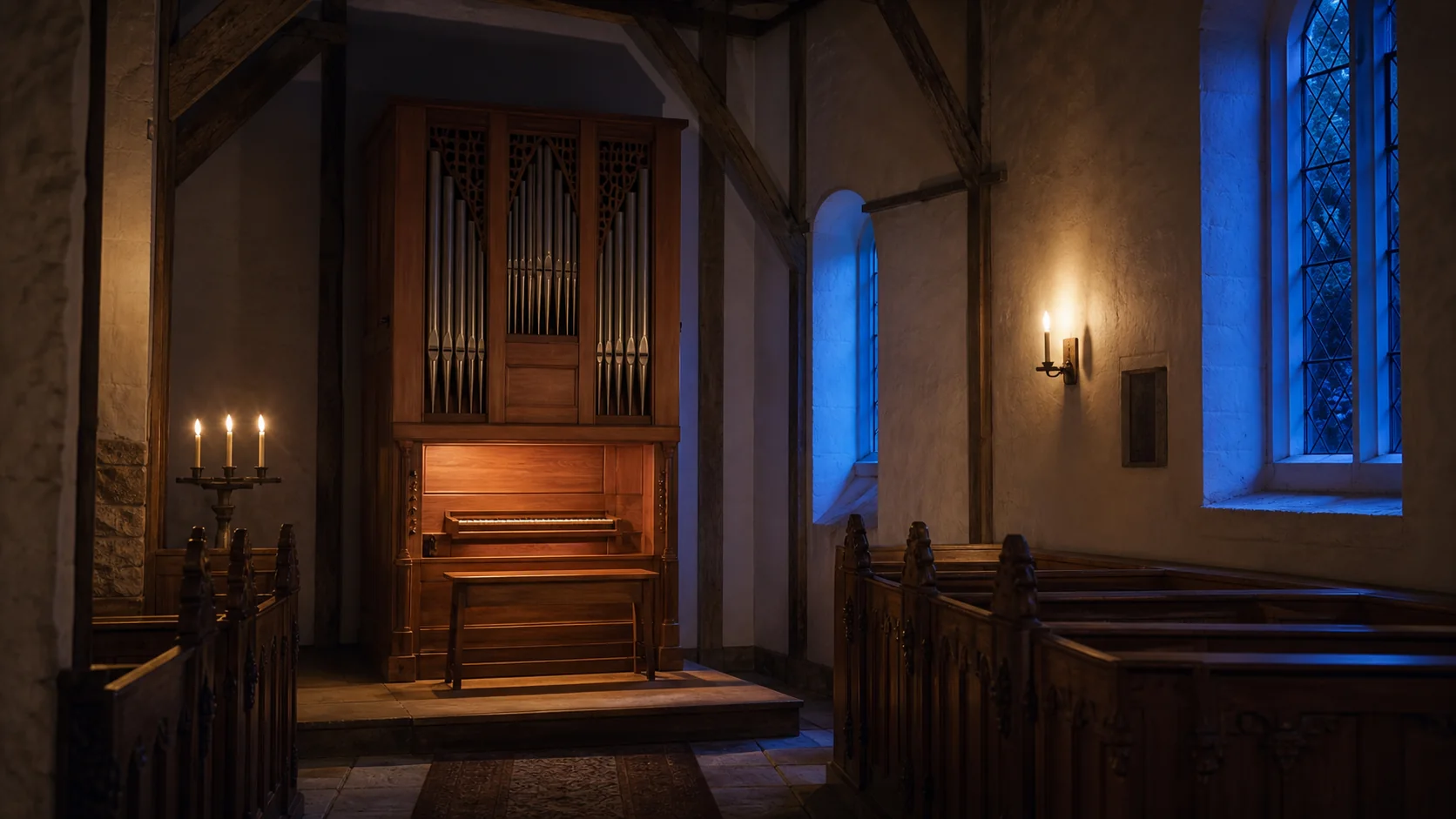
Martin Ott Opus 60 at St. John's Lutheran Church
Martin Ott Opus 60 was commissioned in 1989 for St. John's Lutheran Church in Decatur, Illinois. The specification gives 35 stops and 48 ranks, with mechanical key action and electric stop action.
Inside the room: the centered Decatur balcony
The organ stood in the center of the rear balcony. The Rückpositiv was built into the balcony rail and projected partly into the nave. At St. John's Lutheran Church, the organ had to take its place within an active worship room. Front, rear and balcony positions create different relationships with the choir and altar; the details above are used where the company account states them.
Placement and acoustics belong together, though they are not the same evidence. The project description can locate Opus 60; only measurements or first-hand technical notes can describe the room's response.
35 stops and 48 ranks: the scale of Opus 60
The published count for Opus 60 is 35 stops and 48 ranks. Stops are the choices presented to the player; ranks are sets of pipes running through the compass. The totals point to a substantial range of resources. They do not tell us whether the tonal weight lay in principals, reeds, enclosed colors or pedal work. No manual count appears in the condensed technical line. The numbers are a useful outline, not a tonal portrait.
The two totals for Opus 60 are separated by 13 ranks. That difference can arise when one stop controls several ranks, but the disposition is needed to identify where. This is why the two numbers should always be printed together.
Console and transmission: the centered Decatur balcony
Tracker action places keys, connecting parts and pallets in one mechanical chain. The summary assigns that principle to Opus 60. Response and comfort would have depended on the exact geometry and later adjustment, neither of which is measured on the page. Key and stop commands followed different paths: mechanical for the notes, electric for registration.
Because the keydesk was joined to the case, the player's position formed part of the architecture of Opus 60. Later regulation cannot be read from that layout alone.
Wood, metal and placement: the centered Decatur balcony
The Pedal C case was placed to the left and the C-sharp case to the right. The Schwellwerk stood above the attached keydesk, with the Hauptwerk above it. The archive also records a Zimbelstern with a rotating star. These are useful points of contact between the written history and the project images. Internal dimensions and the complete division layout of Opus 60 are not supplied.
The physical details of Opus 60 matter because they show how the organ shared space with people. They are more useful than a generic description that could belong to any neighboring commission.
From dedication to daily use: the centered Decatur balcony
The Hauptwerk and Schwellwerk occupied the center. Richard Resch, Kantor and associate professor at Concordia Seminary in Fort Wayne, served as organ consultant. A church organ can accompany people as well as stand alone in recital. For Opus 60, those roles are kept separate unless the project narrative or a dated program connects them. The account identifies no resident organist or later concert.
Later testimony could add the sound and people now absent from the written history of Opus 60. Until then, the technical record carries the story.
Evidence, images and unanswered questions for Opus 60
The former Martin Ott page for Opus 60, dated February 6, 2020, is the main source for this account. The page supplies 1 linked image for comparison with the text. Their placement on the project page ties them to Opus 60. Individual image credits are absent from the extracted material. Its evidence stops before the present day; current location, access and condition need newer confirmation. A full disposition and a recent survey remain the most useful missing documents.