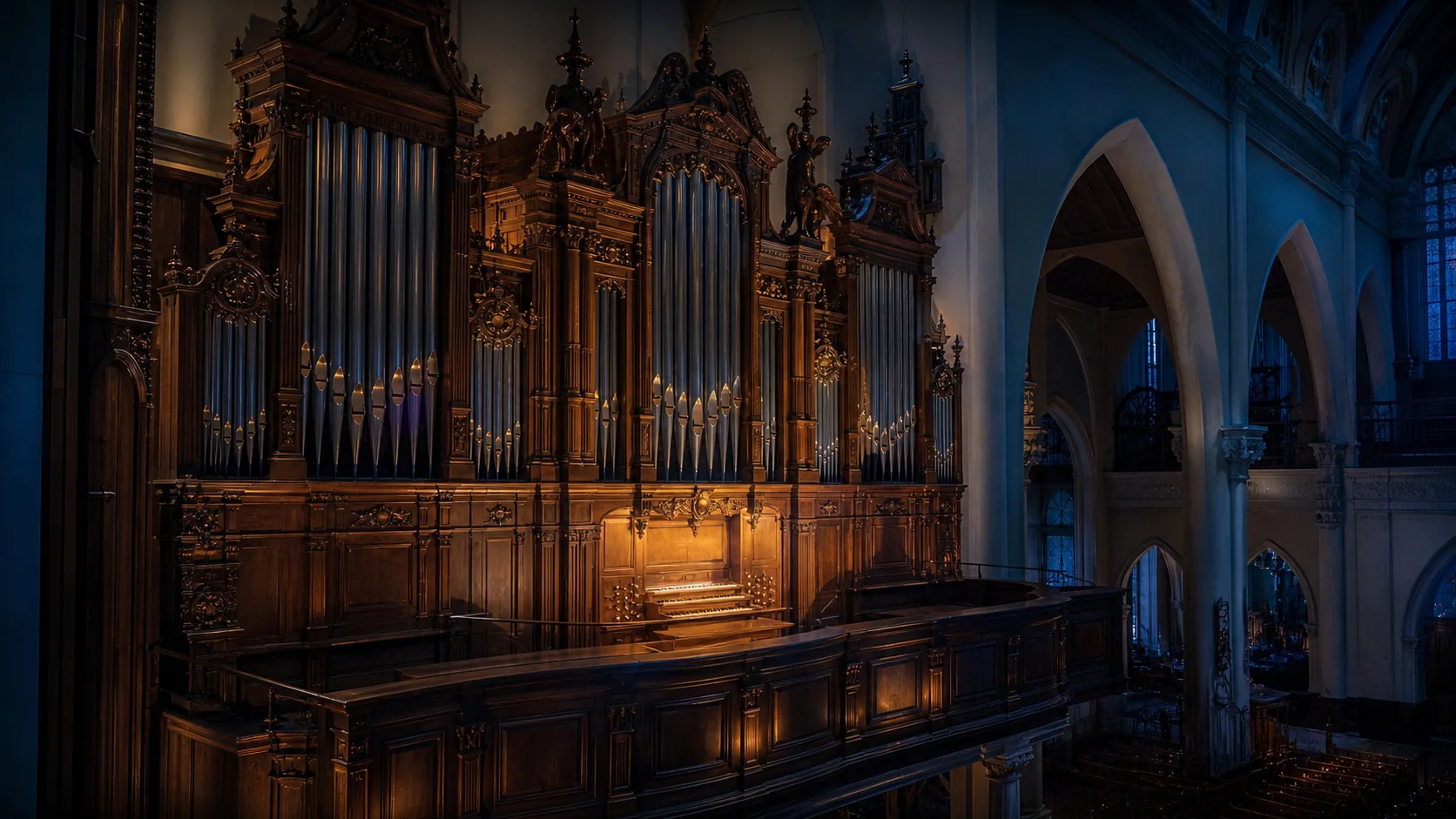
Martin Ott Opus 61 at St. Monica R.C. Church
Martin Ott Opus 61 was commissioned in 1989 for St. Monica R.C. Church in Creve Coeur, Missouri. The specification gives 22 stops and 25 ranks with suspended mechanical action.
Architecture and placement: St. Monica's first pipe-organ commission
The organ was installed at the front of the sanctuary, to the right of the altar. The source traces St. Monica to its establishment as a mission church and records that its first building was completed in 1872. The company page identifies the sanctuary as the third church structure on the site and dates it to 1960-61. The church had no pipe organ before the commission described on the page. The commission brought Opus 61 into St. Monica R.C. Church, Creve Coeur, Missouri. The room was not background scenery: its available space and the location of singers shaped the installation, even though the surviving description answers only part of that spatial puzzle.
Balcony, chancel and floor positions each create practical limits for an organ. Where the page names one for Opus 61, it is a project fact rather than a general guess about the building.
22 stops and 25 ranks: the scale of Opus 61
On paper, Opus 61 offers 22 stops drawn from 25 ranks. Those figures measure different things: console controls on one side and pipe sets on the other. There are enough resources for more than a single chorus, yet the totals do not reveal which division carried which colors. The number of manuals requires the full specification. The disposition, rather than arithmetic alone, would reveal the builder's priorities.
Because ranks outnumber stops by 3 in Opus 61, at least some controls may represent compound pipework. The abbreviated figures do not assign those ranks to divisions. The relationship is informative, but it is not a substitute for the disposition.
How the notes travel: St. Monica's first pipe-organ commission
The key action in Opus 61 was mechanical and suspended. Each key therefore worked through connected parts, while the term suspended refers to the hanging pull of the action. It says nothing certain about how heavy the keyboard felt after installation.
Touch is a physical result, not a synonym for mechanical action. A player or technician would need to examine Opus 61 before describing its present feel.
Inside the physical design: St. Monica's first pipe-organ commission
For Opus 61, the account records enough physical detail to discuss the installation without pretending to reconstruct the whole organ. Windchest plans and full case dimensions remain unavailable.
For Opus 61, the case and console belong to the historical argument, not merely the decoration. Their arrangement records practical choices made for this particular room.
The human side of the commission: St. Monica's first pipe-organ commission
The company page also records an enlargement in 1980-81, before Monsignor Nicholas A. Schneider arrived in 1984. Marie Kremer played the dedicatory recital. The specification tells us what resources the player could draw upon, not which pieces filled St. Monica R.C. Church. Programs, bulletins and recordings would turn that outline into a fuller listening history. What followed would need programs or institutional records.
The dated recital, concert or dedication named above gives Opus 61 a fixed point in musical history. It does not describe everything heard before or after that occasion.
Evidence, images and unanswered questions for Opus 61
This history draws on the company's Opus 61 project page as it stood on February 6, 2020. Alongside the description are 2 project-page images. The company presented these files as the gallery for Opus 61. Credit wording is available for 2 of the listed views. The material can identify the project without serving as a modern inspection report. New evidence should begin with the institution, a photographer credit and a date.