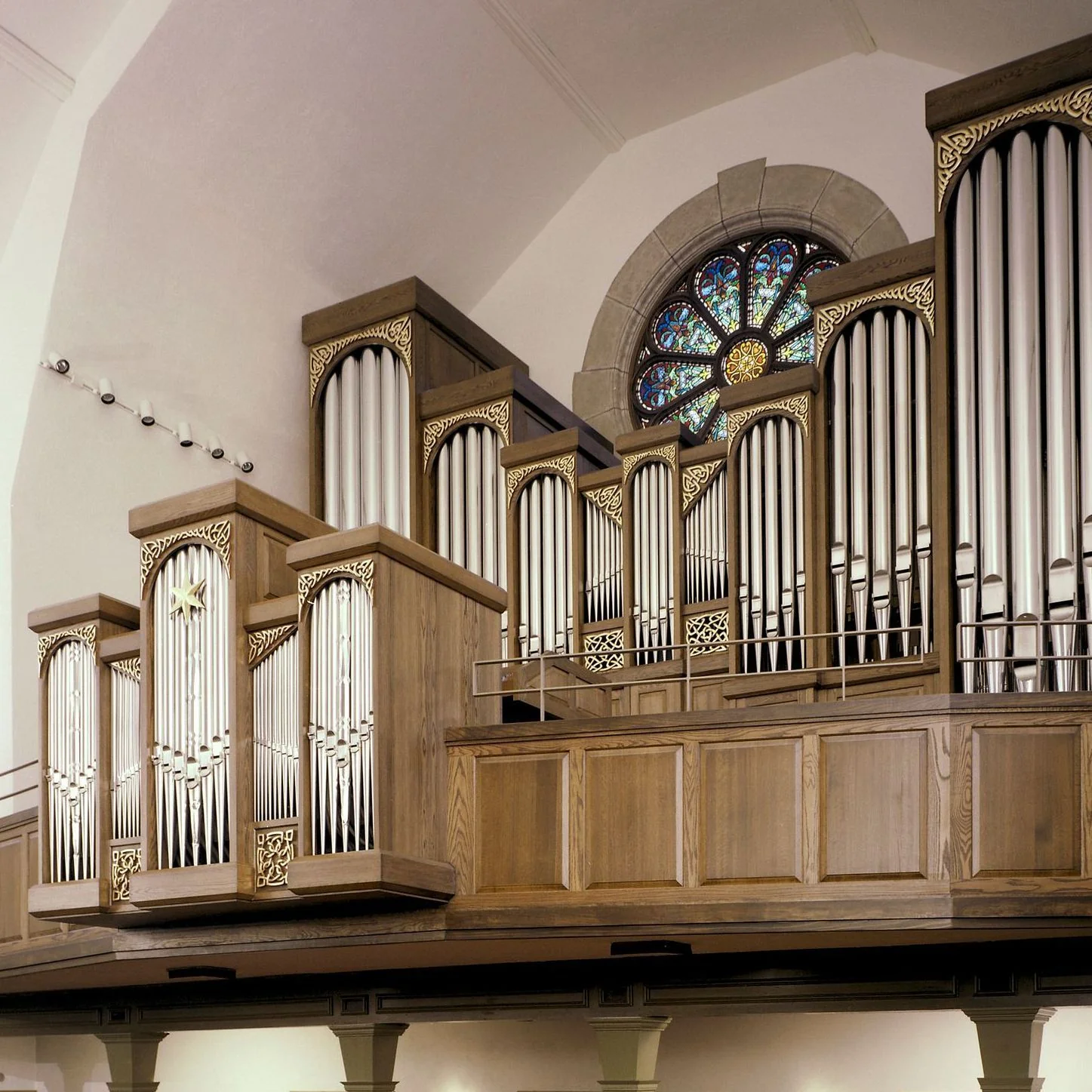
Martin Ott Opus 64 at St. Brigid's R.C. Church
Martin Ott Opus 64 was commissioned in 1989 for St. Brigid's Roman Catholic Church in San Diego. Its 37 stops and 51 ranks used mechanical key action with electric stop action. The former builder lists 1989 as the commission year. Saint Brigid Parish gives a separate milestone: dedication on October 3, 1993. Its church history also confirms 37 stops, 51 ranks and 2,536 pipes.
A room shaped for sound: St. Brigid's rose window
The balcony design worked around the church's large rose window: Pedal and Hauptwerk stood to either side, the Schwellwerk was centered below the window, and the Rückpositiv projected over the rail. A detached console left room for three choir risers and allowed the music director to conduct from the bench. The setting was St. Brigid's R.C. Church in San Diego, California. For an organ in worship, the player's view and the distance from singers can be as practical as the stoplist. This account follows the placement details recorded for Opus 64.
A photograph can confirm where the case stood at St. Brigid's R.C. Church, but it cannot measure how sound carried. Written dimensions or an acoustic report would be needed for that second question.
37 stops and 51 ranks: the scale of Opus 64
Opus 64 is summarized as an organ of 37 stops and 51 ranks. The difference between those totals matters because a stop name does not always correspond to one independent rank. This is a broad specification, but a large count is not a synonym for loudness. Wind pressure, voicing and the room still govern the result. The manual count is not stated in the short summary. These totals establish scale; they do not replace the actual specification.
In Opus 64, the rank count exceeds the stop count by 14. Compound stops such as mixtures can place several ranks under one control, but their allocation is not given. That distinction keeps a numerical summary from turning into a guessed tonal scheme.
From console to pipe: St. Brigid's rose window
The key action of Opus 64 is mechanical, or tracker, in the company description. A key moves connected parts that open the pallet for its note. The label explains the route of command, while touch weight still depends on leverage, couplers and regulation. Electrical stop control worked alongside mechanical keys. One selected ranks; the other carried the player's notes to the chests.
A detached mechanical console solves a choir-placement problem by creating another one for the builder: the tracker path becomes longer and more complex. That was the arrangement documented for Opus 64.
Music and people: St. Brigid's rose window
Music director Jerry Witt initiated the purchase with a major gift honoring his mother, while Richard Proulx served as organ consultant. Larry Smith played the dedicatory recital on October 3, 1993; the company account says the program was recorded the following week for CD release. Martin Ott Opus 64 is pictured on the company page alongside that recital recording. Stop totals outline resources; they do not tell us the music heard at St. Brigid's R.C. Church. The strongest evidence comes from named organists, dedicatory events and any commission goals recorded for Opus 64. Later programs could extend that chronology.
One program can reveal repertory and occasion without describing routine use. More bulletins or recordings would show how Opus 64 settled into the institution.
Evidence, images and unanswered questions for Opus 64
The starting point is Martin Ott's own Opus 64 page, retained in its February 6, 2020 form. Readers can compare the account with 3 images linked on that page. Each file was linked directly from the same project entry. None carries an individual photographer credit in the extracted text. That dated account is useful for the commission history, not as proof of the organ's state today. A modern condition note would bring the history forward without rewriting the older evidence.