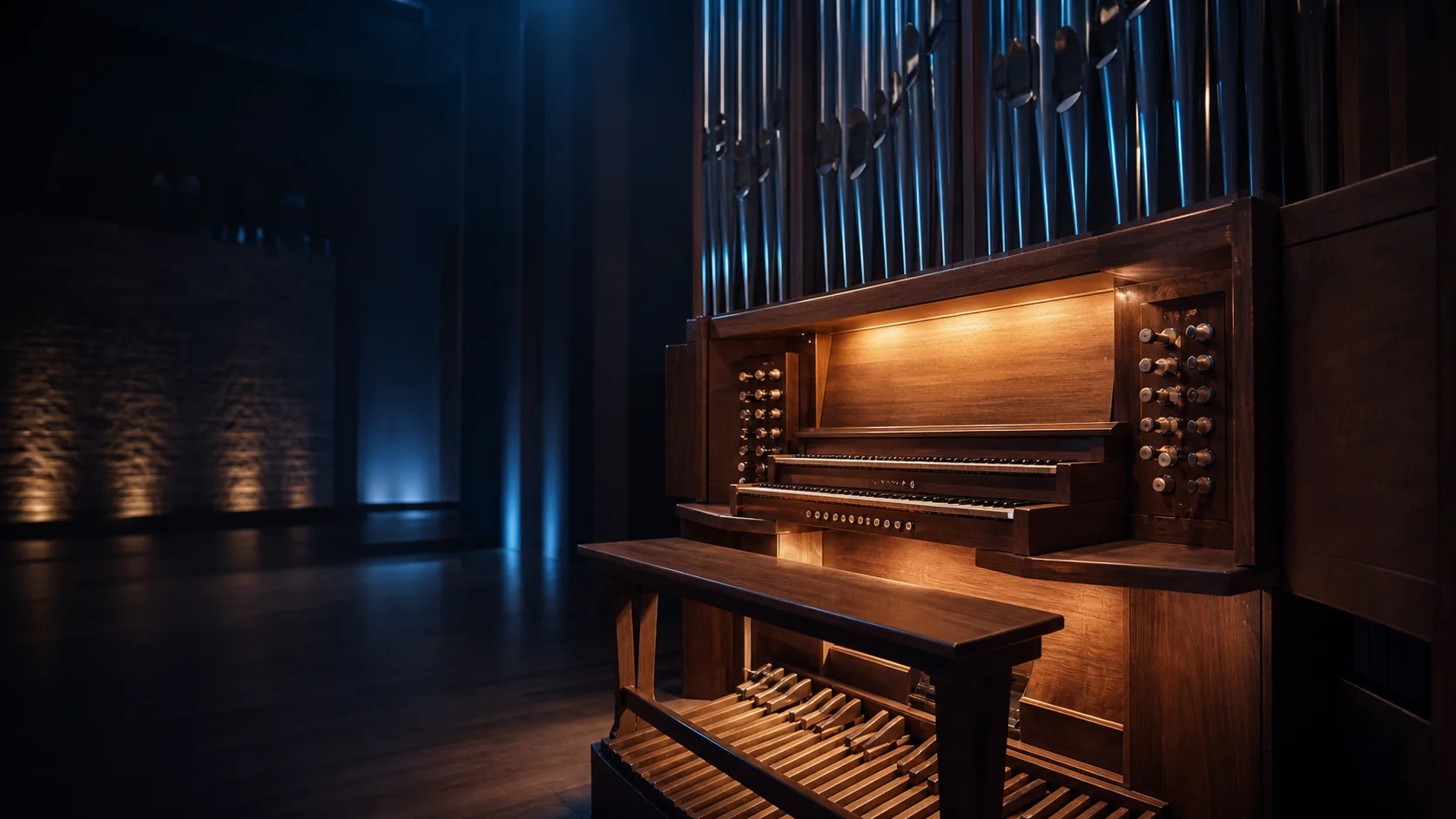
Martin Ott Opus 65: from the St. Louis convention to Medford
Martin Ott Opus 65 was commissioned in 1990 for Immanuel Lutheran Church in Medford, Wisconsin. The 18-stop, 21-rank mechanical-action organ was completed for exhibition at a 1993 national pastoral musicians convention in St. Louis and moved to Medford afterward. St. Louis was the convention site, not the location of the parish.
Balcony, altar and sight lines: the Medford church after the St. Louis exhibition
The organ's two documented geographies mark different stages of one commission. St. Louis was the site of the 1993 national pastoral musicians convention where the completed Opus 65 was shown and played. After the convention, the instrument went to Immanuel Lutheran Church in Medford, Wisconsin, the parish for which it had been commissioned. There the sanctuary's high A-frame ceiling and the organ's central position in the large rear balcony became part of its permanent architectural setting.
The room is best read through concrete clues: case position, nearby architecture and the player's relation to other musicians. Opus 65 should not be assigned a reverberation profile from appearance alone.
18 stops and 21 ranks: the scale of Opus 65
The catalogue figures for Opus 65 read 18 stops and 21 ranks. One total counts the player's controls, the other the pipe sets available behind them. This count suggests room for contrasting families without describing their balance. A stoplist is needed before calling the design bright, dark, orchestral or classically ordered. The overview leaves the number of keyboards unspecified. A stop-by-stop account of Opus 65 must wait for the complete disposition.
Opus 65 has 3 more ranks than stops. A mixture or another compound resource may account for part of the gap, though the short summary does not locate it. For Opus 65, the arithmetic is a useful check on the missing stoplist.
Touch, coupling and response: the Medford church after the St. Louis exhibition
In Opus 65, the player reached the windchest through a physical key linkage rather than an electrical key signal. That is the essential meaning of mechanical action. It cannot tell us how the finished keyboard felt or how the action has worn since installation.
Touch is a physical result, not a synonym for mechanical action. A player or technician would need to examine Opus 65 before describing its present feel.
Cabinet, console and pipework: the Medford church after the St. Louis exhibition
The Pedal and Hauptwerk divisions shared C and C-sharp wind chests. Red oak was used for the casework, and the manual key action was suspended. The materials and placement named here make the commission recognizable in photographs. They do not amount to a pipe-by-pipe inventory or a full set of shop drawings for Opus 65.
A clear project photograph may verify timber, placement and facade rhythm. Windchests, trackers and enclosed divisions of Opus 65 remain partly hidden from that view.
Players and occasions: the Medford church after the St. Louis exhibition
In 1993 the completed instrument was exhibited at a national pastoral musicians convention in St. Louis, where organists played it in a series of noon performances. After the convention, the instrument was moved to Immanuel Lutheran Church. The musical story at Immanuel Lutheran Church begins where the account names a player, a recital or a reason for the commission. Regular service use and later concerts need their own documentation. Its subsequent concert life is not described.
The musical event named on the page supplies a date that can be checked against local records. It leaves room for a longer chronology of Opus 65.
Evidence, images and unanswered questions for Opus 65
For Opus 65, the closest source is the former builder's project page dated February 6, 2020. It links 3 images from the corresponding project directory. Together they form the visual record published beside Opus 65. Of those files, 1 carries caption or credit context. Uncaptioned views remain broadly labeled, and the old page cannot answer questions about later alterations. Dated photographs or an institutional inventory could continue the story.