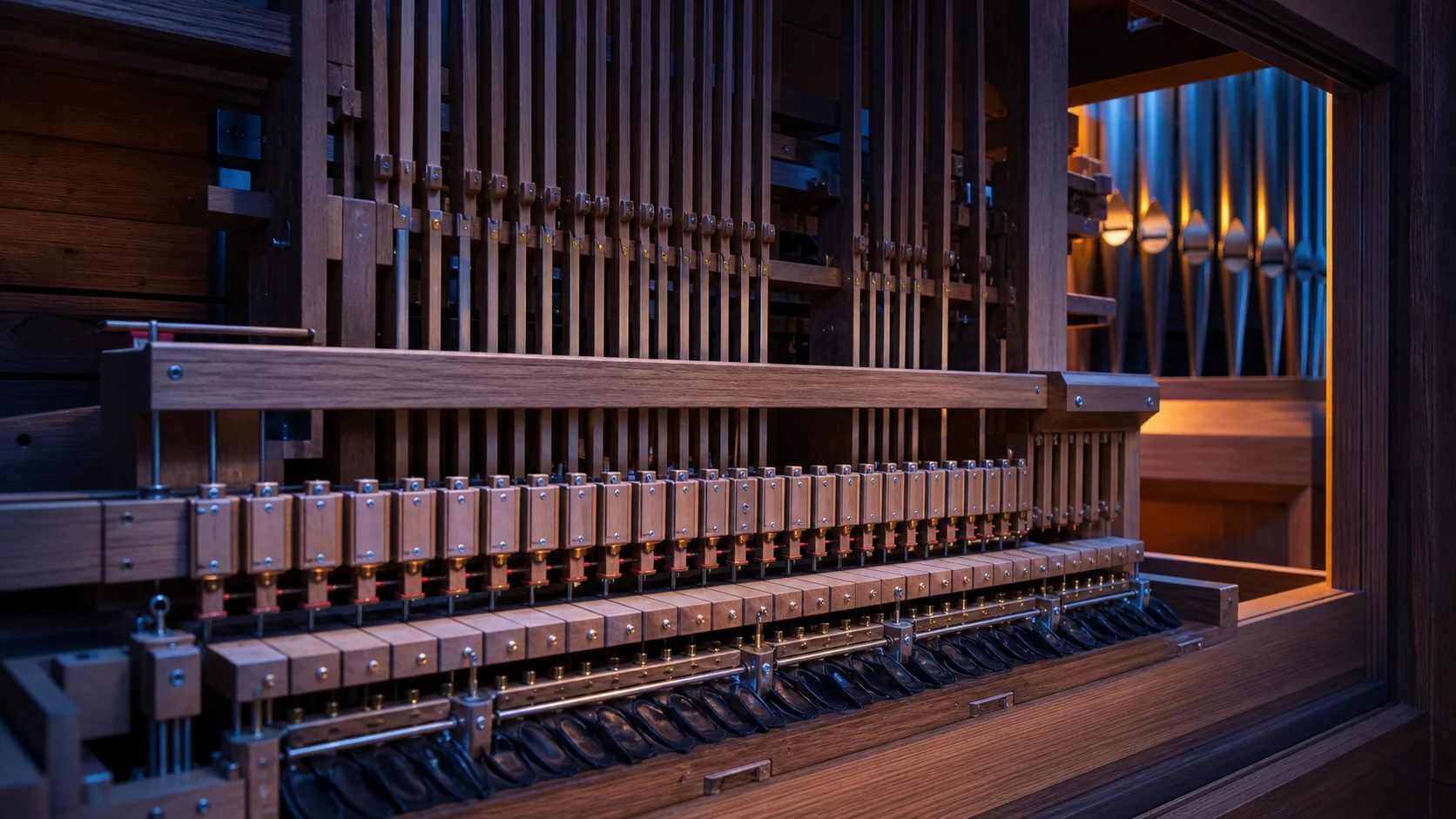
Martin Ott Opus 67 at St. Timothy Lutheran Church
The project identity dates Martin Ott Opus 67 to 1978 and records a relocation around 2002, while the narrative says St. Matthew Lutheran Church in Madison commissioned it in 1990. The source does not reconcile those dates.
How the room shaped the commission: the relocation from Madison to Naperville
St. Timothy Lutheran Church in Naperville purchased the instrument and commissioned Martin Ott to relocate it. In the Naperville sanctuary, the organ stood at the front to the right of the altar. The commission brought Opus 67 into St. Timothy Lutheran Church, Naperville, Illinois. The room was not background scenery: its available space and the location of singers shaped the installation, even though the surviving description answers only part of that spatial puzzle.
Balcony, chancel and floor positions each create practical limits for an organ. Where the page names one for Opus 67, it is a project fact rather than a general guess about the building.
16 stops and 17 ranks: the scale of Opus 67
On paper, Opus 67 offers 16 stops drawn from 17 ranks. Those figures measure different things: console controls on one side and pipe sets on the other. The figures describe moderate breadth, not volume. Voicing, wind and the room would decide how large the organ seemed to a listener. The number of manuals requires the full specification. Its 1 listed extension helps explain why stops and ranks need not form matching totals. The disposition, rather than arithmetic alone, would reveal the builder's priorities.
Because ranks outnumber stops by 1 in Opus 67, at least some controls may represent compound pipework. The abbreviated figures do not assign those ranks to divisions. The page separately lists 1 extension. The relationship is informative, but it is not a substitute for the disposition.
The route from key to pipe: the relocation from Madison to Naperville
No electrical key command is listed for Opus 67; the keys worked mechanically to admit wind to the pipes. This gives a clear technical category but not a condition report. Coupling load and present regulation remain unknown.
Tracker layout links architecture and touch: distance, turns and couplers all affect the path. The short account of Opus 67 does not provide those shop dimensions.
Materials and workmanship: the relocation from Madison to Naperville
The specification for Opus 67 gives 16 stops, 17 ranks, one extension, and mechanical action. A Fagott 16-foot and Zimbelstern followed in 2005. For Opus 67, the account records enough physical detail to discuss the installation without pretending to reconstruct the whole organ. Windchest plans and full case dimensions remain unavailable.
For Opus 67, the case and console belong to the historical argument, not merely the decoration. Their arrangement records practical choices made for this particular room.
Recitals, worship and memory: the relocation from Madison to Naperville
When St. Matthew changed denomination in 2001, the organ became available for another home. Two stops prepared in the earlier design, a Trompete 8-foot and Viola 8-foot, were then installed. The specification tells us what resources the player could draw upon, not which pieces filled St. Timothy Lutheran Church. Programs, bulletins and recordings would turn that outline into a fuller listening history. No dedicatory recital is named in the available material.
The absence of a recital in the surviving text does not mean Opus 67 went unheard. It means that a dated public event has not yet been established from this material.
Evidence, images and unanswered questions for Opus 67
This history draws on the company's Opus 67 project page as it stood on February 6, 2020. Alongside the description are 1 project-page image. The company presented these files as the gallery for Opus 67. No photographer is identified beside these files. The material can identify the project without serving as a modern inspection report. New evidence should begin with the institution, a photographer credit and a date.