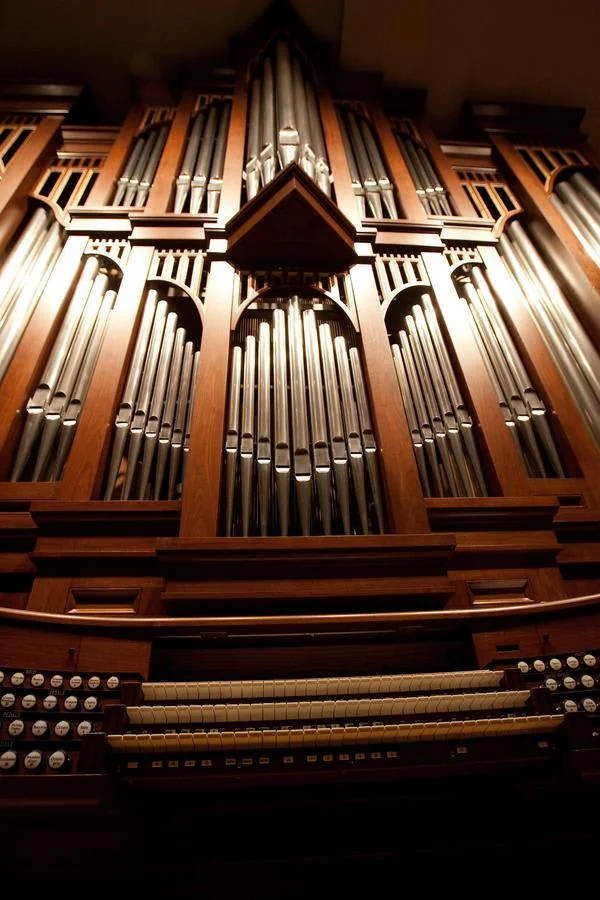
Martin Ott Opus 66 at Principia College
Martin Ott Opus 66 was commissioned in 1990 for Principia College in Elsah, Illinois. The specification gives 26 stops and 34 ranks, with mechanical key action and dual mechanical and electric stop action. The former builder dates the commission to 1990 and prints 26 stops with 34 ranks. Principia College's instruments page labels Opus 66 as a 1992 chapel organ with 28 stops and 34 ranks. Both versions are retained because the date and stop total serve different records.
The architectural setting: Principia's disputed chapel chronology
The organ stood on the rear balcony of the college chapel. The source names John Near as college organist and chair of the music department, and notes his scholarship on Widor. Opus 66 was built for Principia College in Elsah, Illinois. That address suggests an audience of students and listeners, yet the historical account is more precise when it names a studio, chapel, hall or faculty member than when one guesses at daily use.
An academic organ may be heard at close range in lessons and at greater distance in recital. A room plan and department records would show which conditions applied to Opus 66.
26 stops and 34 ranks: the scale of Opus 66
The published count for Opus 66 is 26 stops and 34 ranks. Stops are the choices presented to the player; ranks are sets of pipes running through the compass. An organ of this scale can distribute several choruses and solo colors, although that possibility must not be mistaken for a verified stop-by-stop plan. No manual count appears in the condensed technical line. The numbers are a useful outline, not a tonal portrait.
The two totals for Opus 66 are separated by 8 ranks. That difference can arise when one stop controls several ranks, but the disposition is needed to identify where. This is why the two numbers should always be printed together.
Key action in practice: Principia's disputed chapel chronology
Tracker action places keys, connecting parts and pallets in one mechanical chain. The summary assigns that principle to Opus 66. Response and comfort would have depended on the exact geometry and later adjustment, neither of which is measured on the page.
Because the keydesk was joined to the case, the player's position formed part of the architecture of Opus 66. Later regulation cannot be read from that layout alone.
Casework and layout: Principia's disputed chapel chronology
Opus 66's attached keydesk used suspended key action. Walnut carvings on the case were gilded in 21-karat gold by Diane Pappas. These are useful points of contact between the written history and the project images. Internal dimensions and the complete division layout of Opus 66 are not supplied.
The physical details of Opus 66 matter because they show how the organ shared space with people. They are more useful than a generic description that could belong to any neighboring commission.
The organ in use: Principia's disputed chapel chronology
The company page also identifies Principia as a Christian Science institution. Joan Lippincott played the dedicatory recital on Sunday, May 1, 1993. An academic commission can move between practice and public performance. For Opus 66, only the players and events named in the historical account are treated as part of that musical life. The dated event is a beginning, not a complete performance history.
Players and consultants are included only where the project history identifies them. That keeps the musical narrative of Opus 66 personal without inventing a cast.
Evidence, images and unanswered questions for Opus 66
The former Martin Ott page for Opus 66, dated February 6, 2020, is the main source for this account. The page supplies 5 linked images for comparison with the text. Their placement on the project page ties them to Opus 66. Individual image credits are absent from the extracted material. Its evidence stops before the present day; current location, access and condition need newer confirmation. A full disposition and a recent survey remain the most useful missing documents.