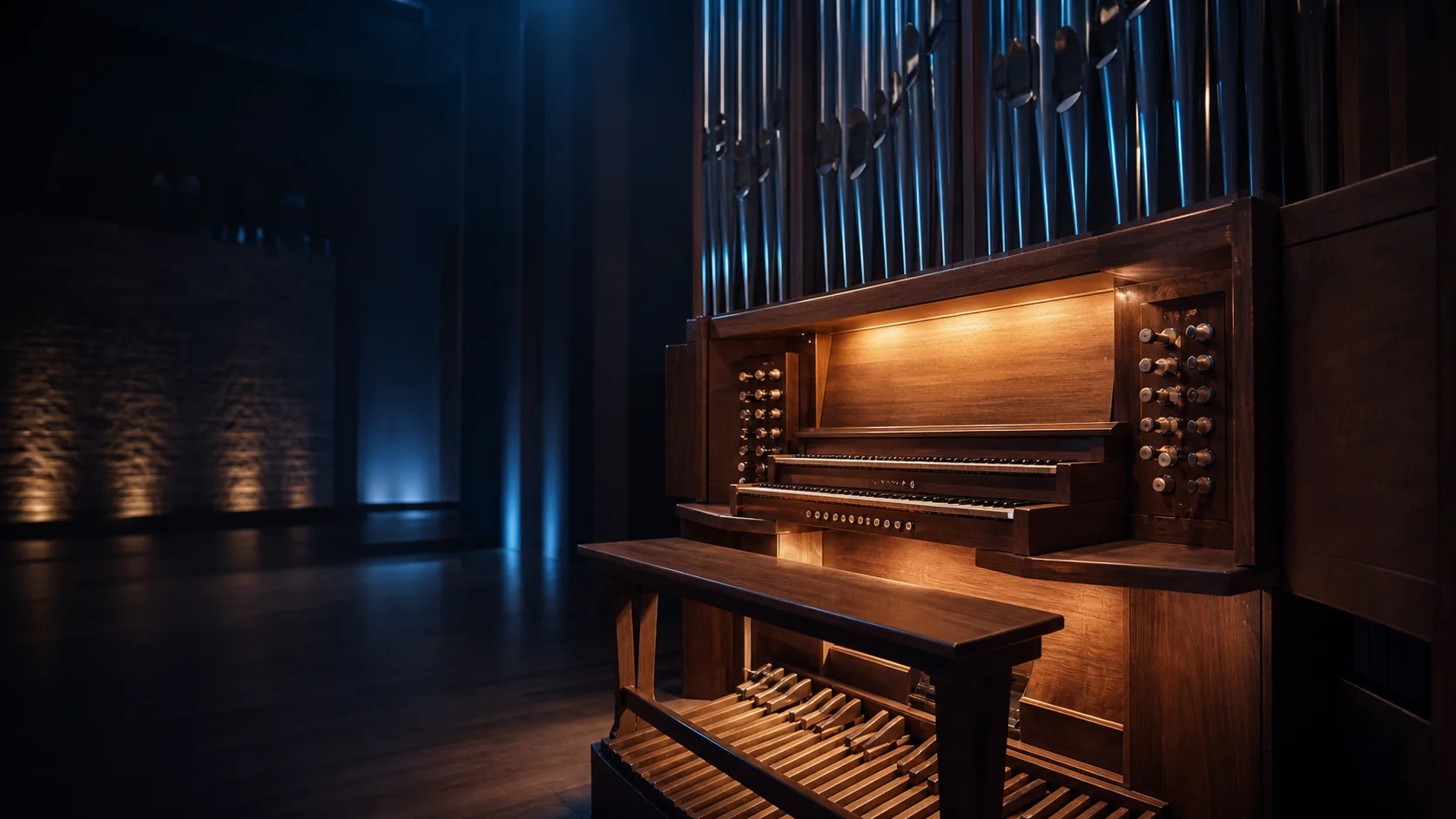
Martin Ott Opus 73 at Unity Lutheran Church
Martin Ott Opus 73 was commissioned in 1993 for Unity Lutheran Church in St. Louis. The specification gives 22 stops, 23 ranks, one extension, mechanical key action, and electric stop action.
Where the instrument stood: Unity's post-fire rebuilding
Unity Church burned on April 6, 1992, and the Bosch organ was destroyed. The commission brought Opus 73 into Unity Lutheran Church, St. Louis, Missouri. In the room documented at Unity Lutheran Church, the room was not background scenery: its available space and the location of singers shaped the installation, even though the surviving description answers only part of that spatial puzzle. No measured acoustic data accompanies the project history.
What survives about the room at Unity Lutheran Church is enough to say this: balcony, chancel and floor positions each create practical limits for an organ. Where the page names one for Opus 73, it is a project fact rather than a general guess about the building. No such measurements accompany the old page.
22 stops and 23 ranks: the scale of Opus 73
On paper, Opus 73 offers 22 stops drawn from 23 ranks. At Unity Lutheran Church, those figures measure different things: console controls on one side and pipe sets on the other. Its numerical scale is neither miniature nor among the firm's largest. The musical plan still rests in the missing sequence of stop names and pitches. The number of manuals requires the full specification. Its 1 listed extension helps explain why stops and ranks need not form matching totals. For Opus 73, the disposition, rather than arithmetic alone, would reveal the builder's priorities.
Because ranks outnumber stops by 1 in Opus 73, at least some controls may represent compound pipework. According to the 22-stop summary for Unity Lutheran Church, the abbreviated figures do not assign those ranks to divisions. The page separately lists 1 extension. For Opus 73, the relationship is informative, but it is not a substitute for the disposition.
The playing action: Unity's post-fire rebuilding
No electrical key command is listed for Opus 73; the keys worked mechanically to admit wind to the pipes. This gives a clear technical category but not a condition report. Coupling load and present regulation remain unknown. Its electric stop system did not replace the tracker key action. The two served different parts of the organist's control.
For Opus 73, action type and tonal design should be read on separate lines. One concerns control; the other concerns what the pipes were made to say.
How the instrument was arranged: Unity's post-fire rebuilding
For Opus 73, the account records enough physical detail to discuss the installation without pretending to reconstruct the whole organ. Windchest plans and full case dimensions remain unavailable.
For Opus 73, the case and console belong to the historical argument, not merely the decoration. According to the design record for Unity Lutheran Church, their arrangement records practical choices made for this particular room.
Listening history: Unity's post-fire rebuilding
Martin Ott had first worked at Unity in 1970, installing a Werner Bosch organ under contract with Werner Bosch Orgelbau. Paul Manz played that instrument's dedicatory recital in February 1971. Twenty-five years after the first recital, Manz returned in February 1996 to play the dedicatory recital for Opus 73. The source names Peter Nettling as music director during the new instrument's development and records that Barbara Harbach followed him in 2009 as music director and professor of music. The specification tells us what resources the player could draw upon, not which pieces filled Unity Lutheran Church. The performance evidence for Unity Lutheran Church sets the limit of the account: programs, bulletins and recordings would turn that outline into a fuller listening history. What followed would need programs or institutional records.
The dated recital, concert or dedication named above gives Opus 73 a fixed point in musical history. It does not describe everything heard before or after that occasion.
Evidence, images and unanswered questions for Opus 73
This history draws on the company's Opus 73 project page as it stood on February 6, 2020. Alongside the description are 3 project-page images. The company presented these files as the gallery for Opus 73. Credit wording is available for 1 of the listed views. At Unity Lutheran Church, the material can identify the project without serving as a modern inspection report. For Opus 73, new evidence should begin with the institution, a photographer credit and a date.