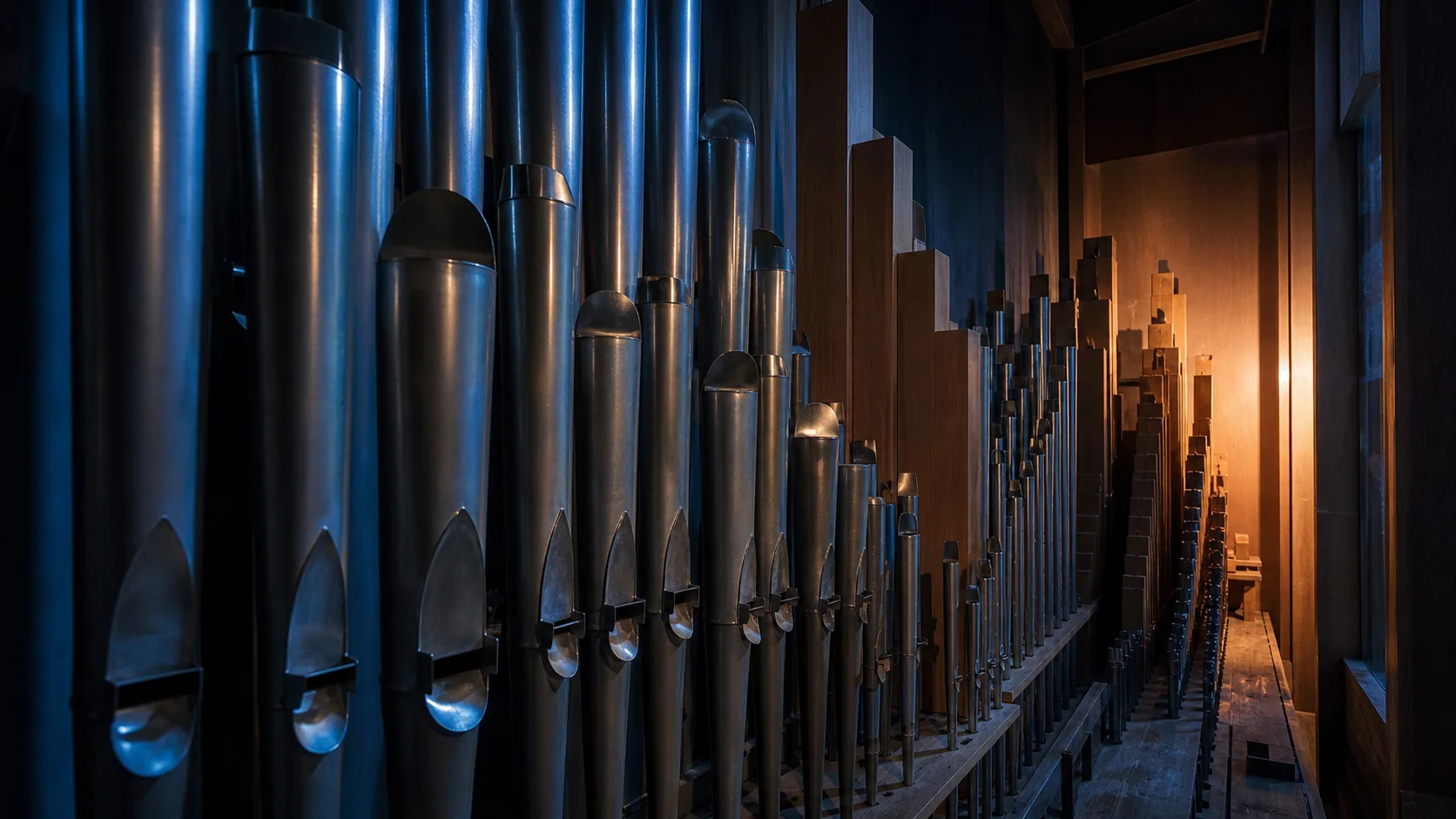
Martin Ott Opus 74 at Lutheran Church of the Apostles
Martin Ott Opus 74 was commissioned in 1993 for Lutheran Church of the Apostles in Atlanta, Georgia. The specification gives 22 stops, 27 ranks, three extensions, and mechanical action.
A room shaped for sound: the Atlanta choir-directing console
The company page names Charles R. Redmond as music director and Terry Byrd Eason as liturgical architect. In Atlanta, Georgia, Lutheran Church of the Apostles supplied the room for this project. According to the architectural record for Lutheran Church of the Apostles, visible placement can often be recovered from the text and photographs, while the way sound decayed through the room needs measurements the page may not provide.
The architectural record from Lutheran Church of the Apostles shows that the architecture helps explain why the instrument took this form, but the text is selective. A plan showing organ, choir and congregation together would sharpen the account of Lutheran Church of the Apostles.
22 stops and 27 ranks: the scale of Opus 74
A first reading of the instrument begins with 22 stops and 27 ranks. The Opus 74 outline adds that the stop total describes selectable resources, while the rank total counts the underlying rows of pipes. Within the published specification for Lutheran Church of the Apostles, the scale sits between a practice organ and the largest church installations. For Opus 74, it leaves open how the builder divided resources among principals, flutes and reeds. One numerical limit remains in Opus 74: the abbreviated entry does not give the keyboard count. The summary notes 3 extensions; extension work allows pipework to be reused at another pitch or under another stop control. The full stoplist is still needed for a dependable tonal reading of Opus 74.
Counting pipe sets gives 5 more than counting stop controls in Opus 74. Within the published specification for Lutheran Church of the Apostles, mixtures are one possible reason; the complete stoplist would settle the question. The page separately lists 3 extensions. For Opus 74, a complete specification would show where each rank actually appears.
From console to pipe: the Atlanta choir-directing console
The action line for Opus 74 points to a direct physical connection between keyboard and valves. Organ builders usually call this tracker action. According to the action account for Lutheran Church of the Apostles, mechanical describes the system, not a promise that every key or coupling felt equally light.
The detached console made the mechanical layout of Opus 74 unusually visible. Trackers and intermediate parts had to carry each key movement across the recorded distance to the chests.
Music and people: the Atlanta choir-directing console
David Sherwien played the inaugural recital on October 13, 1995. The source does not provide a later account of the instrument's location, condition, ownership, or alterations. Opus 74 entered a working musical community at Lutheran Church of the Apostles. The performance evidence for Lutheran Church of the Apostles sets the limit of the account: the page records selected people and events, while the routine life of services and rehearsals remains largely offstage. The next musical chapter remains to be documented.
The people named above turn the specification of Opus 74 into a human story. Their documented role is clear, while later organists and programs still need sources.
Evidence, images and unanswered questions for Opus 74
A copy of the Martin Ott project page dated February 6, 2020 supplies the documentary record for Opus 74. Its visual material consists of 1 linked image. They are the images the former company chose to publish with Opus 74. The gallery offers no individual credit line. Among the surviving sources for Lutheran Church of the Apostles, later ownership and maintenance fall outside what this dated page can verify. For Opus 74, a current institutional photograph and complete stoplist would fill the largest gaps.