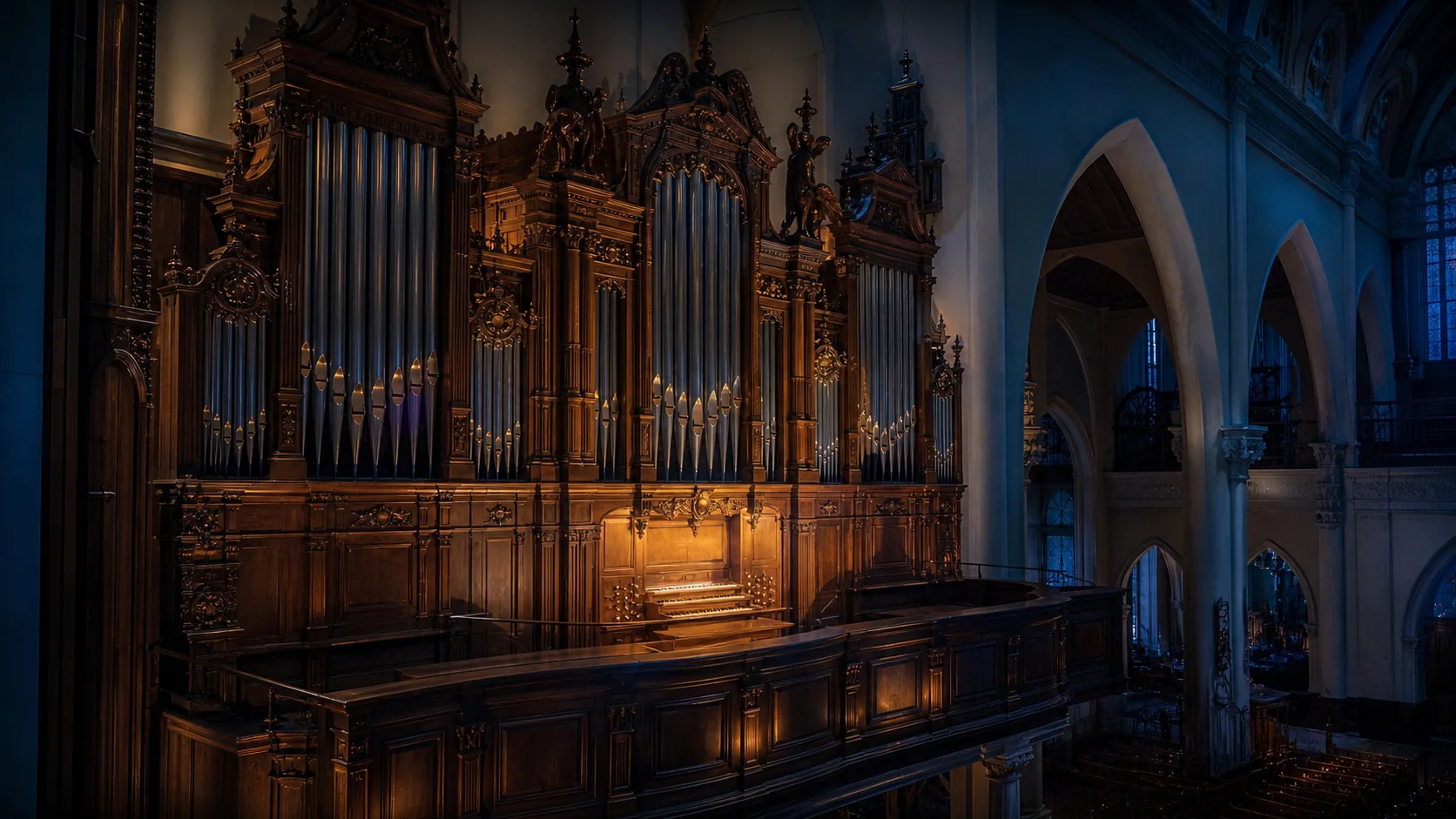
Martin Ott Opus 77 at Fresno State University
Martin Ott Opus 77 was commissioned in 1993 for Fresno State University in California. The specification gives 20 stops and 22 ranks with suspended mechanical action.
How the room shaped the commission: Fresno State's concert hall
The organ stood at the front center of the concert hall in the campus music building. At Fresno State University, the room and the curriculum would have met around the organ. The dated description gives enough to discuss the installation, while leaving the timetable of lessons and performances to later institutional records. No measured acoustic data accompanies the project history.
The next useful institutional evidence would be a room plan, a recital program or a faculty inventory. Each would answer a different question about Opus 77. The available account does not include it.
20 stops and 22 ranks: the scale of Opus 77
The catalogue figures for Opus 77 read 20 stops and 22 ranks. The 20-stop, 22-rank summary for Fresno State University shows that one total counts the player's controls, the other the pipe sets available behind them. The figures describe moderate breadth, not volume. For Opus 77, voicing, wind and the room would decide how large the organ seemed to a listener. The overview leaves the number of keyboards unspecified. A stop-by-stop account of Opus 77 must wait for the complete disposition.
Opus 77 has 2 more ranks than stops. According to the 20-stop summary for Fresno State University, a mixture or another compound resource may account for part of the gap, though the short summary does not locate it. For Opus 77, the arithmetic is a useful check on the missing stoplist.
The route from key to pipe: Fresno State's concert hall
In Opus 77, the player reached the windchest through a physical key linkage rather than an electrical key signal. That is the essential meaning of mechanical action. The action record from Fresno State University is precise on this point: it cannot tell us how the finished keyboard felt or how the action has worn since installation.
The technical description from Fresno State University documents one point: an attached console makes the case itself the player's workstation. For Opus 77, that fact is documented even though key depth and touch weight are not.
Materials and workmanship: Fresno State's concert hall
Opus 77's keydesk was attached to the case, and the suspended action connected the keyboards directly with the mechanism. It also names Dame Gillian Weir, Guy Bovet, and Susan Landale among performers in the Philip Lorenz Memorial Keyboard Concerts series. The design evidence from Fresno State University has one clear limit: the materials and placement named here make the commission recognizable in photographs. They do not amount to a pipe-by-pipe inventory or a full set of shop drawings for Opus 77.
At Fresno State University, a clear project photograph may verify timber, placement and facade rhythm. Windchests, trackers and enclosed divisions of Opus 77 remain partly hidden from that view.
Recitals, worship and memory: Fresno State's concert hall
Aaron Vartanian, Laurell Huber, and John Near served as advisers. David Higgs played the dedicatory recital on April 20, 1996, and the source records a performance by Loan Lippincott on February 13, 2000. A caption says Opus 77 and Opus 79 were shipped together to the West Coast. At Fresno State University, named teachers, students or recitalists are better guides to use than the institution's name alone. The specification suggests possibilities for study, but programs are needed to show what was actually played. Its subsequent concert life is not described.
The performance evidence for Fresno State University sets the limit of the account: the musical event named on the page supplies a date that can be checked against local records. It leaves room for a longer chronology of Opus 77.
Evidence, images and unanswered questions for Opus 77
For Opus 77, the closest source is the former builder's project page dated February 6, 2020. According to the surviving sources for Fresno State University, it links 1 image from the corresponding project directory. Together they form the visual record published beside Opus 77. For Opus 77, the page does not name a photographer for the listed views. The Opus 77 evidence also shows that uncaptioned views remain broadly labeled, and the old page cannot answer questions about later alterations. One documentary limit remains for Opus 77: dated photographs or an institutional inventory could continue the story.