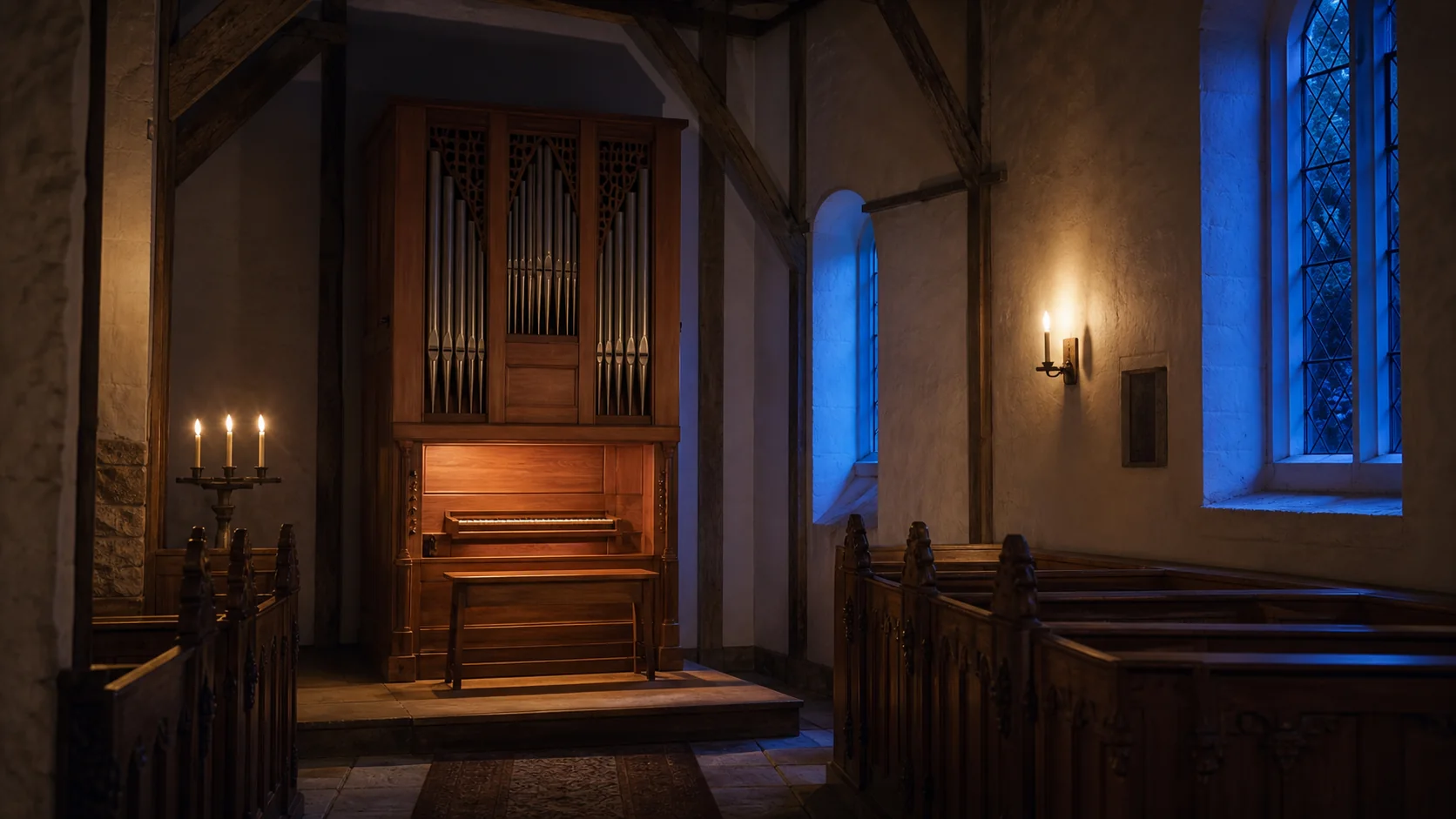
Martin Ott Opus 76 at Redeemer Lutheran Church
The project identity dates Martin Ott Opus 76 to 1986 and records its relocation to Redeemer Lutheran Church in Fort Wayne in 2010. The continuo had four stops and four ranks with mechanical action.
The architectural setting: Redeemer's A440 and A415 continuo
The setting was Redeemer Lutheran Church in Fort Wayne, Indiana. For an organ in worship, the player's view and the distance from singers can be as practical as the stoplist. This account follows the placement details recorded for Opus 76. Room dimensions and sound-decay figures are absent.
A photograph can confirm where the case stood at Redeemer Lutheran Church, but it cannot measure how sound carried. Written dimensions or an acoustic report would be needed for that second question. No such measurements accompany the old page.
4 stops and 4 ranks: the scale of Opus 76
Opus 76 is summarized as an organ of 4 stops and 4 ranks. Within the published specification for Redeemer Lutheran Church, the difference between those totals matters because a stop name does not always correspond to one independent rank. The compact count favors economy. Its musical range depends on the actual stop names, any divided stops and the way the ranks are shared. For Opus 76, the manual count is not stated in the short summary. The Opus 76 outline adds that these totals establish scale; they do not replace the actual specification.
Opus 76 gives the same number for stops and ranks. The match is useful, though only the disposition can show whether every control had an independent pipe set. The 4-stop, 4-rank summary for Redeemer Lutheran Church shows that that distinction keeps a numerical summary from turning into a guessed tonal scheme.
Key action in practice: Redeemer's A440 and A415 continuo
The key action of Opus 76 is mechanical, or tracker, in the company description. The technical description from Redeemer Lutheran Church documents one point: a key moves connected parts that open the pallet for its note. For Opus 76, the label explains the route of command, while touch weight still depends on leverage, couplers and regulation.
The action record from Redeemer Lutheran Church is precise on this point: the action label becomes more meaningful when read beside console placement and division layout. For Opus 76, only the details explicitly recorded above can complete that picture.
Casework and layout: Redeemer's A440 and A415 continuo
Opus 76's 50-note manual compass ran from C, D, and D-sharp to d-prime, and the keyboard could transpose between A440 and A415. The red oak case followed a Baroque design with a solid frame and raised-panel construction. Granadilla was used for the natural keys and white beech for the sharps. Both key and stop action were mechanical, using sticker action. The source also notes that the domed caps of the Rohrflöte 4-foot pipes were soldered permanently to the pipe bodies. Taken together, these construction details give Opus 76 a physical identity beyond its stop count. At Redeemer Lutheran Church, a complete case drawing and internal chest plan are still missing.
The design evidence from Redeemer Lutheran Church has one clear limit: console position can reveal the intended relationship between player, choir and room. It does not, by itself, explain the internal division plan of Opus 76.
The organ in use: Redeemer's A440 and A415 continuo
Stop totals outline resources; they do not tell us the music heard at Redeemer Lutheran Church. The strongest evidence comes from named organists, dedicatory events and any commission goals recorded for Opus 76. In the musical record for Redeemer Lutheran Church, the account identifies no resident organist or later concert.
Without a named player or program, the musical account remains modest. That is preferable to assigning repertory to Opus 76 from its stop count alone.
Evidence, images and unanswered questions for Opus 76
The starting point is Martin Ott's own Opus 76 page, retained in its February 6, 2020 form. Readers can compare the account with 1 image linked on that page. Among the surviving sources for Redeemer Lutheran Church, each file was linked directly from the same project entry. None carries an individual photographer credit in the extracted text. For Opus 76, that dated account is useful for the commission history, not as proof of the organ's state today. The Opus 76 evidence also shows that a modern condition note would bring the history forward without rewriting the older evidence.