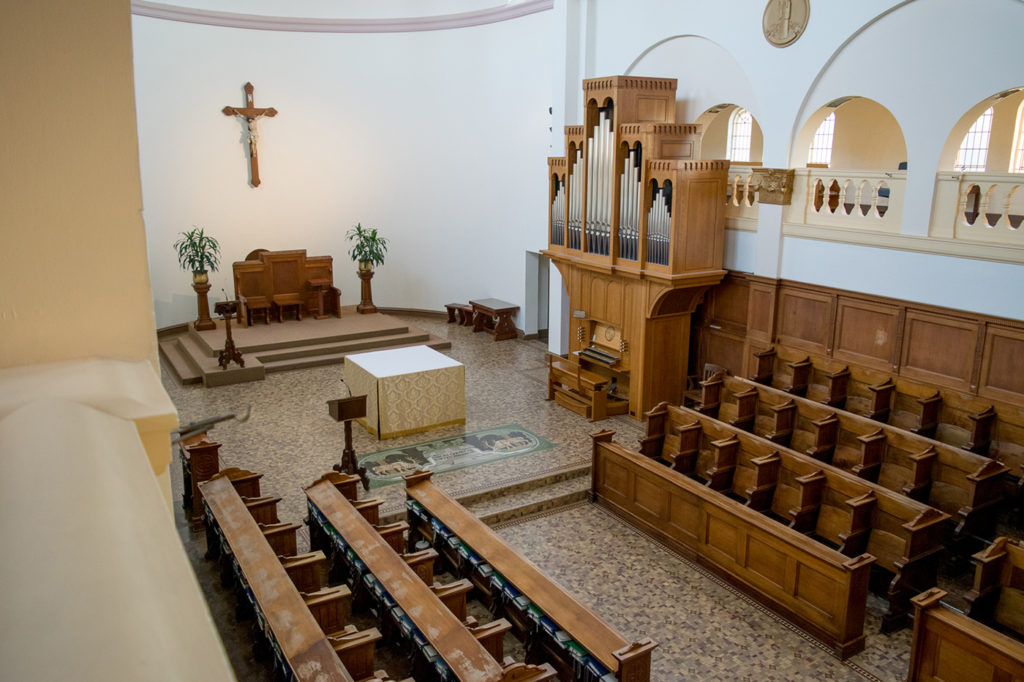
Martin Ott Opus 79 at Mount Angel Abbey
Martin Ott Opus 79 was commissioned with Opus 80 for Mount Angel Abbey in St. Benedict, Oregon. The former builder's page gives an older 1993 project line and describes a 15-stop, 15-rank mechanical-action choir organ with 866 pipes. Mount Angel Abbey's institutional history dates construction to 1995 and installation to spring 1996, and gives 856 pipes. The two pipe counts are attributed to their sources rather than merged.
Reading the sanctuary: Mount Angel's choir organ
The dual-organ plan grew from an Abbey committee formed in December 1991. Martin Ott first visited on Annunciation Day in 1992 and proposed a European monastic model: a smaller instrument in the choir and a larger organ at the rear of the nave. The commission brought Opus 79 into Mount Angel Abbey, St. Benedict, Oregon. The architectural record from Mount Angel Abbey shows that the room was not background scenery: its available space and the location of singers shaped the installation, even though the surviving description answers only part of that spatial puzzle.
At Mount Angel Abbey, balcony, chancel and floor positions each create practical limits for an organ. Where the page names one for Opus 79, it is a project fact rather than a general guess about the building.
15 stops and 15 ranks: the scale of Opus 79
On paper, Opus 79 offers 15 stops drawn from 15 ranks. The Opus 79 outline adds that those figures measure different things: console controls on one side and pipe sets on the other. At Mount Angel Abbey, the scale sits between a practice organ and the largest church installations. For Opus 79, it leaves open how the builder divided resources among principals, flutes and reeds. The number of manuals requires the full specification. One numerical limit remains in Opus 79: the disposition, rather than arithmetic alone, would reveal the builder's priorities.
Opus 79 gives the same number for stops and ranks. For Opus 79, the match is useful, though only the disposition can show whether every control had an independent pipe set. Within the published specification for Mount Angel Abbey, the relationship is informative, but it is not a substitute for the disposition.
Keys and windchests: Mount Angel's choir organ
No electrical key command is listed for Opus 79; the keys worked mechanically to admit wind to the pipes. According to the action account for Mount Angel Abbey, this gives a clear technical category but not a condition report. Coupling load and present regulation remain unknown.
At Mount Angel Abbey, tracker layout links architecture and touch: distance, turns and couplers all affect the path. The short account of Opus 79 does not provide those shop dimensions.
The organ as an object: Mount Angel's choir organ
Most of the pipework shared one expression enclosure, apart from the Principal 8 and the lowest twelve Subbass 16 pipes. For Opus 79, the account records enough physical detail to discuss the installation without pretending to reconstruct the whole organ. Windchest plans and full case dimensions remain unavailable.
For Opus 79, the case and console belong to the historical argument, not merely the decoration. The surviving design account for Mount Angel Abbey clarifies this point: their arrangement records practical choices made for this particular room.
Musical life around the instrument: Mount Angel's choir organ
The organ was built in 1995 and installed in spring 1996. Committee members initially considered that plan unrealistic, but visits to Ott instruments in St. Louis convinced Fr. Marius Walter and Fr. Jerome that a versatile choir organ could serve daily worship. The community later requested a formal dual-organ proposal. Martin Ott Opus 79 could register and play the Grand Organ, while Opus 80 could operate the choir instrument in return. Richard Houghton handled engineering and execution, Herbert Bilgram made the music-rack inlay, and the company page names nine craftspeople who participated in construction.
Its caption places Opus 79 beside Opus 80 and directs readers to the larger organ's page for shared construction notes. The specification tells us what resources the player could draw upon, not which pieces filled Mount Angel Abbey. The musical record from Mount Angel Abbey is incomplete here: programs, bulletins and recordings would turn that outline into a fuller listening history. For Opus 79, no dedicatory recital is named in the available material.
The absence of a recital in the surviving text does not mean Opus 79 went unheard. It means that a dated public event has not yet been established from this material.
Evidence, images and unanswered questions for Opus 79
The former builder's Opus 79 page, preserved in its February 6, 2020 form, links four project images and supplies the older commission account. No photographer is identified beside those files.
Mount Angel Abbey's institutional organ page adds a current public specification and a photograph of the Choir Organ. It supports the 1995 construction date, spring 1996 installation, 15 stops, 15 ranks and 856 pipes. The page does not state a photographer credit or reuse licence for the image, and it is not a technical survey of the organ's present condition.