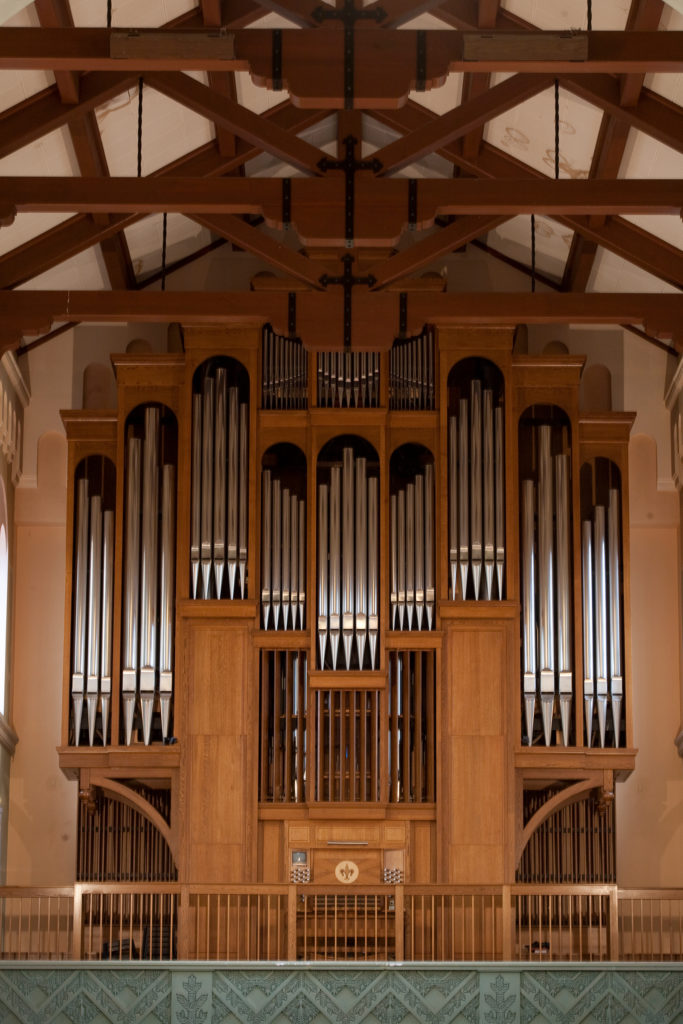
Martin Ott Opus 80 at Mount Angel Abbey
Martin Ott Opus 80 was commissioned in 1993 as the grand organ for Mount Angel Abbey in St. Benedict, Oregon. The specification gives 35 stops, 44 ranks, two extensions, mechanical key action, and electric stop action. The old catalogue line gives 1993, but the Abbey chronology places construction between May 1997 and February 1998 and completion in June 1998. Mount Angel Abbey publishes 37 stops, 44 ranks and 2,478 pipes, rather than silently adopting the older 35-stop summary.
Inside the room: Mount Angel's grand organ
Opus 80's smaller companion, Opus 79, was built in 1995 and installed at the abbey in spring 1996. In St. Benedict, Oregon, Mount Angel Abbey supplied the room for this project. What survives about the room at Mount Angel Abbey is enough to say this: visible placement can often be recovered from the text and photographs, while the way sound decayed through the room needs measurements the page may not provide. Room dimensions and sound-decay figures are absent.
In the room documented at Mount Angel Abbey, the architecture helps explain why the instrument took this form, but the text is selective. A plan showing organ, choir and congregation together would sharpen the account of Mount Angel Abbey. The available account does not include it.
35 stops and 44 ranks: the scale of Opus 80
A first reading of the instrument begins with 35 stops and 44 ranks. The published numbers for Mount Angel Abbey support a narrower conclusion: the stop total describes selectable resources, while the rank total counts the underlying rows of pipes. The totals point to a substantial range of resources. They do not tell us whether the tonal weight lay in principals, reeds, enclosed colors or pedal work. For Opus 80, the abbreviated entry does not give the keyboard count. The summary notes 2 extensions; extension work allows pipework to be reused at another pitch or under another stop control. The full stoplist is still needed for a dependable tonal reading of Opus 80.
Counting pipe sets gives 9 more than counting stop controls in Opus 80. According to the 35-stop summary for Mount Angel Abbey, mixtures are one possible reason; the complete stoplist would settle the question. The page separately lists 2 extensions. For Opus 80, a complete specification would show where each rank actually appears.
Console and transmission: Mount Angel's grand organ
The action line for Opus 80 points to a direct physical connection between keyboard and valves. Organ builders usually call this tracker action. The technical description from Mount Angel Abbey documents one point: mechanical describes the system, not a promise that every key or coupling felt equally light. Stop selection was electric, while the keys retained their mechanical linkage. These were separate control systems.
The electrical system describes transmission, not musical character. Voicing and pipework remain separate parts of the story of Opus 80.
Wood, metal and placement: Mount Angel's grand organ
Several more months were devoted to technical installation and pipe voicing, and the instrument was completed in June 1998. Each manual keyboard had 61 notes. Granadilla was used for the natural keys, while the sharps were covered with cow bone. The mechanical key-action parts were made from hornbeam, and western cedar was used for the trackers. The case, console and placement clues belong to the individual story of Opus 80. In the design record for Mount Angel Abbey, further claims about internal construction would require drawings or an on-site survey.
Casework has two jobs here: it gives Opus 80 a public face and organizes the mechanism behind it. The design evidence from Mount Angel Abbey has one clear limit: the page does not say that every visible facade pipe was necessarily speaking.
From dedication to daily use: Mount Angel's grand organ
Construction of Opus 80 ran from May 1997 through February 1998. Opus 80 entered a working musical community at Mount Angel Abbey. For Opus 80, the page records selected people and events, while the routine life of services and rehearsals remains largely offstage. At Mount Angel Abbey, the account identifies no resident organist or later concert.
At Mount Angel Abbey, no program is available here to connect the stoplist with repertory. Local bulletins or musicians' papers may eventually supply that missing side of Opus 80.
Evidence, images and unanswered questions for Opus 80
The former builder's Opus 80 page, captured on February 6, 2020, supplies nine linked project images. Seven carry caption or credit context in the extracted material.
Mount Angel Abbey's institutional organ page adds a public photograph, the June 1998 completion chronology and its 37-stop, 44-rank, 2,478-pipe specification. That source closes the earlier photo and specification gap, but it does not state reuse rights for the image or provide a dated technical report on present condition.