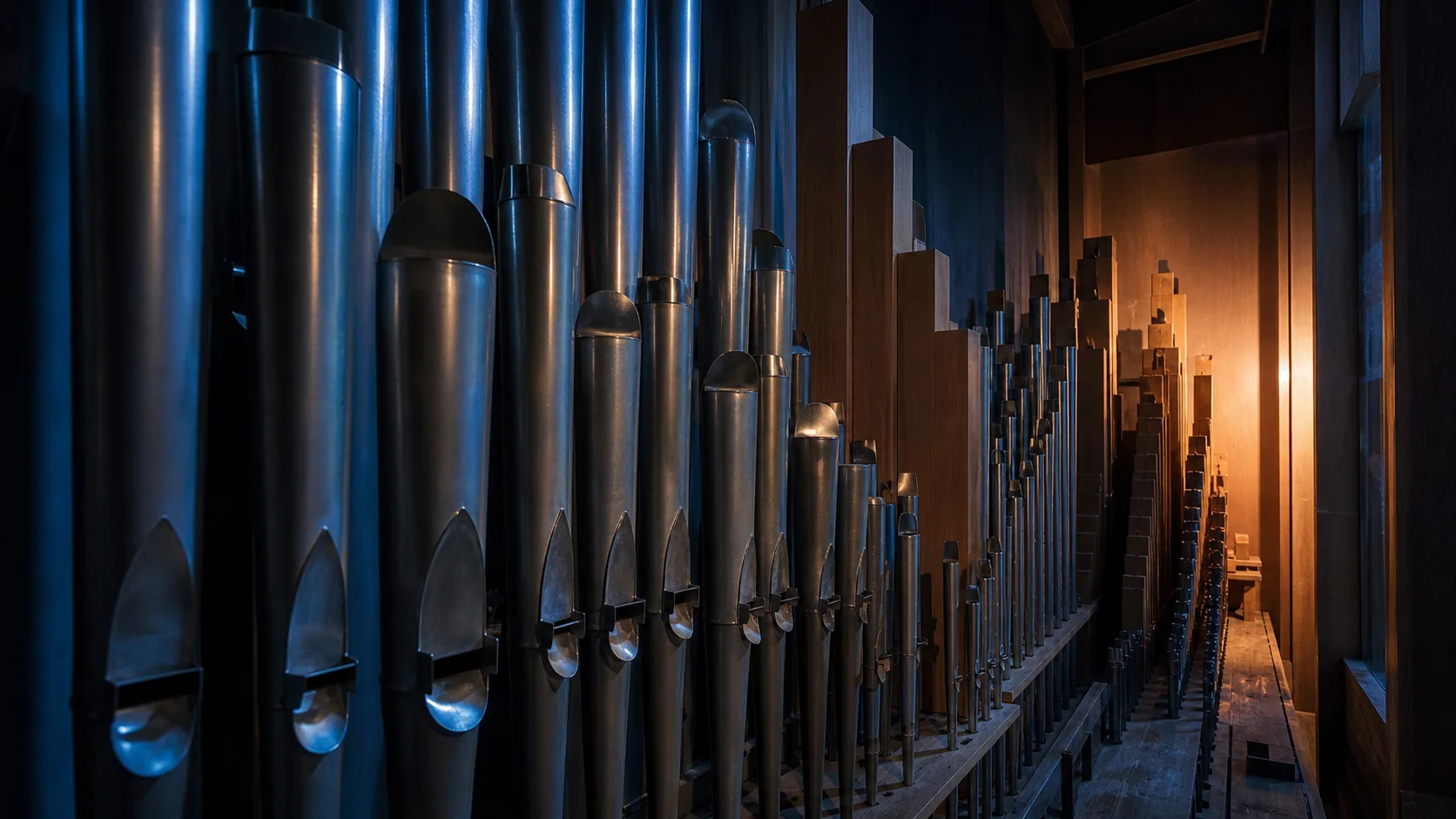
Martin Ott Opus 82 at Immanuel Lutheran Church
Martin Ott Opus 82 was commissioned in 1994 for Immanuel Lutheran Church in Cedarburg, Wisconsin. The specification gives 18 stops, 22 ranks, one extension, and mechanical action.
The space around the organ: Cedarburg's replacement tracker organ
The sanctuary's earlier electro-pneumatic organ had become mechanically unstable and was considered beyond repair. It stood on the sanctuary balcony. The setting was Immanuel Lutheran Church in Cedarburg, Wisconsin. The architectural record from Immanuel Lutheran Church shows that for an organ in worship, the player's view and the distance from singers can be as practical as the stoplist. This account follows the placement details recorded for Opus 82.
A photograph can confirm where the case stood at Immanuel Lutheran Church, but it cannot measure how sound carried. At Immanuel Lutheran Church, written dimensions or an acoustic report would be needed for that second question.
18 stops and 22 ranks: the scale of Opus 82
Opus 82 is summarized as an organ of 18 stops and 22 ranks. For Opus 82, the difference between those totals matters because a stop name does not always correspond to one independent rank. The figures describe moderate breadth, not volume. The published numbers for Immanuel Lutheran Church support a narrower conclusion: voicing, wind and the room would decide how large the organ seemed to a listener. The Opus 82 outline adds that the manual count is not stated in the short summary. The figures for Opus 82 also show that its 1 listed extension helps explain why stops and ranks need not form matching totals. One numerical limit remains in Opus 82: these totals establish scale; they do not replace the actual specification.
In Opus 82, the rank count exceeds the stop count by 4. Compound stops such as mixtures can place several ranks under one control, but their allocation is not given. The page separately lists 1 extension. At Immanuel Lutheran Church, that distinction keeps a numerical summary from turning into a guessed tonal scheme.
Control at the keydesk: Cedarburg's replacement tracker organ
The key action of Opus 82 is mechanical, or tracker, in the company description. At Immanuel Lutheran Church, a key moves connected parts that open the pallet for its note. For Opus 82, the label explains the route of command, while touch weight still depends on leverage, couplers and regulation.
The detached console made the mechanical layout of Opus 82 unusually visible. The technical description from Immanuel Lutheran Church documents one point: trackers and intermediate parts had to carry each key movement across the recorded distance to the chests.
Construction in the room: Cedarburg's replacement tracker organ
The case was built from solid oak, with raised panels of quarter-sawn oak. Carved pipe shades were plated with 23.5-karat gold. The detached console left space for the church choir between the console and organ case. Taken together, these construction details give Opus 82 a physical identity beyond its stop count. At Immanuel Lutheran Church, a complete case drawing and internal chest plan are still missing.
In the design record for Immanuel Lutheran Church, console position can reveal the intended relationship between player, choir and room. It does not, by itself, explain the internal division plan of Opus 82.
Programs and performance evidence: Cedarburg's replacement tracker organ
The source also says its Romantic design no longer met the congregation's musical needs. Opus 82 was commissioned as a replacement that could support a broader repertoire. Stop totals outline resources; they do not tell us the music heard at Immanuel Lutheran Church. The strongest evidence comes from named organists, dedicatory events and any commission goals recorded for Opus 82. The surviving text gives no dated performance event.
In the musical record for Immanuel Lutheran Church, without a named player or program, the musical account remains modest. That is preferable to assigning repertory to Opus 82 from its stop count alone.
Evidence, images and unanswered questions for Opus 82
The starting point is Martin Ott's own Opus 82 page, retained in its February 6, 2020 form. Readers can compare the account with 2 images linked on that page. According to the surviving sources for Immanuel Lutheran Church, each file was linked directly from the same project entry. For Opus 82, none carries an individual photographer credit in the extracted text. The Opus 82 evidence also shows that that dated account is useful for the commission history, not as proof of the organ's state today. One documentary limit remains for Opus 82: a modern condition note would bring the history forward without rewriting the older evidence.