Martin Ott Opus 83 at First Presbyterian Church
Martin Ott Opus 83 was commissioned in 1995 for First Presbyterian Church in Urbana, Illinois. The stop specification gives 24 stops and 30 ranks, with tracker action and a detached console.
Where the instrument stood: the Urbana balcony and detached console
The contemporary sanctuary placed the organ at the center of the balcony. That distance left room for three choir risers while preserving the responsive keyboard touch described by the source. First Presbyterian Church in Urbana, Illinois gave Opus 83 its architectural setting. A church organ shares the interior with singers and worshippers, so case position and sight lines belong to the musical history whenever the commission description names them.
The interior is best read through concrete clues: case position, nearby architecture and the player's relation to other musicians. Opus 83 should not be assigned a reverberation profile from appearance alone.
24 stops and 30 ranks: the scale of Opus 83
The catalogue figures for Opus 83 read 24 stops and 30 ranks. One total counts the player's controls, the other the rows of pipes available behind them. According to the 24-stop summary for First Presbyterian Church, its numerical scale is neither miniature nor among the firm's largest. The musical plan still rests in the missing sequence of names of the stops and pitches. The overview does not state the number of keyboards. A stop-by-stop account of Opus 83 must wait for the complete disposition.
Opus 83 has 6 more ranks than stops. A mixture could explain part of the gap, although the abbreviated record does not place it. For Opus 83, the arithmetic offers a check against the missing stoplist.
The playing action: the Urbana balcony and detached console
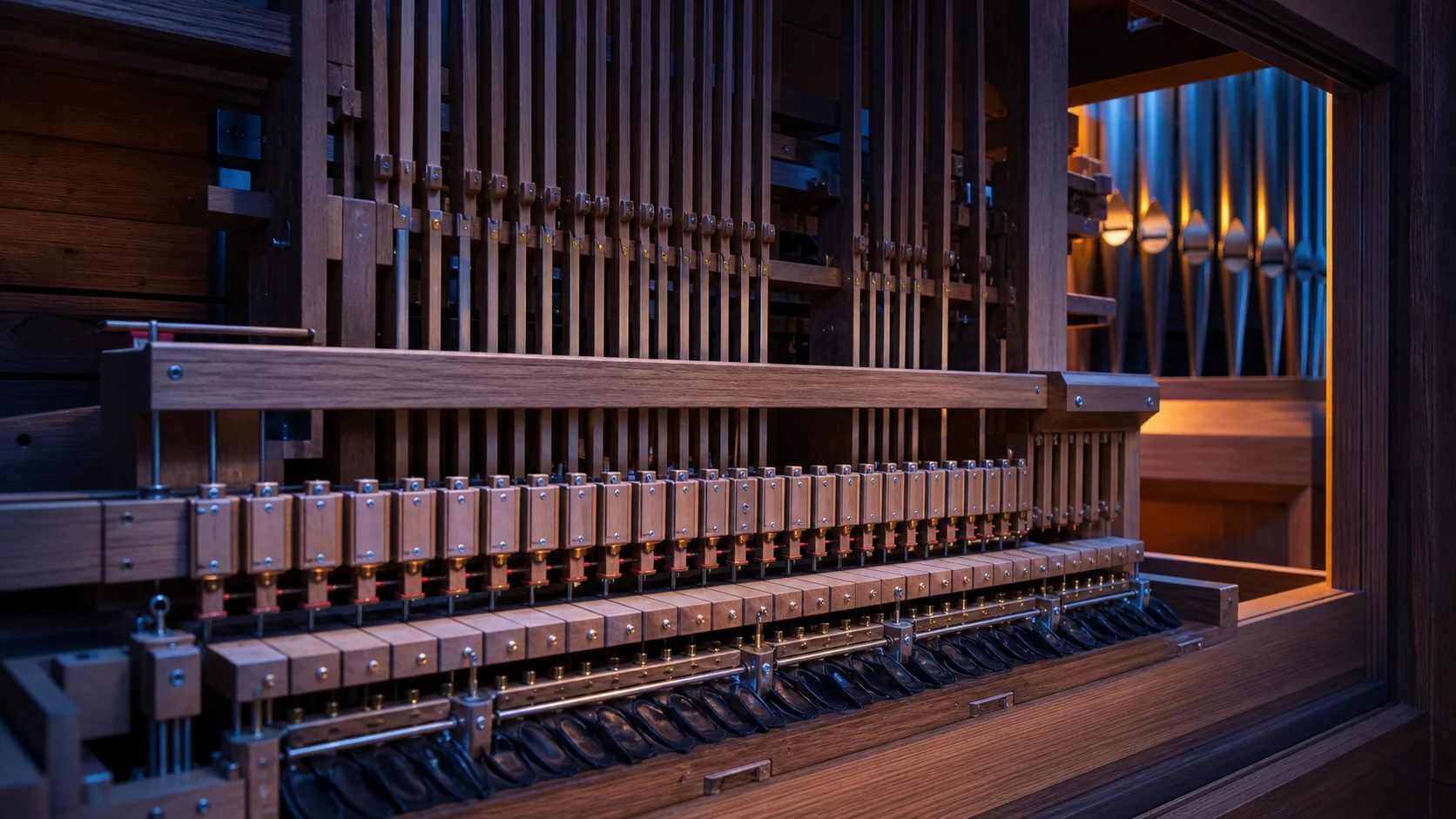
In Opus 83, the player reached the windchest through a direct tracker linkage instead of an electrical key command. This is the basic meaning of tracker action. It cannot tell us how the keyboard felt when completed or how the action has worn since installation.
In Opus 83, the space between console and case was crossed by direct tracker linkage. The entry records that arrangement but gives no measurements for key resistance or lost motion.
How the instrument was arranged: the Urbana balcony and detached console
Red oak was used for the casework. The detached mechanical-action console stood about ten feet from the organ case. The materials and placement named here make the organ project recognizable in project images, although they do not provide a pipe-by-pipe inventory or a complete set of workshop drawings for Opus 83.
A well-framed installation image may verify timber, placement and facade pattern. Windchests, trackers and enclosed divisions of Opus 83 remain only partly visible in that image.
Listening history: the Urbana balcony and detached console
A drawing by Humayun Somjee was dated 1994, one year before the organ project recorded on the entry. The company entry does not document subsequent alterations, ownership, or condition. The musical history at First Presbyterian Church begins where the record names a player, a recital or a reason for the organ project. At First Presbyterian Church, regular service use and later concerts need their own documentation. No dedicatory recital is named in the surviving material.
The project entry is quiet about performances. A church, school or owner's archive may hold the first dependable musical date for Opus 83.
Evidence, images and unanswered questions for Opus 83
For Opus 83, the closest source is the former builder's project entry dated February 6, 2020. It links 3 images from the corresponding project directory. Together they form the image record published beside Opus 83. Of those files, 1 carries caption or credit context. Without captions, the views remain broad evidence and cannot settle questions about later alterations. Dated images or an institutional inventory could carry the account forward.