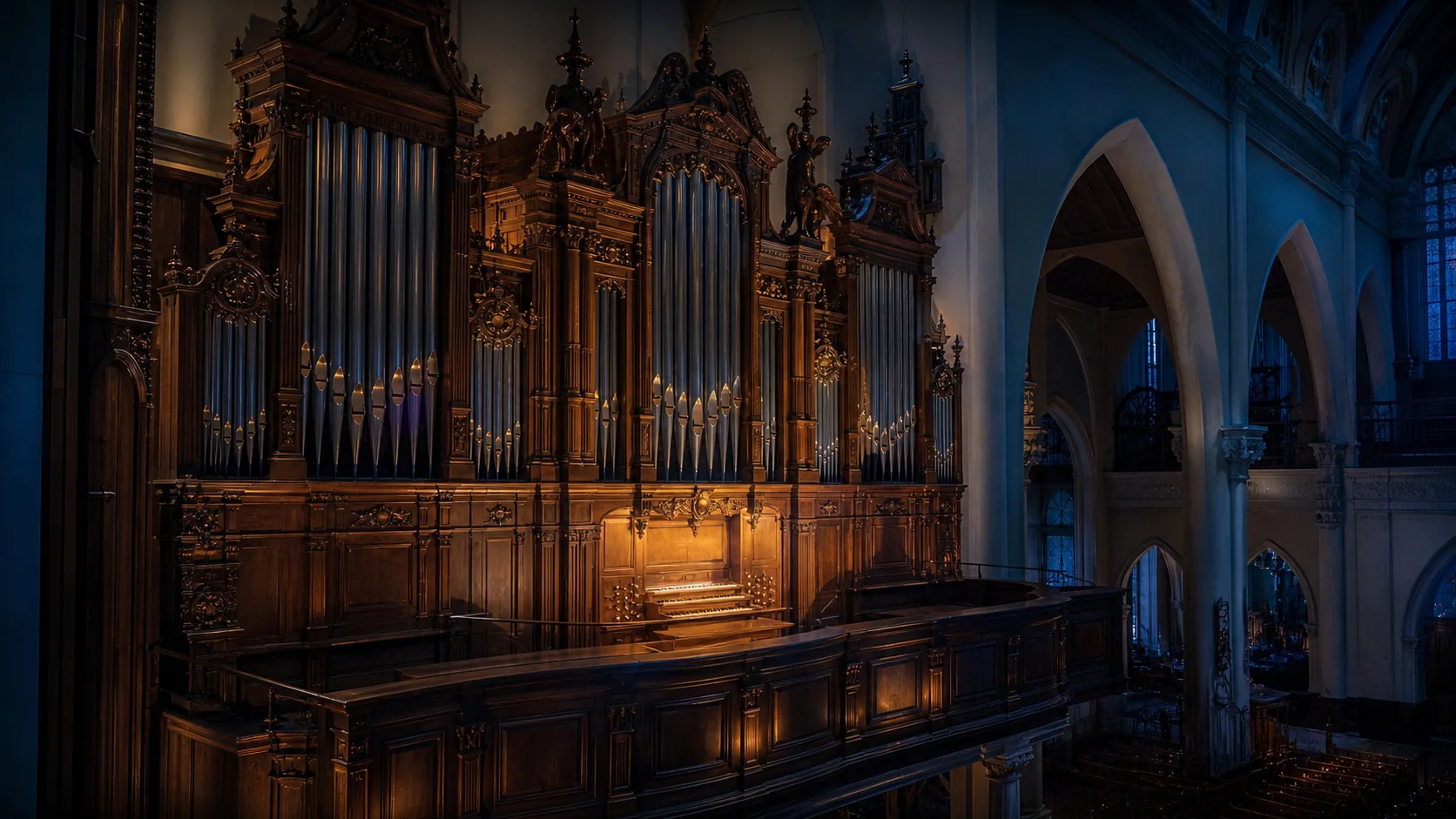
Martin Ott Opus 85 at St. Mark's Lutheran Church
Martin Ott Opus 85 was commissioned in 1995 for St. Mark's Lutheran Church in Asheville, North Carolina. The stop specification gives 21 stops, 27 ranks, one extension, mechanical key action, and electric stop action.
Balcony, altar and sight lines: St. Mark's detached mechanical console
The organ stood at the front of the church. The organ project brought Opus 85 into St. Mark's Lutheran Church, Asheville, North Carolina. The interior actively shaped the commission: space for singers affected the installation, while the surviving narrative leaves several spatial questions open. No measured acoustic data accompanies the commission history.
Balcony, chancel and positions on the floor set practical limits for an installation. Where the entry names one for Opus 85, it is a detail established by the project record rather than a broad guess about the building. No such measurements accompany the old page.
21 stops and 27 ranks: the scale of Opus 85
On paper, Opus 85 offers 21 stops drawn from 27 ranks. The two figures answer different questions: one counts console controls, the other pipe sets. Within the published specification for St. Mark's Lutheran Church, this count suggests room for contrasting families without describing their balance. For Opus 85, a stoplist is needed before calling the design bright, dark, orchestral or classically ordered. The number of manuals requires the complete stop specification. Its 1 listed extension helps show why stop and rank figures can differ. Arithmetic cannot reveal the builder's priorities; the disposition can.
Because ranks outnumber stops by 6 in Opus 85, at least some controls may represent compound pipework. Within the published specification for St. Mark's Lutheran Church, the abbreviated figures do not assign those ranks to divisions. The entry separately lists 1 extension. The numerical relationship is helpful, but it is not a substitute for the disposition.
Touch, coupling and response: St. Mark's detached mechanical console
No electrical key command is listed for Opus 85; the keys worked mechanically to admit wind to the pipes. The technical description from St. Mark's Lutheran Church documents one point: this gives a clear technical category but not a condition report. Coupling load and present regulation remain unknown. Its electric stop system did not replace the tracker key action. The two served different parts of the organist's control.
For Opus 85, action type and tonal design should be read on separate lines. The action record from St. Mark's Lutheran Church is precise on this point: one concerns control; the other concerns what the pipes were made to say.
Cabinet, console and pipework: St. Mark's detached mechanical console
Opus 85's red oak case was separated from the detached mechanical-action console. The entry also records the organ's front placement, red oak case and detached mechanical-action console. For Opus 85, the record records enough construction detail to discuss the installation without claiming to recreate the whole organ. Neither windchest drawings nor full case dimensions survive here.
For Opus 85, the organ case and console belong to the documentary story, not merely the decoration. Their arrangement preserves practical decisions made for this room.
Players and occasions: St. Mark's detached mechanical console
The company entry names Bonnie Richards as director of music and Scott Riedel as organ consultant. Paul Weber and Florence Weber played the dedicatory recital. It does not document subsequent alterations, ownership, or condition. The specification lists resources at the console, not the repertory heard in St. Mark's Lutheran Church. Concert programs, parish bulletins and recordings could build that outline into a richer listening history. What followed would need programs or institutional records.
The dated recital, concert or dedication identified above gives Opus 85 a fixed point in musical history. At St. Mark's Lutheran Church, it does not describe everything heard before or after that occasion.
Evidence, images and unanswered questions for Opus 85
This history draws on the company's Opus 85 project entry as it stood on February 6, 2020. Alongside the written account are 2 project-page images. The company grouped these files as its gallery for Opus 85. No photographer is identified beside these files. The surviving evidence can identify the commission without serving as a modern inspection report. New evidence should begin with the institution, a named photographic credit and a date.