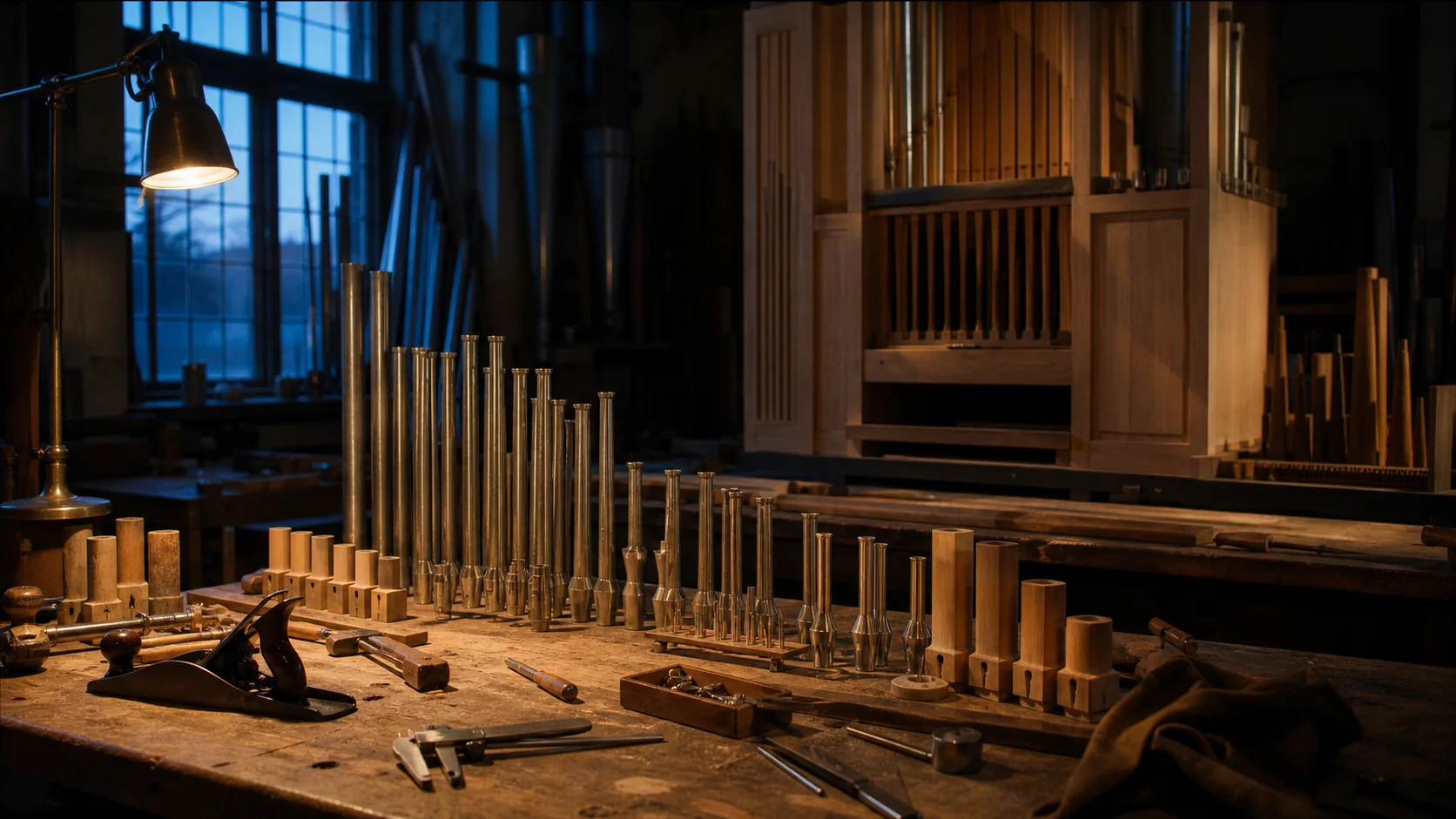
Martin Ott Opus 86 at Grace Cathedral
Martin Ott Opus 86 was commissioned in 1996 for Grace Cathedral in Topeka, Kansas. The finished specification gives eight stops and ten ranks with tracker action.
The architectural setting: Grace Cathedral's black-walnut organ
The instrument stood along the west wall of St. Mary's Chapel, opposite a stained-glass window. Ralph C. Flowers, a longtime member of the cathedral choir, left a bequest for a small two-manual organ with a full pedalboard in the chapel. After his death in 1995, Dean Marc D. Lee appointed a chapel organ committee, which selected the Martin Ott Pipe Organ Company. In Topeka, Kansas, Grace Cathedral supplied the interior for this project. Photographs may establish placement, but only measurements can describe the room's decay time.
The architecture helps account for the instrument's form, although the written record remains selective. An architectural plan placing organ, choir and congregation together would clarify the record of Grace Cathedral.
8 stops and 10 ranks: the scale of Opus 86
A first reading of the instrument begins with 8 stops and 10 ranks. The stop total describes selectable resources, while the count of pipe ranks counts the underlying rows of pipes. Such a scale suits practice, continuo or intimate rooms when the surrounding commission history supports that use. The two counts alone do not assign a purpose. The condensed entry does not give the keyboard count. A reliable tonal reading still requires the full stoplist of Opus 86.
Counting rows of pipes gives 2 more than counting stop controls in Opus 86. Mixtures are one possible reason; the full disposition would settle the question. A full specification would show where each rank actually appears.
Key action in practice: Grace Cathedral's black-walnut organ
The action line for Opus 86 points to a direct physical connection between keyboard and valves. Organ builders usually call this tracker action. At Grace Cathedral, mechanical describes the system, not a promise that every key or coupling felt equally light.
An attached console makes the organ case itself the player's workstation. For Opus 86, that fact is documented even though key depth and touch weight are not.
Casework and layout: Grace Cathedral's black-walnut organ
Opus 86's attached keydesk and case were made from Missouri black walnut, and its two manuals shared a common wind chest and swell expression. Casework, console and siting give an individual profile to Opus 86. Further claims about construction inside the case would require drawings or a survey made at the site.
Casework has two jobs here: it gives Opus 86 a visible architectural presence and organizes the mechanism behind it. The entry does not say that every visible front pipe was certainly a sounding pipe.
The organ in use: Grace Cathedral's black-walnut organ
The original contract prepared for two later stops; Harold H. Geer and others gave them in memory of John C. Lincoln. The completed ten-rank instrument was installed in November 1998. Opus 86 entered a working musical community at Grace Cathedral. The entry records selected people and events, while the ordinary rhythm of services and rehearsals remains largely offstage. The surviving text gives no dated performance event.
No program is available here to connect the disposition with repertory. Local bulletins or musicians' papers may eventually supply that missing side of Opus 86.
Evidence, images and unanswered questions for Opus 86
A copy of the Martin Ott project entry was captured on February 6, 2020 and documents Opus 86. Its visual material consists of 3 linked images. They are the project views the former company chose to publish with Opus 86. The image group offers no individual credit line. The dated page cannot establish subsequent ownership or maintenance. A current institutional photograph and full disposition would fill the largest gaps.