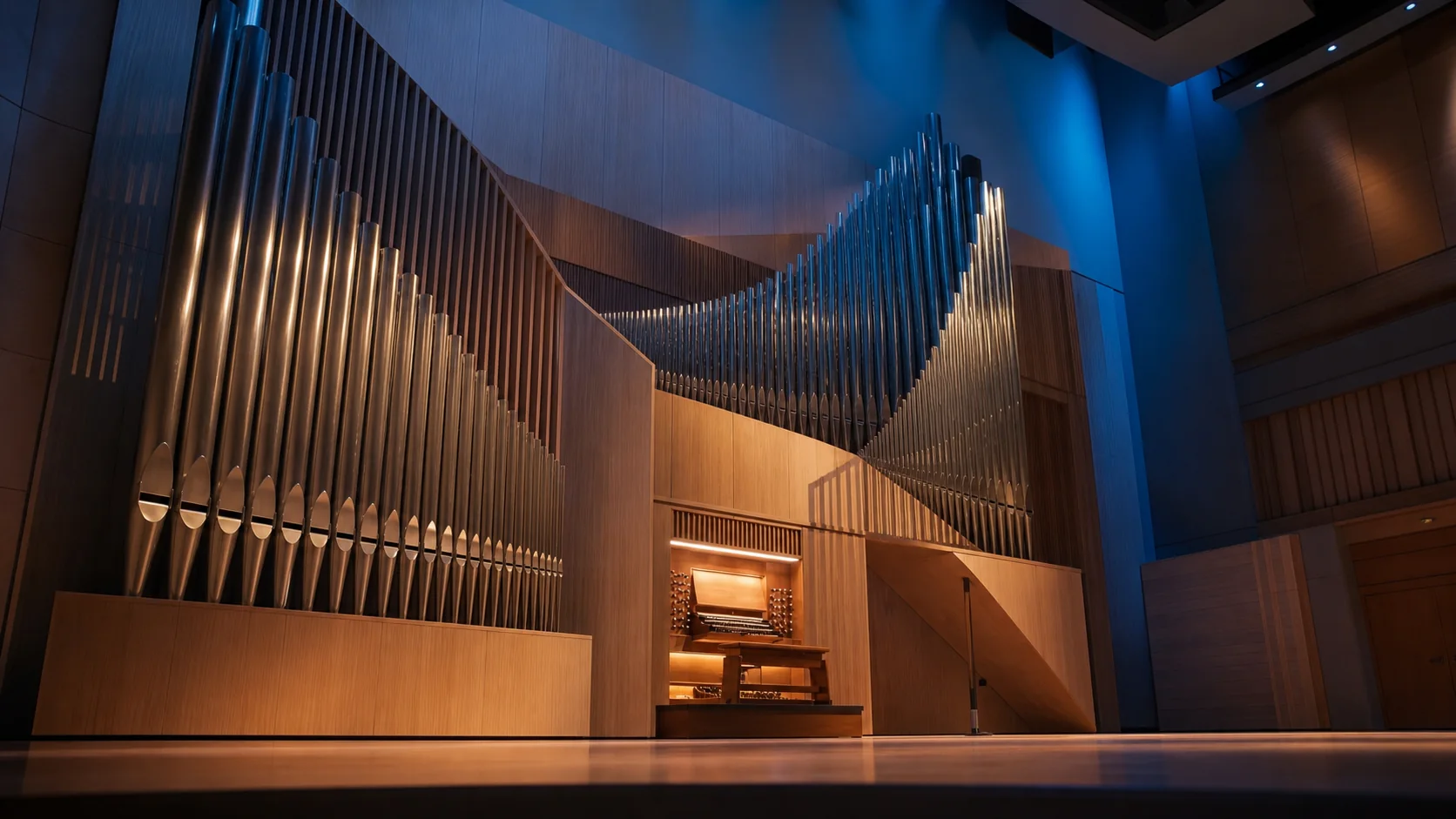
Martin Ott Opus 87 at Jacobs School of Music, Indiana University
Martin Ott Opus 87 was commissioned in 1997 for the Jacobs School of Music at Indiana University in Bloomington. The archived overview gives five stops and five ranks with tracker action.
How the room shaped the commission: Indiana University's teaching organ
Jacobs School of Music, Indiana University in Bloomington, Indiana places Opus 87 within a teaching institution. An academic organ may support lessons, practice or recitals, but the commission account must tell us which of those roles actually applied. Its helpful evidence lies in the identified room, placement and people. The written account includes no acoustic measurements.
The institution's name identifies the setting, but not the exact balance between teaching and public performance. Photographs can help place Opus 87; schedules and programs would explain its use. That evidence has not yet surfaced.
5 stops and 5 ranks: the scale of Opus 87
The short specification lists 5 stops against 5 ranks. A rank is one row of pipes, while a stop is the organist's means of selecting a resource. The published numbers for Jacobs School of Music, Indiana University support a narrower conclusion: this is a small instrument by pipe-organ standards, though pitch levels and pipe families can still provide useful contrast. The record does not state how many manuals were available to the player. Without stop names and pitches, a claim about color would outrun the evidence.
The two counts are equal for Opus 87. Equal totals are tidy on paper but do not remove the need to inspect divided, compound or borrowed stops. The published numbers invite questions that only the names of the stops can settle.
The route from key to pipe: Indiana University's teaching organ
According to the action account for Jacobs School of Music, Indiana University, pressing a key on a mechanical organ sets a train of parts in motion until a pallet opens at the windchest. That is the arrangement named for Opus 87. The surviving description does not record touch weight, wear or subsequent maintenance.
Under the action description for Jacobs School of Music, Indiana University, tracker layout links architecture and touch: distance, turns and couplers all affect the path. The short account of Opus 87 does not provide those shop dimensions.
Materials and workmanship: Indiana University's teaching organ
Although the instrument had three manuals, the bottom keyboard, Manual I, functioned by coupling Manuals II and III together. This arrangement simulated the resources of a three-manual organ within the compact specification. The playing console also included pistons and a swell shoe for practical use. Oak was used for the organ case. Beyond the manual arrangement, console aids, case material, and commission credit, the company entry supplies no later account of the organ's location, alterations, ownership, or condition. These details help separate Opus 87 from nearby commissions in the firm's catalogue. The project entry is not a technical survey, which would require another kind of source.
Case and key materials document craft and appearance, not tonal design. They document craft and appearance; pipe composition and voicing need separate evidence for Opus 87.
Recitals, worship and memory: Indiana University's teaching organ
The source names professor emeritus Larry Smith, then chair of the Jacobs School organ department, as the commissioner. The educational setting broadens the possible uses of Opus 87, yet it does not write the concert history for us. Department records and recital programs would supply that missing chronology. No dedicatory recital is named in the surviving material.
A specification describes potential; performance records describe use. The second kind of evidence is still missing for Opus 87.
Evidence, images and unanswered questions for Opus 87
The company entry for Opus 87, preserved from February 6, 2020, provides the commission facts used here. The associated gallery contains 1 image. The dated project gallery links all of them to the Opus 87 page. Photographer names are not attached to these images. The entry proves their association with the commission, but it does not establish present condition or ownership. The best additions would be a recently credited image and the complete stop specification.