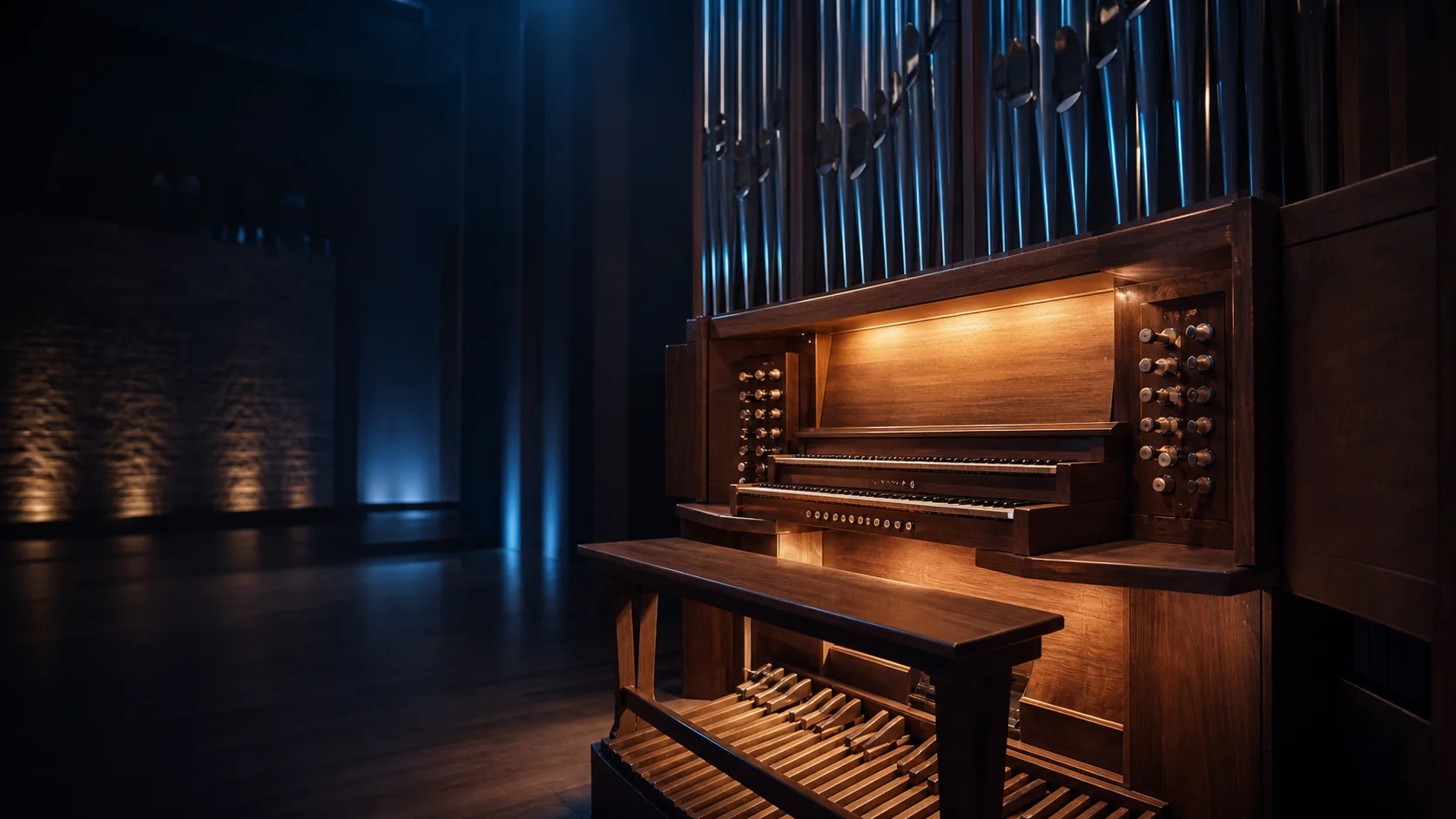
Martin Ott Opus 89 at Marmion Abbey
Martin Ott Opus 89 was commissioned in 1997 for Marmion Abbey in Aurora, Illinois. The stop specification gives 18 stops and 22 ranks with suspended tracker action.
Reading the sanctuary: Sascha Ott's Marmion Abbey case
The organ stood at the front of the worship space, to the left of the altar. Marmion Abbey in Aurora, Illinois gave Opus 89 its architectural setting. A church organ shares the interior with singers and worshippers, so case position and sight lines belong to the musical history whenever the commission description names them.
The interior is best read through concrete clues: case position, nearby architecture and the player's relation to other musicians. Opus 89 should not be assigned a reverberation profile from appearance alone.
18 stops and 22 ranks: the scale of Opus 89
The catalogue figures for Opus 89 read 18 stops and 22 ranks. One total counts the player's controls, the other the rows of pipes available behind them. The 18-stop, 22-rank summary for Marmion Abbey shows that the scale sits between a practice organ and the largest church installations. For Opus 89, it leaves open how the builder divided resources among principals, flutes and reeds. The overview does not state the number of keyboards. A stop-by-stop account of Opus 89 must wait for the complete disposition.
Opus 89 has 4 more ranks than stops. A mixture could explain part of the gap, although the abbreviated record does not place it. For Opus 89, the arithmetic offers a check against the missing stoplist.
Keys and windchests: Sascha Ott's Marmion Abbey case
The key action in Opus 89 was mechanical and suspended. Each key therefore worked through connected parts, while the term suspended refers to the hanging pull of the action. It says nothing certain about how heavy the keyboard felt after installation.
Touch is a physical result, not a synonym for tracker action. A player or technician would need to examine Opus 89 before describing its present feel.
The organ as an object: Sascha Ott's Marmion Abbey case
Sascha Ott, Martin Ott's son, designed its red oak case. Its surviving evidence is limited to the stop specification, placement, case designer, project names, and recital date. The materials and placement named here make the organ project recognizable in project images, although they do not provide a pipe-by-pipe inventory or a complete set of workshop drawings for Opus 89.
A well-framed installation image may verify timber, placement and facade pattern. Windchests, trackers and enclosed divisions of Opus 89 remain only partly visible in that image.
Musical life around the instrument: Sascha Ott's Marmion Abbey case
The source names Abbot Vincent P. Bataille, O.S.B., in the commission record. Marie Kremer served as organ consultant, and Karel Paukers played the dedicatory recital on Sunday, March 21, 1999. The captured company entry gives no further account of subsequent alterations, relocation, ownership, or condition. The musical history at Marmion Abbey begins where the record names a player, a recital or a reason for the organ project. The performance evidence for Marmion Abbey sets the limit of the account: regular service use and later concerts need their own documentation. Its subsequent concert life is not described.
The musical event named on the entry supplies a date that can be checked against local records. It leaves room for a longer chronology of Opus 89.
Evidence, images and unanswered questions for Opus 89
For Opus 89, the closest source is the former builder's project entry dated February 6, 2020. At Marmion Abbey, it links 3 images from the corresponding project directory. Together they form the image record published beside Opus 89. The entry does not name a photographer for the listed views. Without captions, the views remain broad evidence and cannot settle questions about later alterations. Dated images or an institutional inventory could carry the account forward.