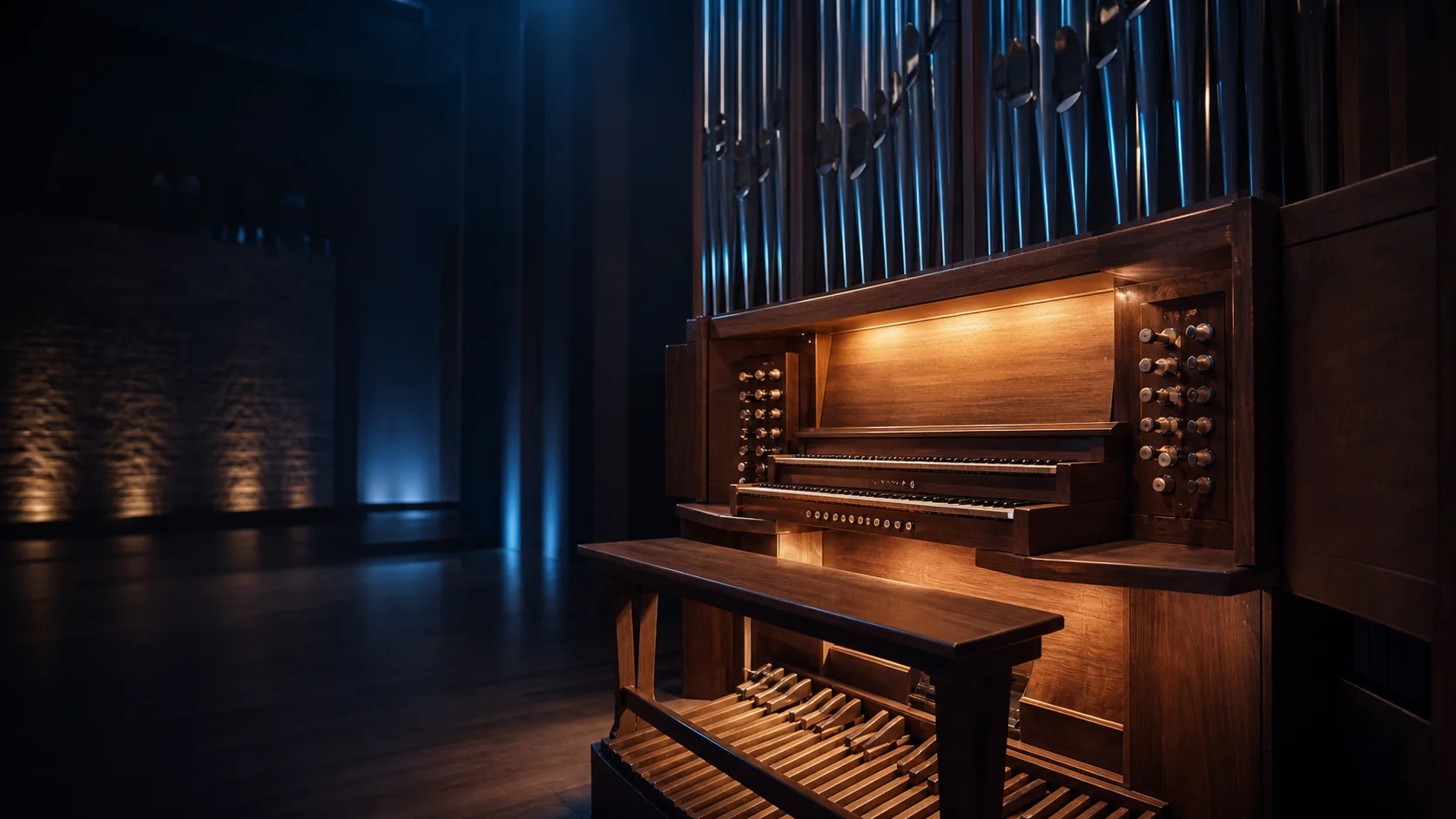
The instrument associated with Trinity Lutheran Church: Opus 9
Martin Ott Opus 9 was a 15-stop, 19-rank mechanical organ built in 1977 for Trinity Lutheran Church in Kirkwood, Missouri. It originally stood at the center front of the sanctuary, with choir seating on both sides of the altar. Wolfgang Rübsam played the dedicatory recital on November 18, 1979.
The project material attaches 1977 to Opus 9. It does not label that figure as the contract, completion, installation, or dedication date. The firm coordinates are Trinity Lutheran Church and Kirkwood, Missouri; a dated programme or contract could narrow the sequence. Nothing in the year alone establishes the present site or playing condition.
The room question behind Opus 9
The builder page places the project at Trinity Lutheran Church in Kirkwood, Missouri, which identifies a worship setting rather than a recital hall or private house. That distinction matters, but it does not supply an acoustic survey. The source gives no verified room volume, surface plan, seating figure, or reverberation time. It is therefore reasonable to discuss the church context while leaving the sound of the room undescribed.
Reading the numerical outline for Trinity Lutheran Church: Opus 9
The surviving overview gives 15 stops and 19 ranks. A stop is the named control available to the player; a rank is a set of pipes following the compass at one pitch and tone colour. Opus 9 therefore has 4 more listed ranks than stops. Compound stops are one possible reason, but the totals do not identify the affected controls. Manual divisions, pedal resources, pitches, and individual stop names are needed before anyone can describe the tonal design in detail.
The numerical line for Opus 9 offers a practical point of comparison for future research at Trinity Lutheran Church. If a later stop list appears, its divisions and pitches can be checked against 15 stops | 19 ranks Mechanical action. Any difference might mark an alteration, a relocation, or a correction to the old summary. Until such a document is dated and attributed, the surviving figures remain the safest description of scale.
Touch, control, and the missing technical detail: Opus 9
For Opus 9 at Trinity Lutheran Church, the overview identifies mechanical action, meaning that motion at a key is carried through a physical linkage toward the valve admitting wind to the pipework. That wording describes the command path, not the case layout, linkage geometry, or present touch. It also does not prove that the stop controls were mechanical unless the page says so separately.
What the project facts suggest, cautiously: Opus 9
Two documented details frame this project: it originally stood at center front and the church seating was reversed in 1986. These facts belong to a church commission, where registration and placement may affect how voices are supported. They do not establish the complete tonal plan or show how the congregation used the organ. A stop list, programme, or dated building account would allow a closer musical reading. The listed 15-stop, 19-rank scale remains the numerical boundary for this reading.
What happened after the organ was built: Opus 9
The church reversed its seating in 1986. The altar moved to the opposite end, leaving the organ and musicians in the rear position. The archived account thus documents two room plans for the same instrument: the front-facing arrangement heard at the 1979 dedication and the reversed sanctuary layout adopted seven years later.
Where the evidence stops for Opus 9
The historical page for Opus 9 links 1 matching image file, beginning with images/009/009_m.jpg. The filename connects the material with the page for Trinity Lutheran Church, but it does not grant publication rights. No usable creator and licence statement appears in the extracted caption material.
The last named event in the Opus 9 history is still a historical marker, not a report on the instrument today. A current note from Trinity Lutheran Church could establish location and condition. A dated stop list would let readers compare the surviving specification with the project as it now stands.