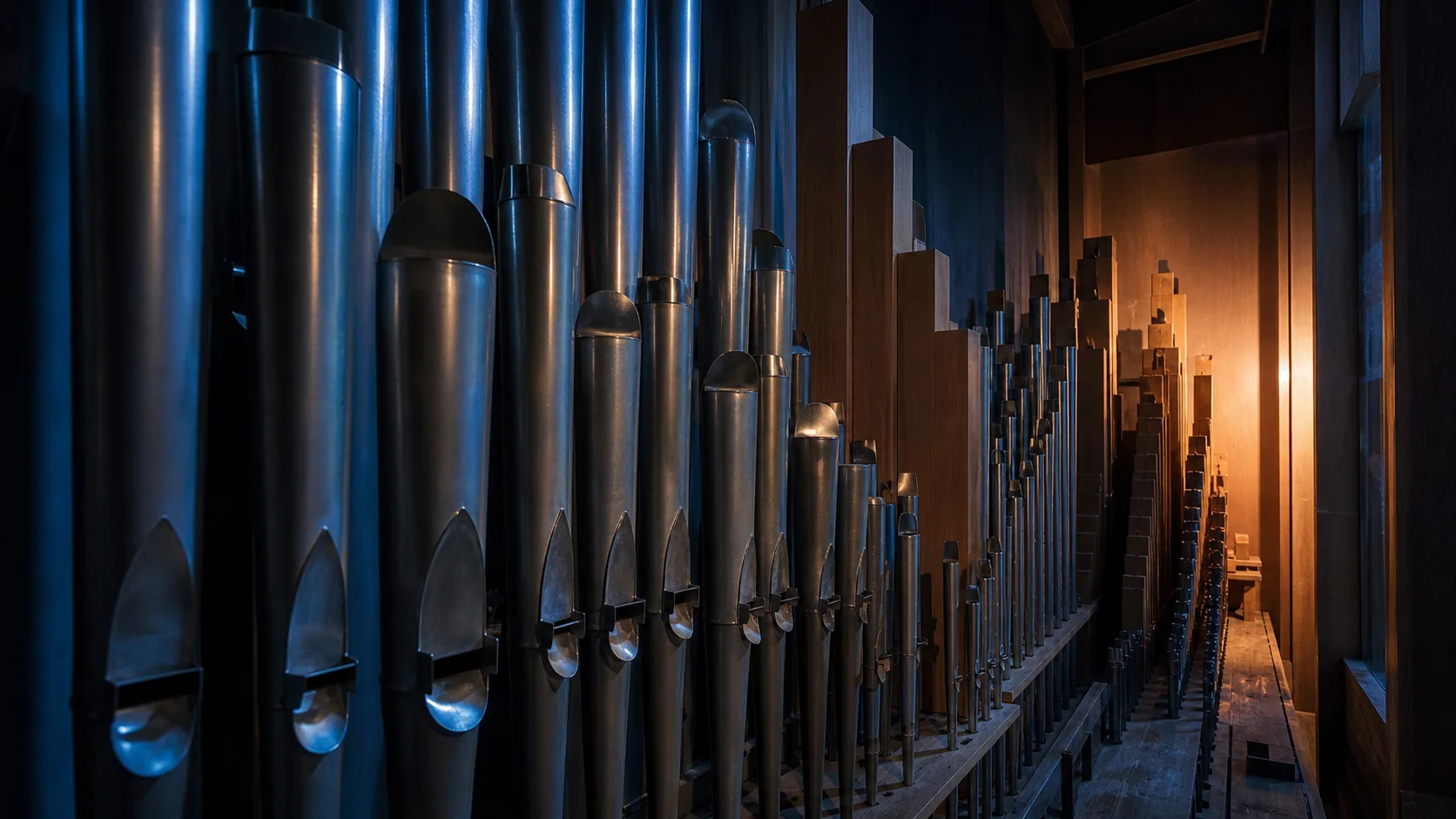
The 1988 chapter of Opus 10 at Furman University
Martin Ott Opus 10 began as an oak-cased house organ commissioned by Jane Shipp for a residence in Fulton, Missouri. A plate says it was built for Mary Jane Shipp in December 1978. The page then records moves to University City in 1983 and Bozeman, Montana, in 1989.
Opus 10 appears in the catalogue under 1988. Catalogue dates can mark different stages of an organ project, and this entry does not choose among them. For Furman University in Greenville, South Carolina, the exact stage remains open unless a narrative or dated document names it. Current status requires newer evidence than the catalogue year.
Greenville as the setting for Opus 10
Opus 10 is tied to Furman University, Greenville, South Carolina. The institutional title is useful because it separates an academic project from a parish or residence instrument. It does not reveal whether the organ stood in a studio, chapel, classroom, or hall unless the narrative says so. No current condition or access claim follows from the historic association.
The recorded scale of Opus 10 at Furman University
Opus 10 is listed with 9 stops and 8 ranks. Those numbers answer different questions: stops describe controls, while ranks count sets of pipes. Opus 10 lists 1 more stop than ranks. Shared or extended pipework can produce that pattern, but these two numbers do not reveal the borrowing scheme. The figures establish the documented scale, not the exact number of pipes, the balance between divisions, or the sound of a particular chorus.
At Furman University, the recorded overview for Opus 10 is useful because it fixes the scale associated with the historical project. That Opus 10 line cannot explain voicing or the balance between divisions. A later specification from Greenville, South Carolina could show whether the count remained stable and whether any stop changed name, pitch, or function. For Opus 10, the older total is reported without assuming continuity.
Action and control in the Greenville project: Opus 10
For Opus 10 at Furman University, mechanical action is the listed key system. In broad terms, the player's finger moves a chain of physical parts rather than sending only an electrical command. The entry does not give tracker lengths, key weight, console distance, or a condition report, so no claim is made about responsiveness now.
Beyond the totals: one clue from Furman University: Opus 10
Beyond the totals, Opus 10 is defined by the source's own sequence: its inscription is dated December 1978 and it was moved to University City in 1983. Within an academic setting, specification and access can serve very different kinds of work, from individual practice to recital. A named function can be reported when the project history supplies it; the institution label alone is not enough. The evidence does not reconstruct curriculum, repertoire, teaching practice, or current availability. The listed 9-stop, 8-rank scale remains the numerical boundary for this reading.
The later chapter at Furman University: Opus 10
In 2002 the nine-stop, eight-rank mechanical instrument was given to Furman University, identified as J. Shipp's alma mater. The entry preserves an itinerary rather than a dedication history. Its December 1978 inscription should remain distinct from the separate date wording in the catalogue, which the source itself does not reconcile. No recital is named.
Photographs and unanswered questions from Greenville: Opus 10
Image evidence for Opus 10 begins with images/010/010_m1.jpg; 4 linked files carry the same project number. That is enough to investigate identity, not enough to treat the files as freely reusable photography. The source page for Furman University supplies no complete credit or licence.
What remains unknown about Opus 10 is concrete: its present location, condition, and complete current specification. The Furman University history could be extended by an identified console or case photograph and a dated institutional account. Until then, the old chronology is not evidence of current access.