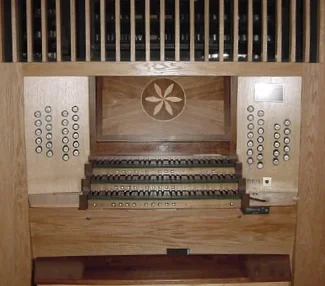
Martin Ott Opus 94 at Atonement Lutheran Church
Martin Ott Opus 94 was commissioned in 1997 for Atonement Lutheran Church in Overland Park, Kansas. The stop specification gives 38 stops, 55 ranks, one extension, mechanical key action, and electric stop action. The former builder assigns a 1997 commission date and records the Rückpositiv as completed in 2006. The Greater Kansas City AGO labels Opus 94 as a 2001 instrument completed in 2007. Commission, first phase, added division and project completion are therefore kept as separate milestones.
A room shaped for sound: Atonement's staged balcony project
The architects and acoustic consultants planned a rear balcony with the organ on the left and choir space on the right. The mechanical key action could adjust for humidity and temperature, and a closed-circuit monitor linked the player visually with the choir director, altar, and narthex. The setting was Atonement Lutheran Church in Overland Park, Kansas. For an organ in worship, the player's view and the distance from singers can be as practical as the disposition. This account follows the placement details recorded for Opus 94.
A photograph can confirm where the organ case stood at Atonement Lutheran Church, but it cannot measure how sound carried. In the room documented at Atonement Lutheran Church, written dimensions or an acoustic report would be needed for that second question.
38 stops and 55 ranks: the scale of Opus 94
Opus 94 is summarized as an organ of 38 stops and 55 ranks. A stop need not correspond to a single independent rank, which is why the two totals deserve separate reading. This is a broad specification, but a large count is not a synonym for loudness. Wind pressure, voicing and the interior still govern the result. The manual count is not stated in the brief outline. Its 1 listed extension helps show why stop and rank figures can differ. The totals establish scale but cannot replace the actual specification.
In Opus 94, the rank count exceeds the stop count by 17. The published numbers for Atonement Lutheran Church support a narrower conclusion: compound stops such as mixtures can place several ranks under one control, but their allocation is not given. The entry separately lists 1 extension. That distinction prevents a numerical outline from becoming an invented tonal scheme.
From console to pipe: Atonement's staged balcony project
The key action of Opus 94 is mechanical, or tracker, in the company description. Under the action description for Atonement Lutheran Church, a key moves connected parts that open the pallet for its note. For Opus 94, the label explains the route of command, while touch weight still depends on leverage, couplers and regulation. Electrical stop control worked alongside mechanical keys. One selected ranks; the other carried the player's notes to the chests.
Electric control gave the builder more freedom in locating the playing console and divisions of Opus 94. The project entry must still be consulted before assigning a detached or movable console.
Music and people: Atonement's staged balcony project
The source contrasts the instrument's clear, bright sound with a Romantic tonal style. The Rückpositiv formed a smaller visual and tonal counterpart to the Great and stood close to the congregation. Stop totals outline resources; they do not tell us the music heard at Atonement Lutheran Church. The strongest evidence comes from named organists, dedicatory events and any commission goals recorded for Opus 94. The surviving text gives no dated performance event.
Without an identified player or program, the musical account remains modest. That is preferable to assigning repertory to Opus 94 from its stop count alone.
Evidence, images and unanswered questions for Opus 94
The starting point is Martin Ott's own Opus 94 page, preserved in the form captured on February 6, 2020. Readers can compare the record with 4 images linked on that page. Every file came directly from the same project entry. None carries an individual named photographic credit in the extracted text. That dated account is useful for the organ project history, not as proof of the organ's state today. A present-day condition report could extend the story without rewriting its older evidence.