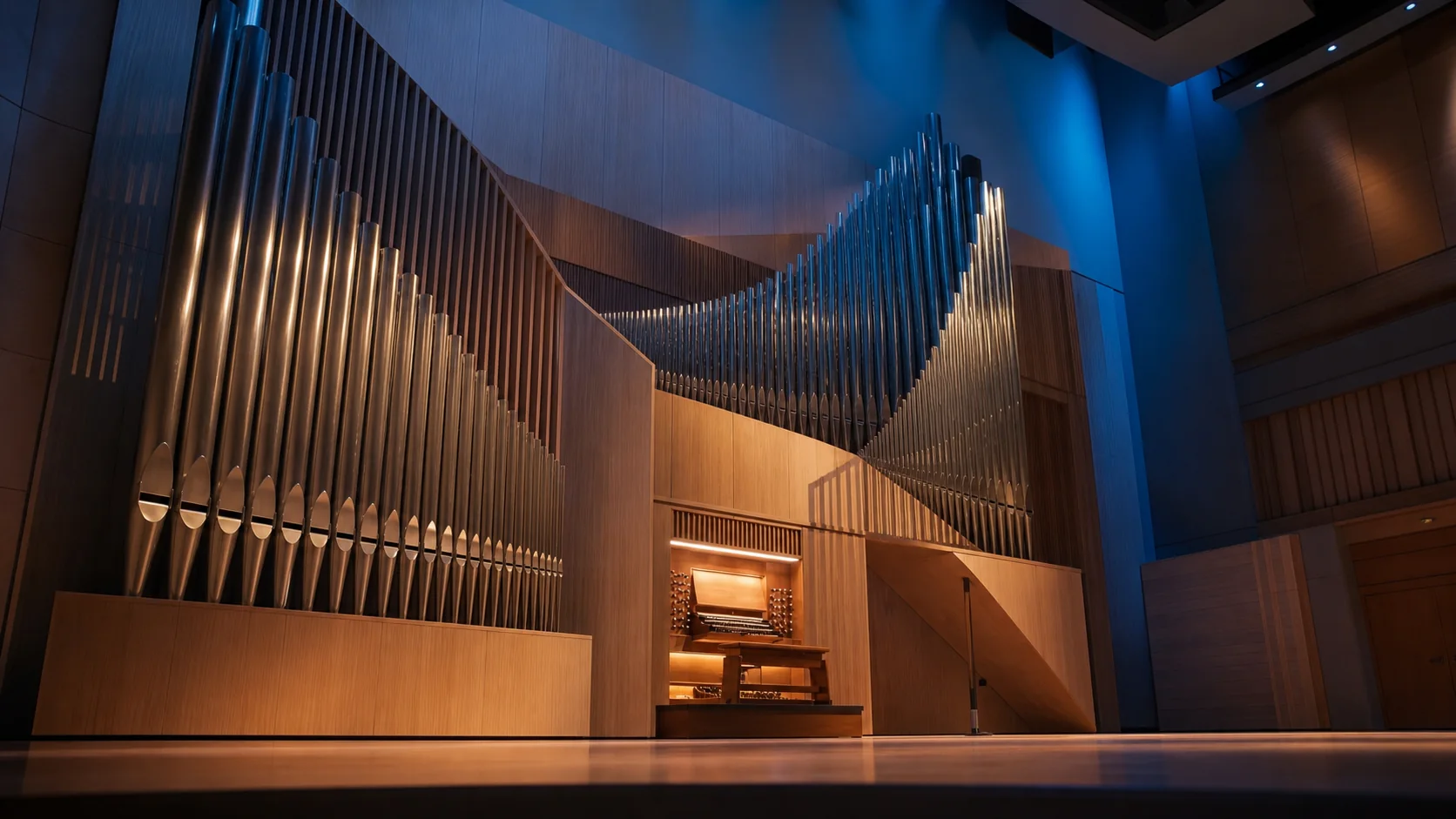
Martin Ott Opus 95 at Shrine of Saint Joseph
Martin Ott Opus 95 documents the 2000-2002 restoration of the 1890 J. G. Pfeffer organ at the Shrine of Saint Joseph in St. Louis. The instrument had 30 stops, 35 ranks, and tracker action.
Balcony, altar and sight lines: the Pfeffer restoration at Saint Joseph
Both the church and organ had fallen into disrepair by 1973, when demolition was being considered. Friends of the shrine later restored the building and began planning the organ project in the late 1990s. The work at Shrine of Saint Joseph in St. Louis, Missouri began with an existing organ. The earlier maker and date therefore remain central, while the Martin Ott phase belongs to a later history of repair, addition or rebuilding. The written account includes no acoustic measurements.
Restoration records need to separate inherited architecture from Martin Ott's interventions. A measured plan would show how the retained and new work occupied the interior. The surviving account does not include it.
30 stops and 35 ranks: the scale of Opus 95
The catalogue figures for Opus 95 read 30 stops and 35 ranks. For Opus 95, one total counts the player's controls, the other the rows of pipes available behind them. The paired counts point to a substantial range of resources. The published numbers for Shrine of Saint Joseph support a narrower conclusion: they do not tell us whether the tonal weight lay in principals, reeds, enclosed colors or pedal work. The Opus 95 outline adds that the overview does not state the number of keyboards. A stop-by-stop account of Opus 95 must wait for the complete disposition.
Opus 95 has 5 more ranks than stops. According to the 30-stop summary for Shrine of Saint Joseph, a mixture could explain part of the gap, although the abbreviated record does not place it. For Opus 95, the arithmetic offers a check against the missing stoplist.
Touch, coupling and response: the Pfeffer restoration at Saint Joseph
In Opus 95, the player reached the windchest through a direct tracker linkage instead of an electrical key command. This is the basic meaning of tracker action. It cannot tell us how the keyboard felt when completed or how the action has worn since installation.
The technical description from Shrine of Saint Joseph documents one point: tracker layout links architecture and touch: distance, turns and couplers all affect the path. The short account of Opus 95 does not provide those shop dimensions.
Cabinet, console and pipework: the Pfeffer restoration at Saint Joseph
Damaged woodwork, wind chests, trackers, leather, and pipes were repaired or replaced in kind. The hand-pumped air mechanism was restored, and the cherry keydesk received a French-shellac finish matching the original. The commission preserved Pfeffer's quarter-tone-sharp pitch and original voicing. The materials and placement named here make the organ project recognizable in project images, although they do not provide a pipe-by-pipe inventory or a complete set of workshop drawings for Opus 95.
At Shrine of Saint Joseph, a well-framed installation image may verify timber, placement and facade pattern. Windchests, trackers and enclosed divisions of Opus 95 remain only partly visible in that image.
Players and occasions: the Pfeffer restoration at Saint Joseph
The Martin Ott company employed German journeyman organ builder Matthias Seredsus for the restoration. The work followed the original builder's materials and methods, including animal-hide glue, while retaining almost all original parts. For Opus 95, registration history crosses two periods: the organ as built and the organ after Martin Ott's work. Programs from both sides of that divide would make the comparison audible. In the musical record for Shrine of Saint Joseph, no dedicatory recital is named in the surviving material.
The project entry is quiet about performances. A church, school or owner's archive may hold the first dependable musical date for Opus 95.
Evidence, images and unanswered questions for Opus 95
For Opus 95, the closest source is the former builder's project entry dated February 6, 2020. It links 2 images from the corresponding project directory. Together they form the image record published beside Opus 95. According to the surviving sources for Shrine of Saint Joseph, of those files, 1 carries caption or credit context. For Opus 95, without captions, the views remain broad evidence and cannot settle questions about later alterations. The Opus 95 evidence also shows that dated images or an institutional inventory could carry the account forward.