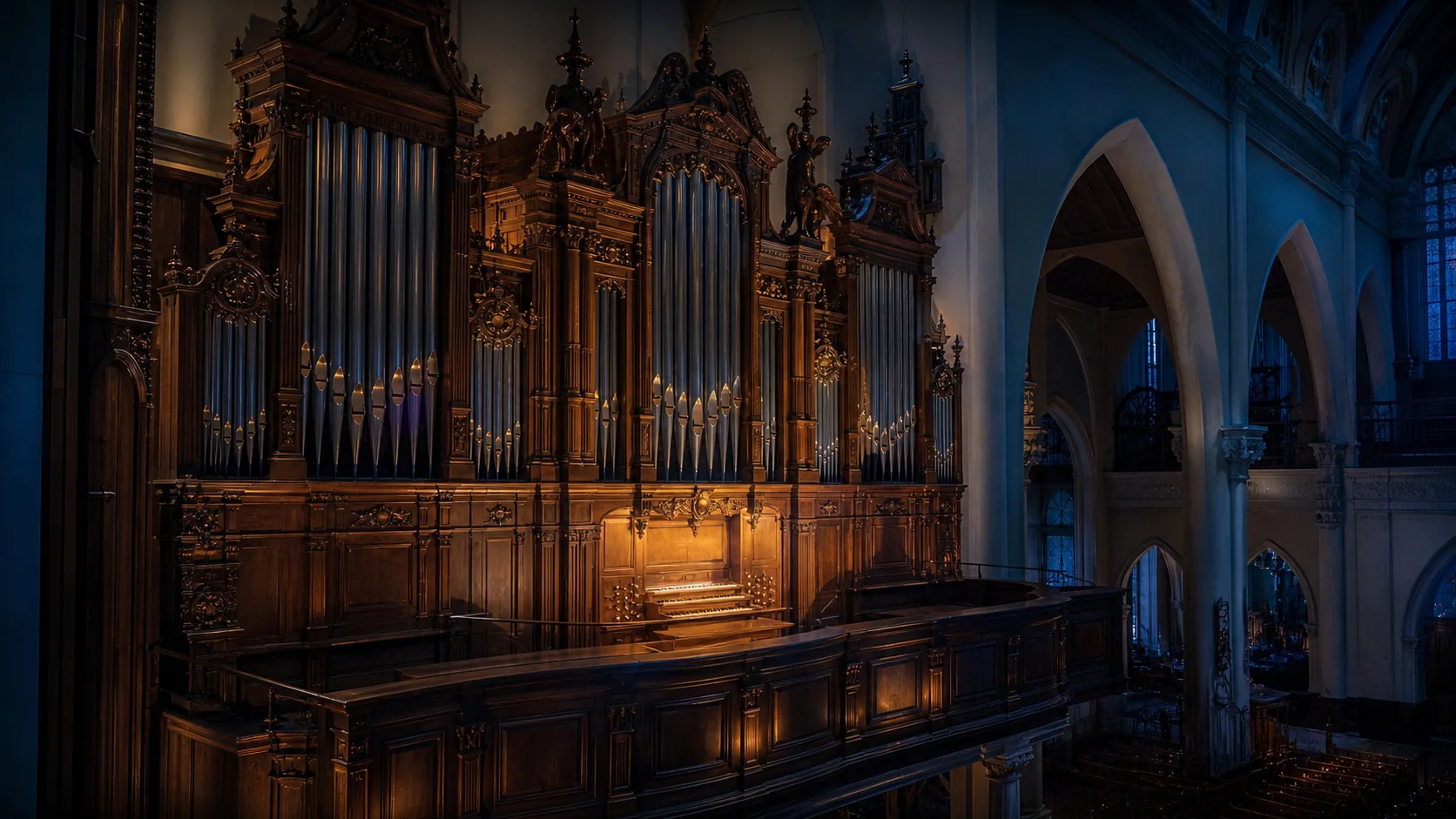
Martin Ott Opus 109 at First Presbyterian Church
Martin Ott Opus 109 was commissioned in 2007 for First Presbyterian Church in Sturgis, Michigan. The stop specification gives 32 stops, 36 ranks, five extensions, electric slider chests, and selected electro-pneumatic actions.
Reading the sanctuary: the Paul Ott core of Opus 109
The commission incorporated an earlier instrument by German organ builder Paul Ott that had been built for First Congregational Church in California and later offered for sale. The organ project brought Opus 109 into First Presbyterian Church, Sturgis, Michigan. What survives about the room at First Presbyterian Church is enough to say this: the interior actively shaped the commission: space for singers affected the installation, while the surviving narrative leaves several spatial questions open.
According to the architectural record for First Presbyterian Church, balcony, chancel and positions on the floor set practical limits for an installation. Where the entry names one for Opus 109, it is a detail established by the project record rather than a broad guess about the building.
32 stops and 36 ranks: the scale of Opus 109
On paper, Opus 109 offers 32 stops drawn from 36 ranks. For Opus 109, the two figures answer different questions: one counts console controls, the other pipe sets. The published numbers for First Presbyterian Church support a narrower conclusion: this is a broad specification, but a large count is not a synonym for loudness. The figures for Opus 109 also show that wind pressure, voicing and the interior still govern the result. The Opus 109 outline adds that the number of manuals requires the complete stop specification. Its 5 listed extensions help show why stop and rank figures can differ. One numerical limit remains in Opus 109: arithmetic cannot reveal the builder's priorities; the disposition can.
Because ranks outnumber stops by 4 in Opus 109, at least some controls may represent compound pipework. According to the 32-stop summary for First Presbyterian Church, the abbreviated figures do not assign those ranks to divisions. The entry separately lists 5 extensions. For Opus 109, the numerical relationship is helpful, but it is not a substitute for the disposition.
Keys and windchests: the Paul Ott core of Opus 109
Electrical commands carried the player's key actions to the chests in Opus 109, with sliders retaining their role in stop selection. According to the action account for First Presbyterian Church, this identifies the layout without establishing how the mechanism behaves today.
For Opus 109, action type and tonal design should be read on separate lines. At First Presbyterian Church, one concerns control; the other concerns what the pipes were made to say.
The organ as an object: the Paul Ott core of Opus 109
Opus 109's console stood on a movable platform, while the organ itself was divided between two side chambers. In the Sturgis installation, the Great Principal 8-foot occupied the facade of the left chamber, and the Pedal Oktavbass 8-foot the chamber to the right of the altar. For Opus 109, the record records enough construction detail to discuss the installation without claiming to recreate the whole organ. The design evidence from First Presbyterian Church has one clear limit: neither windchest drawings nor full case dimensions survive here.
For Opus 109, the organ case and console belong to the documentary story, not merely the decoration. The design evidence from First Presbyterian Church has one clear limit: their arrangement preserves practical decisions made for this room.
Musical life around the instrument: the Paul Ott core of Opus 109
Albert Bolitho, organ professor emeritus at Albion College, played the dedicatory recital. The specification lists resources at the console, not the repertory heard in First Presbyterian Church. The musical record from First Presbyterian Church is incomplete here: concert programs, parish bulletins and recordings could build that outline into a richer listening history. What followed would need programs or institutional records.
The dated recital, concert or dedication identified above gives Opus 109 a fixed point in musical history. According to the musical record for First Presbyterian Church, it does not describe everything heard before or after that occasion.
Evidence, images and unanswered questions for Opus 109
This history draws on the company's Opus 109 project entry as it stood on February 6, 2020. Alongside the written account are 3 project-page images. The company grouped these files as its gallery for Opus 109. No photographer is identified beside these files. The project sources for First Presbyterian Church leave one question open: the surviving evidence can identify the commission without serving as a modern inspection report. For Opus 109, new evidence should begin with the institution, a named photographic credit and a date.