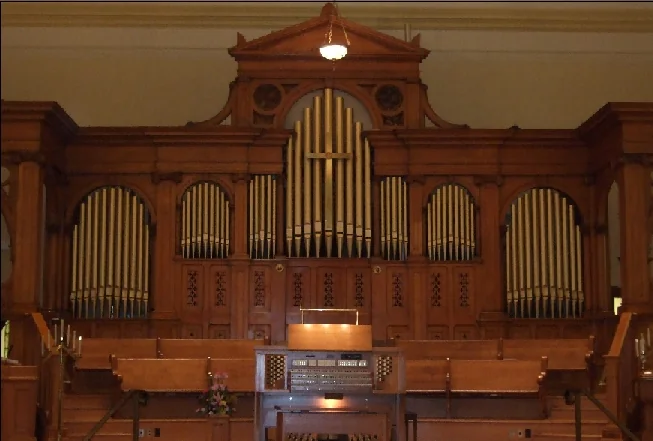
Martin Ott Opus 110 at First Presbyterian Church of Ypsilanti
Martin Ott Opus 110 grew from First Presbyterian Church of Ypsilanti's 2001 plan to refurbish its Jardine organ. Jardine and Sons had built the earlier instrument in 1899, and it was rebuilt in 1948.
Inside the room: Ypsilanti's restoration and enlargement
After the first effort stalled for eighteen months, the church hired the Martin Ott company. The work at First Presbyterian Church of Ypsilanti in Ypsilanti, Michigan began with an existing organ. In the room documented at First Presbyterian Church of Ypsilanti, the earlier maker and date therefore remain central, while the Martin Ott phase belongs to a later history of repair, addition or rebuilding. No reverberation time or room volume is recorded.
The interior belongs to both the earlier organ and the later restoration. Photographs and plans should therefore be dated before they are used to explain the placement of Opus 110. The surviving account does not include it.
35 stops and 41 ranks: the scale of Opus 110
A first reading of the instrument begins with 35 stops and 41 ranks. For Opus 110, the stop total describes selectable resources, while the count of pipe ranks counts the underlying rows of pipes. One numerical limit remains in Opus 110: the paired counts point to a substantial range of resources. Within the published specification for First Presbyterian Church of Ypsilanti, they do not tell us whether the tonal weight lay in principals, reeds, enclosed colors or pedal work. The Opus 110 outline adds that the condensed entry does not give the keyboard count.
The figures for Opus 110 also show that the outline notes 4 extensions; extension work allows pipework to be reused at another pitch or under another stop control. A reliable tonal reading still requires the full stoplist of Opus 110. The former builder and a Diapason festival notice print 35 stops and 41 ranks. A Diapason builder article instead gives 35 registers, 40 ranks and four extensions. Different treatment of borrowed or extended material may explain the count, so both totals remain visible.
Counting rows of pipes gives 6 more than counting stop controls in Opus 110. According to the 35-stop summary for First Presbyterian Church of Ypsilanti, mixtures are one possible reason; the full disposition would settle the question. The entry separately lists 4 extensions. For Opus 110, a full specification would show where each rank actually appears.
Console and transmission: Ypsilanti's restoration and enlargement
The former builder calls Opus 110 electro-mechanical, while the detailed project specification also uses the term electro-tracker. Both descriptions point to electrical command working with mechanical components inside the organ; neither supports describing the key action as a traditional direct tracker linkage from console to pallet.
The Pedal includes electro-pneumatic resources, another reason to keep the action terms precise. A shop drawing would be needed to trace every signal and mechanical stage between the three-manual console and the chests.
Wood, metal and placement: Ypsilanti's restoration and enlargement
The commission specification gives 35 stops, 41 ranks, four extensions, three manuals, electro-tracker action, and 2,409 wood and metal pipes. Much of the Choir division retained Jardine pipework, preserving an English tonal element within a broader European and American design. The pipes occupied a space behind the original wooden facade. Consultant John Weaver met with Ott after technical installation to discuss final voicing and praised the low, practical console, whose controls sat close to the keyboards. Casework, console and siting give an individual profile to Opus 110. The surviving design account for First Presbyterian Church of Ypsilanti clarifies this point: further claims about construction inside the case would require drawings or a survey made at the site.
Casework has two jobs here: it gives Opus 110 a visible architectural presence and organizes the mechanism behind it. According to the design record for First Presbyterian Church of Ypsilanti, the entry does not say that every visible front pipe was certainly a sounding pipe.
From dedication to daily use: Ypsilanti's restoration and enlargement
The company entry announced a January 24, 2009 dedication service and concert with Weaver; Martin Ott Opus 110 is not assigned any later status by that page. For Opus 110, registration history crosses two periods: the organ as built and the organ after Martin Ott's work. The performance evidence for First Presbyterian Church of Ypsilanti sets the limit of the account: programs from both sides of that divide would make the comparison audible. The next musical chapter remains to be documented.
The people identified above turn the stop specification of Opus 110 into a human story. The performance evidence for First Presbyterian Church of Ypsilanti sets the limit of the account: their documented role is clear, while later organists and programs still need sources.
Evidence, images and unanswered questions for Opus 110
The former builder's Opus 110 page, captured on February 6, 2020, supplies six project images but no individual photographer credit in the extracted gallery. Diapason sources preserve both the 40-rank and 41-rank accounts.
Heidi Bender's 2012 concert report publishes a later documentary view of the organ and console. It is evidence of the instrument in concert use, not evidence that Bender served as consultant or church organist. The source page states no reuse licence for the photograph, so publication rights remain unconfirmed.