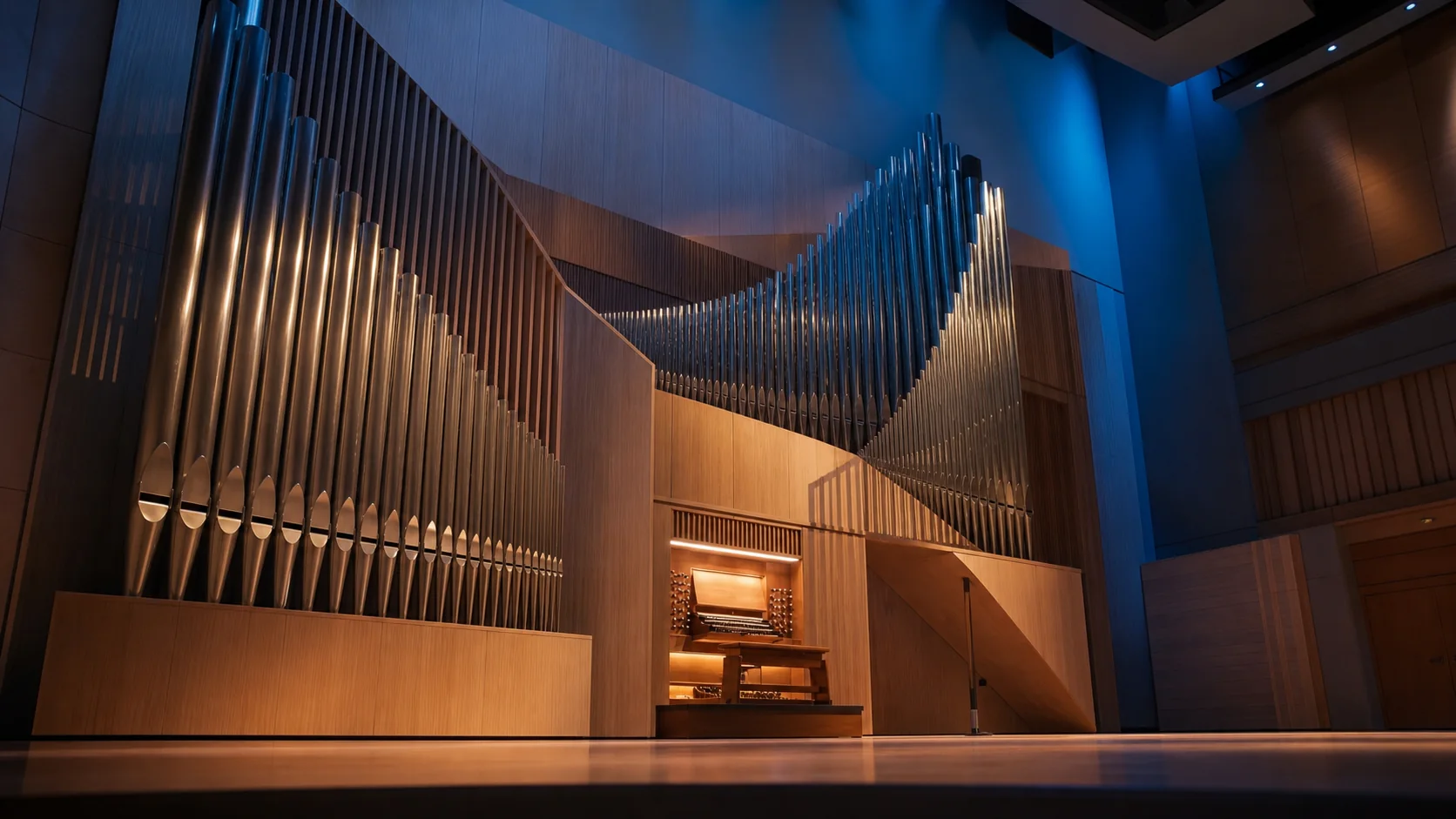
Martin Ott Opus 111 at St. Peter's Episcopal Church
Martin Ott Opus 111 was commissioned in 2006 for St. Peter's Episcopal Church in Washington, North Carolina. The stop specification gives 23 stops, 24 ranks, three extensions, mechanical key action, and electric stop action.
Architecture and placement: St. Peter's walnut chamber organ
The organ occupied an existing chamber to the right of the altar. St. Peter's was established in 1822 and first shared a free church with Methodist, Presbyterian, and Baptist congregations. In 1824 it erected a frame church facing Main Street at the corner of Main and Bonner. Opus 111 was planned for the worship space at St. Peter's Episcopal Church. What survives about the room at St. Peter's Episcopal Church is enough to say this: the most dependable room clues are concrete ones such as altar, balcony, windows or choir position; a general claim about the building's sound requires more evidence.
For Opus 111, visible surroundings and measured acoustics must be kept separate. In the room documented at St. Peter's Episcopal Church, one can be checked against photographs; the other requires data or testimony from the interior.
23 stops and 24 ranks: the scale of Opus 111
The short specification lists 23 stops against 24 ranks. The 23-stop, 24-rank summary for St. Peter's Episcopal Church shows that a rank is one row of pipes, while a stop is the organist's means of selecting a resource. There are enough resources for more than a single chorus, yet the paired counts do not reveal which division carried which colors. For Opus 111, the record does not state how many manuals were available to the player. The entry also counts 3 extensions, showing that one rank supplied more than one pitch or stop function. The Opus 111 outline adds that without stop names and pitches, a claim about color would outrun the evidence.
There is a 1-rank gap between the two totals for Opus 111. The 23-stop, 24-rank summary for St. Peter's Episcopal Church shows that it signals that stop and rank counts are structured differently, without revealing the exact compound stops involved. The entry separately lists 3 extensions. For Opus 111, the published numbers invite questions that only the names of the stops can settle.
How the notes travel: St. Peter's walnut chamber organ
The action record from St. Peter's Episcopal Church is precise on this point: pressing a key on a mechanical organ sets a train of parts in motion until a pallet opens at the windchest. That is the arrangement named for Opus 111. For Opus 111, the surviving description does not record touch weight, wear or subsequent maintenance. The stops used electric action even though the key action remained mechanical, a distinction worth keeping in the written account.
Because the keydesk was joined to the organ case, the player's position formed part of the architecture of Opus 111. The technical description from St. Peter's Episcopal Church documents one point: later regulation cannot be read from that layout alone.
Inside the physical design: St. Peter's walnut chamber organ
Walnut was used for the organ case, which incorporated an attached keydesk. These details help separate Opus 111 from nearby commissions in the firm's catalogue. According to the design record for St. Peter's Episcopal Church, the project entry is not a technical survey, which would require another kind of source.
According to the design record for St. Peter's Episcopal Church, case and key materials document craft and appearance, not tonal design. They document craft and appearance; pipe composition and voicing need separate evidence for Opus 111.
The human side of the commission: St. Peter's walnut chamber organ
The company entry places the organ project within the congregation's longer history. The source gives those historical notes but does not document the organ's subsequent alterations or condition. At St. Peter's Episcopal Church, the organ may have met hymn singing, choral accompaniment and solo repertoire, but the commission history must name the intended roles. Dated programs would show how Opus 111 was used after dedication. The performance evidence for St. Peter's Episcopal Church sets the limit of the account: no dedicatory recital is named in the surviving material.
A specification describes potential; performance records describe use. The second kind of evidence is still missing for Opus 111.
Evidence, images and unanswered questions for Opus 111
The company entry for Opus 111, preserved from February 6, 2020, provides the commission facts used here. The associated gallery contains 6 images. The dated project gallery links all of them to the Opus 111 page. Photographer names are not attached to these images. The project sources for St. Peter's Episcopal Church leave one question open: the entry proves their association with the commission, but it does not establish present condition or ownership. For Opus 111, the best additions would be a recently credited image and the complete stop specification.