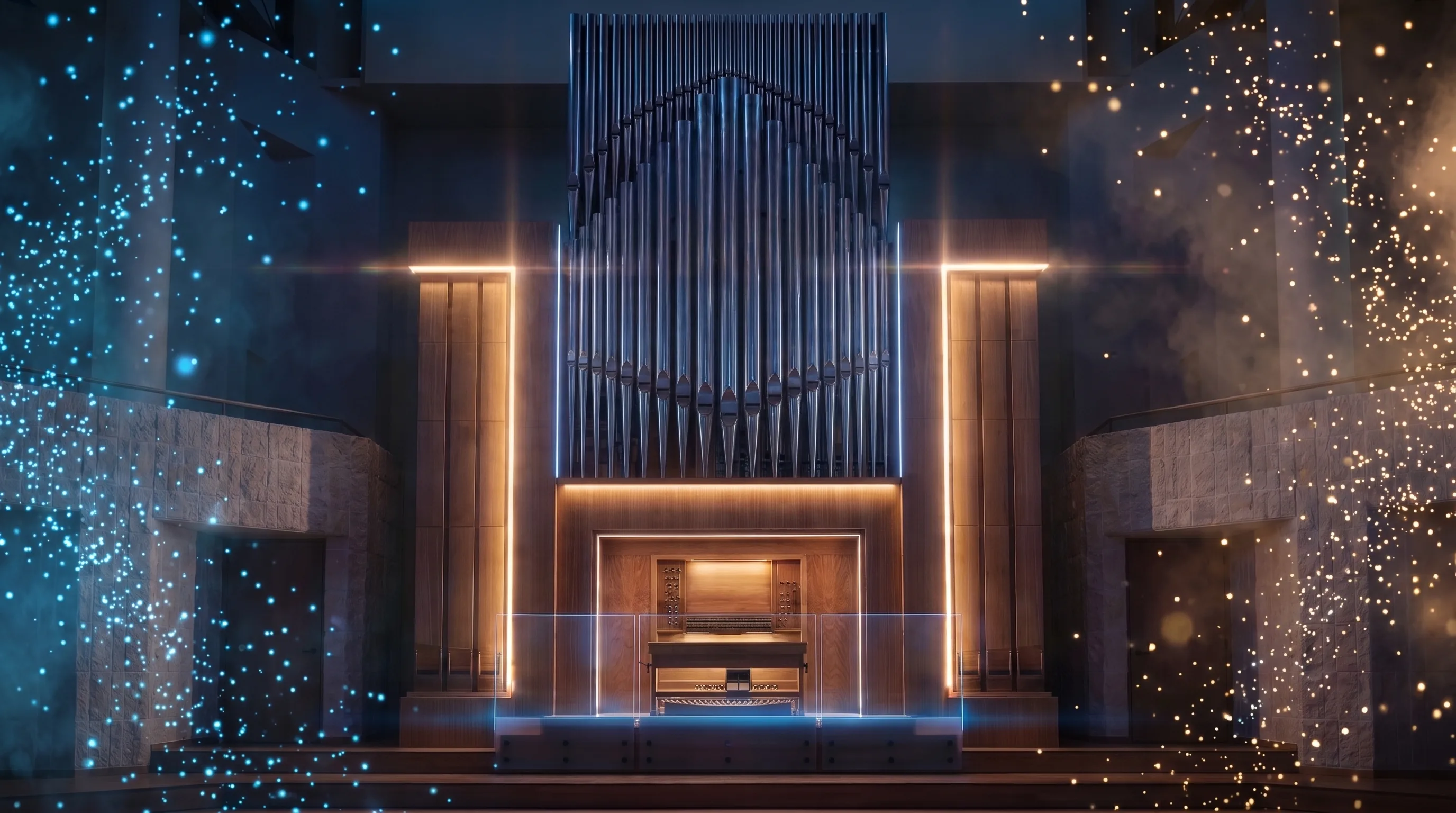
Martin Ott Opus 112 at Good Shepherd Lutheran Church
Martin Ott Opus 112 was commissioned in 2008 for Good Shepherd Lutheran Church in Herndon, Virginia. The two-manual specification gives 32 stops, 33 ranks, four extensions, and electric slider action.
The space around the organ: Herndon's delayed sanctuary project
Martin Ott mailed an initial specification on January 14, 2004, but the first committee became inactive when plans for the new sanctuary encountered delays. Good Shepherd moved to its new Herndon sanctuary in June 2008. The setting was Good Shepherd Lutheran Church in Herndon, Virginia. At Good Shepherd Lutheran Church, for an organ in worship, the player's view and the distance from singers can be as practical as the disposition. This account follows the placement details recorded for Opus 112.
A photograph can confirm where the organ case stood at Good Shepherd Lutheran Church, but it cannot measure how sound carried. In the room documented at Good Shepherd Lutheran Church, written dimensions or an acoustic report would be needed for that second question.
32 stops and 33 ranks: the scale of Opus 112
Opus 112 is summarized as an organ of 32 stops and 33 ranks. According to the 32-stop summary for Good Shepherd Lutheran Church, a stop need not correspond to a single independent rank, which is why the two totals deserve separate reading. The numerical breadth is clear. One numerical limit remains in Opus 112: its actual power and blend would depend on pipe scales, materials, wind and the building around it. For Opus 112, the manual count is not stated in the brief outline. Its 4 listed extensions help show why stop and rank figures can differ. The Opus 112 outline adds that the totals establish scale but cannot replace the actual specification.
In Opus 112, the rank count exceeds the stop count by 1. Within the published specification for Good Shepherd Lutheran Church, compound stops such as mixtures can place several ranks under one control, but their allocation is not given. The entry separately lists 4 extensions. For Opus 112, that distinction prevents a numerical outline from becoming an invented tonal scheme.
Control at the keydesk: Herndon's delayed sanctuary project
The technical summary places electrical control at the slider chests of Opus 112. Such an arrangement can accommodate a detached console or separated divisions, but the project entry does not measure speed, noise or reliability.
The electrical system describes transmission, not musical character. Voicing and pipework remain separate parts of the story of Opus 112.
Construction in the room: Herndon's delayed sanctuary project
Several weeks of technical installation were followed by pipe voicing, and the company entry records the organ's use on September 28, 2009. Taken together, these construction details give Opus 112 a physical identity beyond its stop count. At Good Shepherd Lutheran Church, a complete case drawing and internal chest plan have not yet surfaced.
The surviving design account for Good Shepherd Lutheran Church clarifies this point: console placement can show how player, choir and room were meant to relate. It cannot alone explain the plan of the internal divisions of Opus 112.
Programs and performance evidence: Herndon's delayed sanctuary project
The committee reformed in 2007 and resumed the organ project. It also names Scott Dettra as dedicatory organist for an event on October 28, 2012. Stop totals outline resources; they do not tell us the music heard at Good Shepherd Lutheran Church. The strongest evidence comes from named organists, dedicatory events and any commission goals recorded for Opus 112. Later programs could extend that chronology.
The musical record from Good Shepherd Lutheran Church is incomplete here: one program can reveal repertory and occasion without describing routine use. More bulletins or recordings would show how Opus 112 settled into the institution.
Evidence, images and unanswered questions for Opus 112
The starting point is Martin Ott's own Opus 112 page, preserved in the form captured on February 6, 2020. Readers can compare the record with 16 images linked on that page. The project sources for Good Shepherd Lutheran Church leave one question open: every file came directly from the same project entry. One documentary limit remains for Opus 112: none carries an individual named photographic credit in the extracted text. For Opus 112, that dated account is useful for the organ project history, not as proof of the organ's state today. The Opus 112 evidence also shows that a present-day condition report could extend the story without rewriting its older evidence.