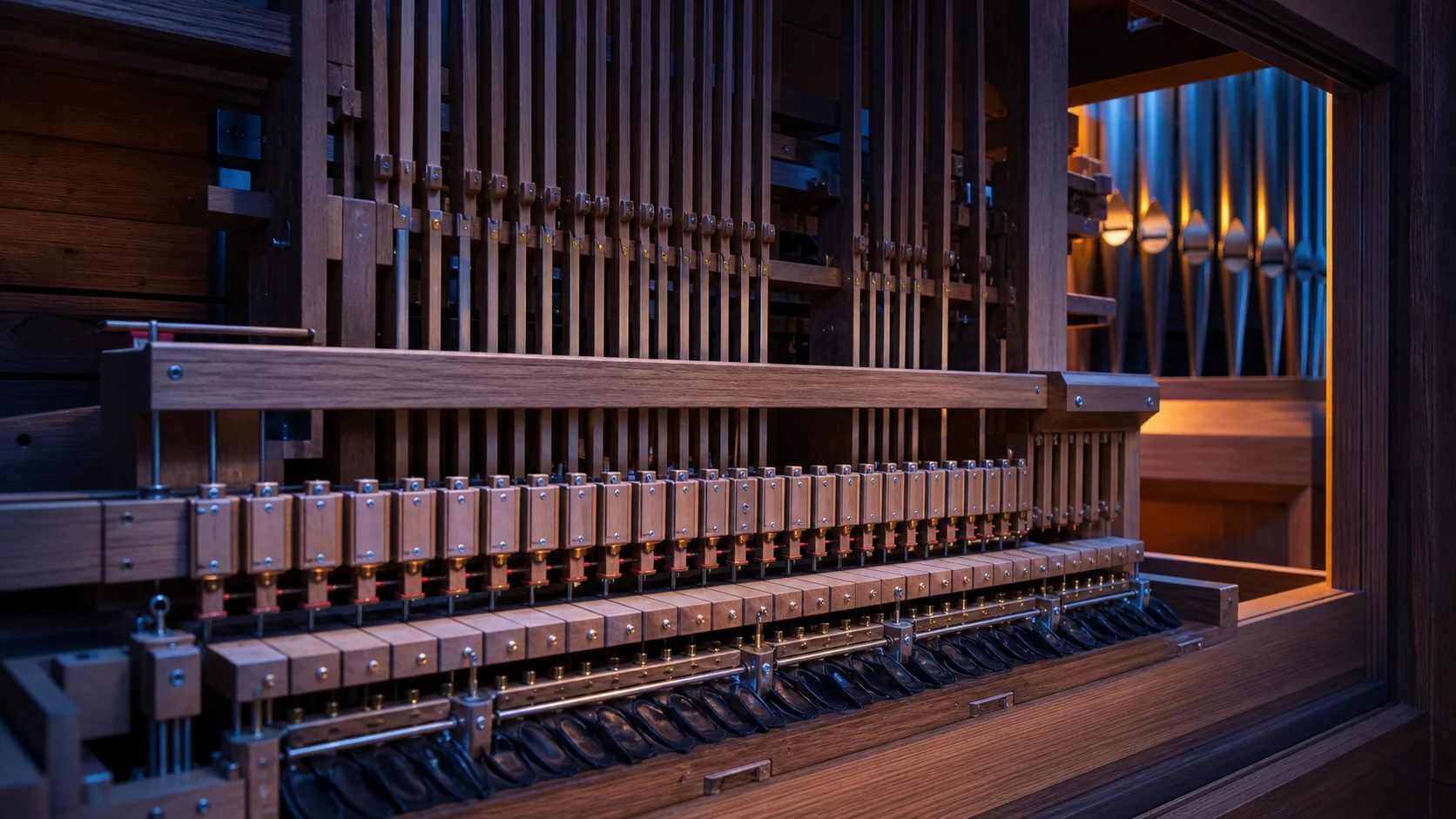
Martin Ott Opus 75 at St. Mary's Cathedral
Martin Ott Opus 75 was commissioned in 1993 for St. Mary's Cathedral in Portland, Oregon. The specification gives 18 stops and 19 ranks with mechanical action.
Balcony, altar and sight lines: the Portland cathedral renovation
In 1994 the cathedral closed for a complete renovation that called for two organs: a rebuilt balcony instrument and a smaller choir organ in the right transept. Benedictine monk Phillip Waibel of Mount Angel Abbey led the search for builders of a balcony organ and a smaller transept organ. About two hundred feet separated it from the balcony organ, whose Great and Pedal divisions had been built by Murray M. Harris and restored by Richard Bond Organ Company. Opus 75 was planned for the worship space at St. Mary's Cathedral. What survives about the room at St. Mary's Cathedral is enough to say this: the most dependable room clues are concrete ones such as altar, balcony, windows or choir position; a general claim about the building's sound requires more evidence.
For Opus 75, visible surroundings and measured acoustics must be kept separate. The architectural record from St. Mary's Cathedral shows that one can be checked against photographs; the other requires data or testimony from the room.
18 stops and 19 ranks: the scale of Opus 75
The short specification lists 18 stops against 19 ranks. At St. Mary's Cathedral, a rank is a set of pipes; a stop is the control through which the organist brings a resource into use. This count suggests room for contrasting families without describing their balance. A stoplist is needed before calling the design bright, dark, orchestral or classically ordered. For Opus 75, how many manuals the player had is not stated here. The Opus 75 outline adds that without the stop names and pitches, any description of color would run ahead of the evidence.
There is a 1-rank gap between the two totals for Opus 75. The 18-stop, 19-rank summary for St. Mary's Cathedral shows that it signals that stop and rank counts are structured differently, without revealing the exact compound stops involved. For Opus 75, the figures invite questions that only the stop names can settle.
Touch, coupling and response: the Portland cathedral renovation
The action record from St. Mary's Cathedral is precise on this point: pressing a key on a mechanical organ sets a train of parts in motion until a pallet opens at the windchest. That is the arrangement named for Opus 75. For Opus 75, the surviving description does not record touch weight, wear or later maintenance.
At St. Mary's Cathedral, tracker layout links architecture and touch: distance, turns and couplers all affect the path. The short account of Opus 75 does not provide those shop dimensions.
Cabinet, console and pipework: the Portland cathedral renovation
Opus 75's two manual divisions, except for the Prinzipal 8-foot, shared a common expression. These details help separate Opus 75 from nearby commissions in the firm's catalogue. According to the design record for St. Mary's Cathedral, the page stops short of a complete technical survey, which is a different kind of document.
The design evidence from St. Mary's Cathedral has one clear limit: materials named for case or keys should not be treated as a tonal description. They tell us about craft and appearance; pipe material and voicing require their own evidence for Opus 75.
Players and occasions: the Portland cathedral renovation
The cathedral reopened in 1996 for the 150th anniversary of its founding. The Ott firm received the choir-organ commission. At St. Mary's Cathedral, the organ may have met hymn singing, choral accompaniment and solo repertoire, but the project history must name the intended roles. Dated programs would show how Opus 75 was used after dedication. In the musical record for St. Mary's Cathedral, no dedicatory recital is named in the available material.
A specification describes potential; performance records describe use. The second kind of evidence is still missing for Opus 75.
Evidence, images and unanswered questions for Opus 75
The company entry for Opus 75, preserved from February 6, 2020, provides the project facts used here. The associated gallery contains 3 images. All belong to the dated gallery attached to the Opus 75 page. The old gallery identifies or credits 1 of its views. The documentary trail from St. Mary's Cathedral stops here: the page proves their association with the project, but it does not establish present condition or ownership. For Opus 75, the best additions would be a credited recent image and the full specification.