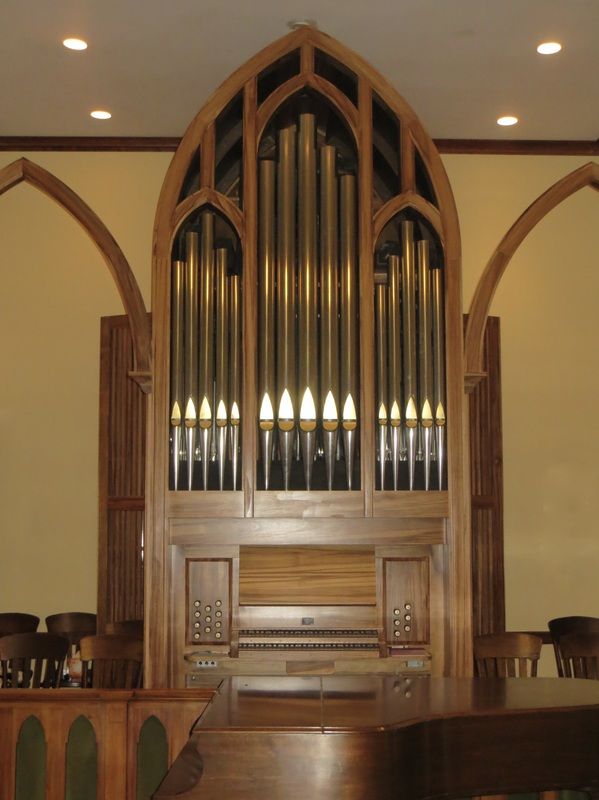
Martin Ott Opus 96 at Sumner Presbyterian Church
Martin Ott Opus 96 was commissioned in 1998 for Sumner Presbyterian Church in Sumner, Mississippi. The builder's specification gives 16 stops, 19 ranks, one extension and tracker action. The church's own organ history confirms the stop and rank totals and records 898 pipes.
The architectural setting: Sumner's red-gum Gothic arches
The organ occupied a former choir chamber to the right of the altar, opposite a Gothic-style stained-glass window. Martin Ott designed a case with three Gothic arches to balance that window. At Sumner Presbyterian Church, the organ had to find its place within a working worship space. What survives about the room at Sumner Presbyterian Church is enough to say this: front, gallery and balcony sites change the organ's relation to choir and altar; this article follows only positions documented by the builder.
In the room documented at Sumner Presbyterian Church, siting and acoustics need to be read together, though they are not the same evidence. The commission description can locate Opus 96; describing the room's response requires measurements or first-hand technical notes.
16 stops and 19 ranks: the scale of Opus 96
The published count for Opus 96 is 16 stops and 19 ranks. According to the 16-stop summary for Sumner Presbyterian Church, stops name the organist's available controls; ranks count the pipe sets behind those choices. There are enough resources for more than a single chorus, yet the paired counts do not reveal which division carried which colors. For Opus 96, no manual count appears in the condensed technical note. The entry also counts 1 extension, showing that one rank supplied more than one pitch or stop function. These figures sketch scale without describing tone.
The two totals for Opus 96 are separated by 3 ranks. The published numbers for Sumner Presbyterian Church support a narrower conclusion: compound stops can create that difference; only the complete disposition can show where the extra ranks lie. The entry separately lists 1 extension. For Opus 96, this is why the two numbers belong together in print.
Key action in practice: Sumner's red-gum Gothic arches
The technical description from Sumner Presbyterian Church documents one point: a tracker mechanism links the keys, connecting parts and pallets in one physical linkage. The outline assigns that principle to Opus 96. For Opus 96, response and comfort would have depended on the precise layout and subsequent regulation, neither of which is measured on the entry.
Because the keydesk was joined to the organ case, the player's position formed part of the architecture of Opus 96. According to the action account for Sumner Presbyterian Church, later regulation cannot be read from that layout alone.
Casework and layout: Sumner's red-gum Gothic arches
Both manual divisions were under expression except for the facade Principal 8-foot, and the keydesk was attached. The surviving design account for Sumner Presbyterian Church clarifies this point: these are helpful points of contact between the written history and the commission images. Internal dimensions and the full division plan of Opus 96 are not supplied. The church identifies a Mississippi Delta red-gum case formed as three Gothic arches for its 1919 Akron Plan sanctuary. It says the metal pipes were made in Europe and the wooden pipes in St. Louis from white oak, cherry and sweet gum. All but fifteen facade pipes are under expression; grenadil and bone appear at the playing console and stop controls.
The physical details of Opus 96 matter because they show how instrument and people occupied the same setting. At Sumner Presbyterian Church, they are more useful than an interchangeable description that could belong to any nearby organ project.
The organ in use: Sumner's red-gum Gothic arches
Perry Redfern served as organ consultant. Redfern also played the dedicatory recital during a worship service on October 22, 2000. Sweet gum grown in Mississippi was shipped to St. Louis for the casework, connecting the instrument's material with its Delta setting. The musical record from Sumner Presbyterian Church is incomplete here: in worship, an organ may accompany congregational music or take a solo role. For Opus 96, those roles are kept separate unless the commission narrative or a dated program connects them. The dated event is a beginning, not a complete record of performances. The parish account also preserves the original Organ Committee: Robert K. Mehrle, Richard L. Parsons, E. Leonard Patterson, R. Keith Turnipseed, J. Stephens Worley and J. J. Webb II.
Players and consultants are included only where the commission history identifies them. That keeps the musical narrative of Opus 96 personal without inventing a cast.
Evidence, images and unanswered questions for Opus 96
The former Martin Ott page for Opus 96, dated February 6, 2020, supplies the builder's project history and two linked images. The extracted entry does not attach an individual photographer credit to either file.
Sumner Presbyterian Church's organ page provides a second institutional account and publishes a photograph of the instrument. It confirms tracker action, 16 stops, 19 ranks, 898 pipes and the red-gum Gothic case. The page does not identify the photographer or state a reuse licence, and it is not a dated technical survey of the organ's present condition.