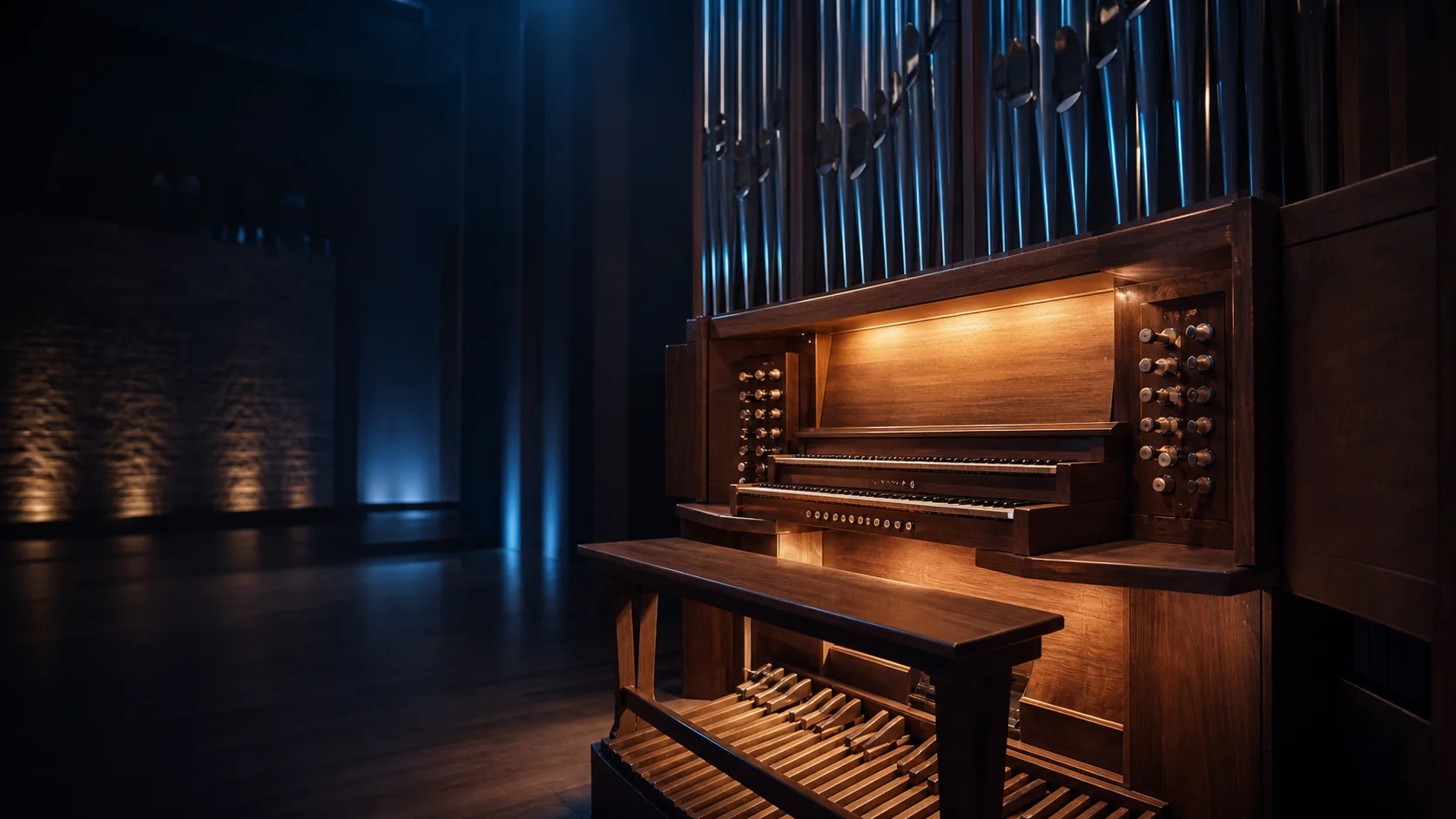
Martin Ott Opus 97 at First United Methodist Church
Martin Ott Opus 97 was commissioned in 1998 for First United Methodist Church in Jackson, Michigan. The stop specification gives 56 stops and 61 ranks, with electric slider chests and selected electro-pneumatic windchests.
How the room shaped the commission: Jackson's replacement for the 1922 Austin
After concluding that repeated repairs had not stopped the Austin's decline, the church requested a proposal for a replacement and renovated the sanctuary and chancel for it. The organ project brought Opus 97 into First United Methodist Church, Jackson, Michigan. In the room documented at First United Methodist Church, the interior actively shaped the commission: space for singers affected the installation, while the surviving narrative leaves several spatial questions open.
The architectural record from First United Methodist Church shows that balcony, chancel and positions on the floor set practical limits for an installation. Where the entry names one for Opus 97, it is a detail established by the project record rather than a broad guess about the building.
56 stops and 61 ranks: the scale of Opus 97
On paper, Opus 97 offers 56 stops drawn from 61 ranks. Within the published specification for First United Methodist Church, the two figures answer different questions: one counts console controls, the other pipe sets. The numerical breadth is clear. Its actual power and blend would depend on pipe scales, materials, wind and the building around it. For Opus 97, the number of manuals requires the complete stop specification. The Opus 97 outline adds that arithmetic cannot reveal the builder's priorities; the disposition can.
Because ranks outnumber stops by 5 in Opus 97, at least some controls may represent compound pipework. The published numbers for First United Methodist Church support a narrower conclusion: the abbreviated figures do not assign those ranks to divisions. For Opus 97, the numerical relationship is helpful, but it is not a substitute for the disposition.
The route from key to pipe: Jackson's replacement for the 1922 Austin
Electrical commands carried the player's key actions to the chests in Opus 97, with sliders retaining their role in stop selection. This identifies the layout without establishing how the mechanism behaves today.
For Opus 97, action type and tonal design should be read on separate lines. According to the action account for First United Methodist Church, one concerns control; the other concerns what the pipes were made to say.
Materials and workmanship: Jackson's replacement for the 1922 Austin
The Pedal and Swell divisions were installed early in 2002, followed by the main case with Great and Choir divisions in August. Pipe voicing was completed in November 2002. For Opus 97, the record records enough construction detail to discuss the installation without claiming to recreate the whole organ. The surviving design account for First United Methodist Church clarifies this point: neither windchest drawings nor full case dimensions survive here.
For Opus 97, the organ case and console belong to the documentary story, not merely the decoration. The surviving design account for First United Methodist Church clarifies this point: their arrangement preserves practical decisions made for this room.
Recitals, worship and memory: Jackson's replacement for the 1922 Austin
In 1996 the church's organ committee and consultant Albert Bolitho visited another Ott installation, then invited Martin Ott to inspect their deteriorating 1922 Austin organ. The organ project was received on November 22, 1998. The specification lists resources at the console, not the repertory heard in First United Methodist Church. In the musical record for First United Methodist Church, concert programs, parish bulletins and recordings could build that outline into a richer listening history. A dedication program has not yet been found for this project.
The absence of a recital in the surviving text does not mean Opus 97 went unheard. The musical record from First United Methodist Church is incomplete here: it means that a dated public event has not yet been established from this material.
Evidence, images and unanswered questions for Opus 97
This history draws on the company's Opus 97 project entry as it stood on February 6, 2020. Alongside the written account are 6 project-page images. The company grouped these files as its gallery for Opus 97. No photographer is identified beside these files. Among the surviving sources for First United Methodist Church, the surviving evidence can identify the commission without serving as a modern inspection report. For Opus 97, new evidence should begin with the institution, a named photographic credit and a date.