01 / 07
Martin Ott Opus 98 at St. Elizabeth Seton Church
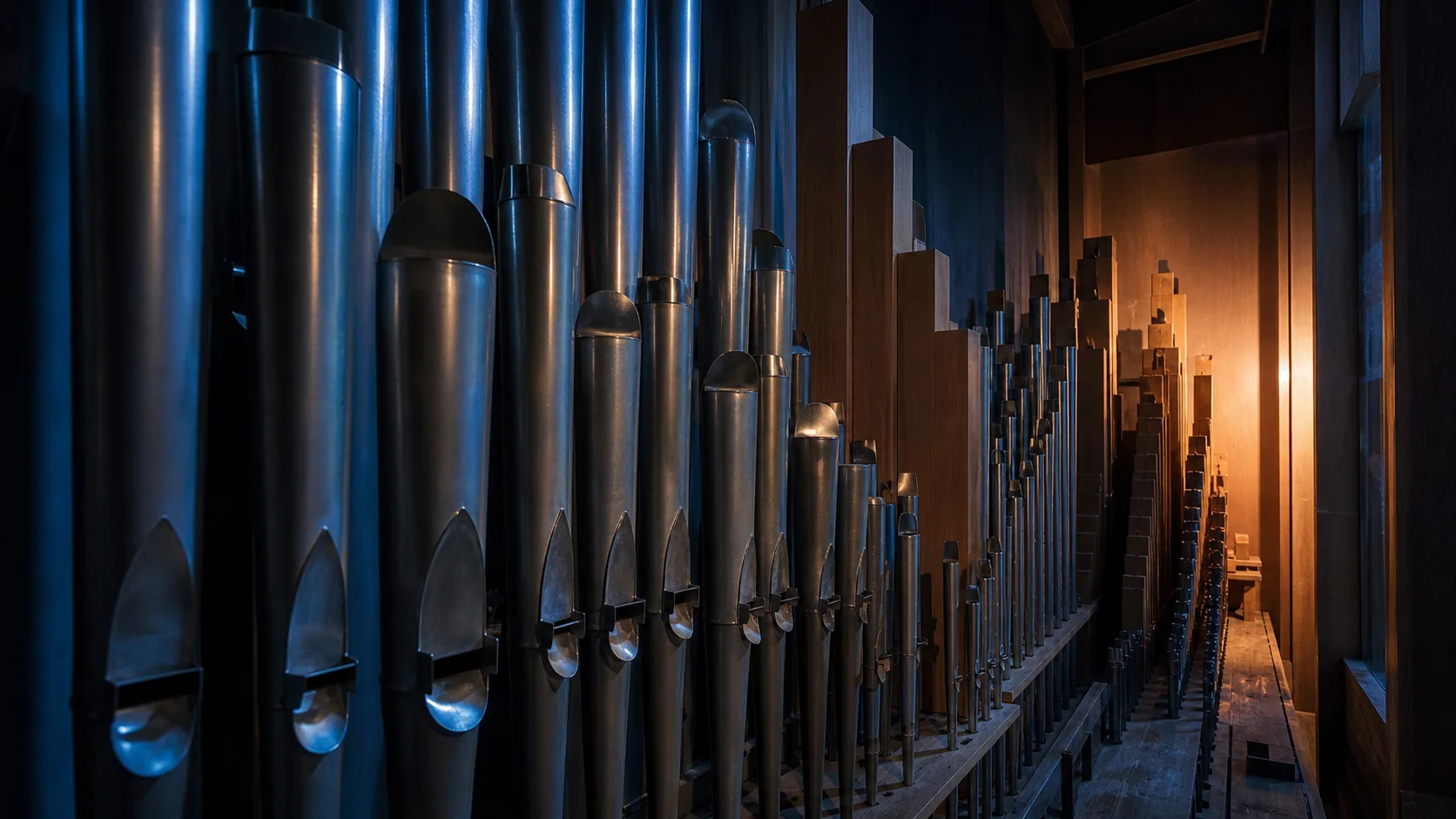
Martin Ott Opus 98 was commissioned in 1998 for St. Elizabeth Seton Church in Orland Hills, Illinois. The stop specification gives 25 stops and 30 ranks with mechanical tracker action.
02 / 07
Organ, choir and congregation: the radial nave at Orland Hills
The contemporary church used a radial nave plan with the altar at the center of the half-circle. In Orland Hills, Illinois, St. Elizabeth Seton Church supplied the interior for this project. Photographs may establish placement, but only measurements can describe the room's decay time.
The architecture helps account for the instrument's form, although the written record remains selective. An architectural plan placing organ, choir and congregation together would clarify the record of St. Elizabeth Seton Church.
03 / 07
25 stops and 30 ranks: the scale of Opus 98
A first reading of the instrument begins with 25 stops and 30 ranks. The Opus 98 outline adds that the stop total describes selectable resources, while the count of pipe ranks counts the underlying rows of pipes. The published numbers for St. Elizabeth Seton Church support a narrower conclusion: its numerical scale is neither miniature nor among the firm's largest. For Opus 98, the musical plan still rests in the missing sequence of names of the stops and pitches. The condensed entry does not give the keyboard count. A reliable tonal reading still requires the full stoplist of Opus 98.
Counting rows of pipes gives 5 more than counting stop controls in Opus 98. Mixtures are one possible reason; the full disposition would settle the question. The 25-stop, 30-rank summary for St. Elizabeth Seton Church shows that a full specification would show where each rank actually appears.
04 / 07
Action and touch: the radial nave at Orland Hills
The action line for Opus 98 points to a direct physical connection between keyboard and valves. Organ builders usually call this tracker action. The technical description from St. Elizabeth Seton Church documents one point: mechanical describes the system, not a promise that every key or coupling felt equally light.
The detached console made the mechanical layout of Opus 98 unusually visible. At St. Elizabeth Seton Church, trackers and intermediate parts had to carry each key movement across the recorded distance to the chests.
05 / 07
Console, divisions and facade: the radial nave at Orland Hills
A detached console stood about ten feet from the organ case, leaving room for three choir risers and instrumentalists. Casework, console and siting give an individual profile to Opus 98. According to the design record for St. Elizabeth Seton Church, further claims about construction inside the case would require drawings or a survey made at the site.
Casework has two jobs here: it gives Opus 98 a visible architectural presence and organizes the mechanism behind it. The design evidence from St. Elizabeth Seton Church has one clear limit: the entry does not say that every visible front pipe was certainly a sounding pipe.
06 / 07
Who played and why: the radial nave at Orland Hills
Choir, organ, and piano were grouped at the front right. That front placement projected the organ toward the congregation. The commission photographs showed Opus 98 during construction and final testing in the Martin Ott workshop in St. Louis and again during installation at the church. The source does not record a later alteration or relocation. Opus 98 entered a working musical community at St. Elizabeth Seton Church. The entry records selected people and events, while the ordinary rhythm of services and rehearsals remains largely offstage. The surviving text gives no dated performance event.
No program is available here to connect the disposition with repertory. Local bulletins or musicians' papers may eventually supply that missing side of Opus 98.
07 / 07
Evidence, images and unanswered questions for Opus 98
A copy of the Martin Ott project entry was captured on February 6, 2020 and documents Opus 98. Its visual material consists of 3 linked images. They are the project views the former company chose to publish with Opus 98. A caption or photographer note accompanies 1 of the files. The documentary trail from St. Elizabeth Seton Church stops here: the dated page cannot establish subsequent ownership or maintenance. For Opus 98, a current institutional photograph and full disposition would fill the largest gaps.